 Cat Trivia Games
iOS App
Guess the Century: Date 10 Real Cat Artworks
Each round shows a real artwork with a cat in it. Pick the century you think it was made in from four choices, then see the museum's date, the title, the artist and a link to the work. Ten rounds, free, with no account.
Loading ten artworks from the Cat Museum.
How the answers work
Each choice is a hundred-year span, such as the 1800s (1800 to 1899) or the 600s BCE (699 to 600 BCE). When a museum dates a work to one year, the right answer is the span that holds that year. When it gives a range, such as 1650-75, the right answer is the span that holds the middle of the range, and none of the three wrong choices touches the museum's range at all, so only one choice can fit.
The deck has 210 of the museum's 246 works: those whose records give a date span of 300 years or less, with titles and descriptions that do not give the year away. Every game mixes works from different eras. They come from the Metropolitan Museum of Art1, the Rijksmuseum2, the National Gallery of Art3, the Art Institute of Chicago4 and the Cleveland Museum of Art5.
A sample game and its answers
These ten rounds were dealt by the game itself. Try them here, then open each answer.
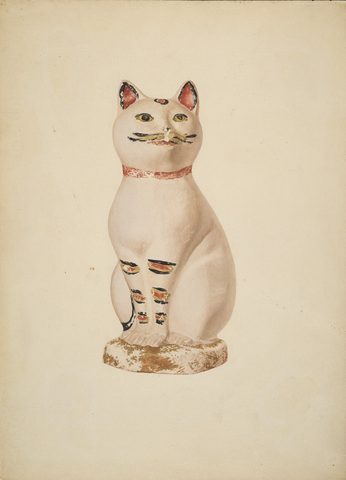
Round 1. Chalkware Cat
Choices: 1500s, 1600s, 1700s, 1900s.
Show the answer
The 1900s. The museum dates it c. 1940, in the 1900s. Betty Fuerst, National Gallery of Art, Public domain.
Betty Fuerst painted this chalkware cat in watercolor around 1940 for the Index of American Design.
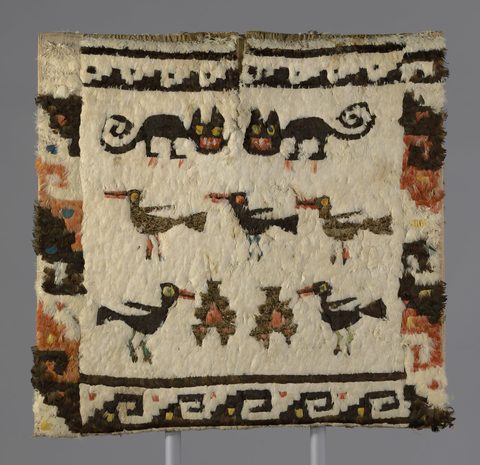
Round 2. Feathered Tabard (Open-sided Tunic)
Choices: 1200s, 1300s, 1500s, 1600s.
Show the answer
The 1500s. The museum dates it 1470-1532; the middle of that range falls in the 1500s. Chimú, Art Institute of Chicago, CC0.
Chimú makers attached feathers to cotton between 1470 and 1532 for this tunic, and two curly-tailed cats lead the parade of birds.
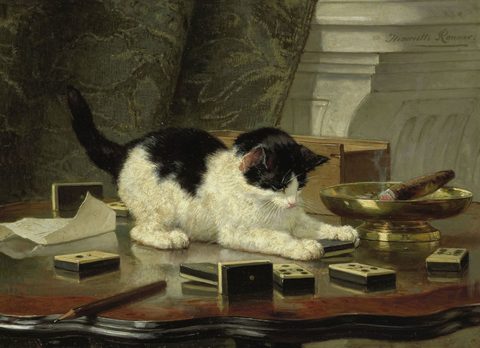
Round 3. Cat at Play
Choices: 1400s, 1700s, 1800s, 1900s.
Show the answer
The 1800s. The museum dates it c. 1860 - c. 1878, in the 1800s. Henriëtte Ronner, Rijksmuseum, Public domain.
Henriëtte Ronner painted this kitten at play among dominoes in oil on panel, sometime around 1860 to 1878.
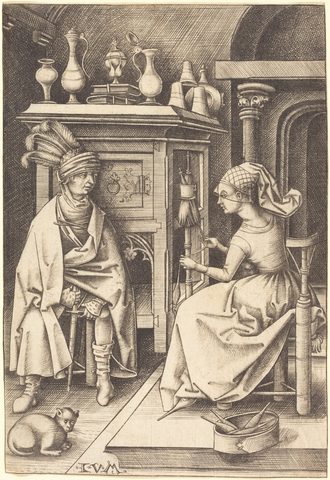
Round 4. The Visit to the Spinner
Choices: 1100s, 1200s, 1400s, 1700s.
Show the answer
The 1400s. The museum dates it c. 1495/1503; the middle of that range falls in the 1400s. Israhel van Meckenem, National Gallery of Art, Public domain.
Israhel van Meckenem engraved this visit around 1495 to 1503, and a cat settles in on the floor to join it.
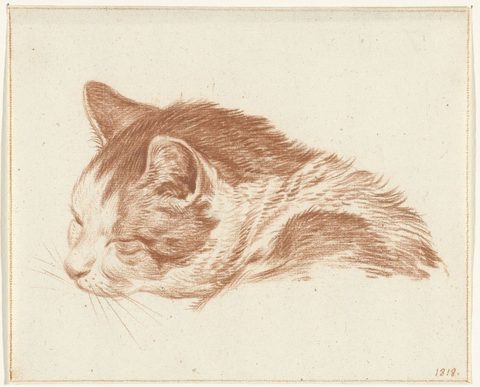
Round 5. Kop van een slapende katIn English: Head of a sleeping cat
Choices: 1500s, 1700s, 1800s, 1900s.
Show the answer
The 1800s. The museum dates it 1818, in the 1800s. Jean Bernard, Rijksmuseum, Public domain.
Jean Bernard drew this sleeping cat's head in red chalk in 1818, and you can almost hear it purring.
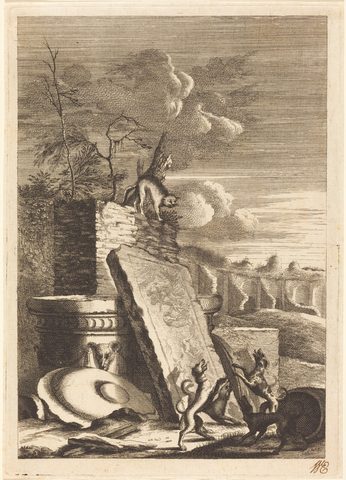
Round 6. Dogs Pursuing a Cat
Choices: 1300s, 1400s, 1600s, 1800s.
Show the answer
The 1600s. The museum dates it c. 1650, in the 1600s. Bernhard Zaech after Jonas Umbach, National Gallery of Art, Public domain.
In this etching from about 1650 by Bernhard Zaech after Jonas Umbach, the dogs give chase but the cat has the high ground.
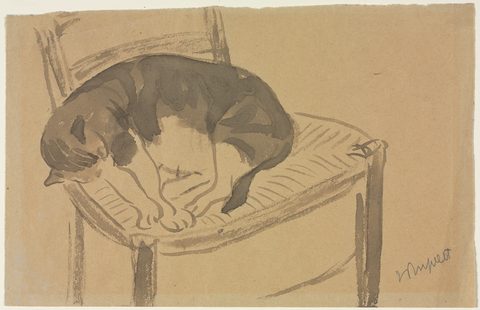
Round 7. Sleeping Cat (recto)
Choices: 1500s, 1600s, 1700s, 1900s.
Show the answer
The 1900s. The museum dates it 1900-1932, in the 1900s. Jane Poupelet, Cleveland Museum of Art, CC0.
French artist Jane Poupelet used brush and gray wash to show a cat claiming a chair for a nap, sometime between 1900 and 1932.
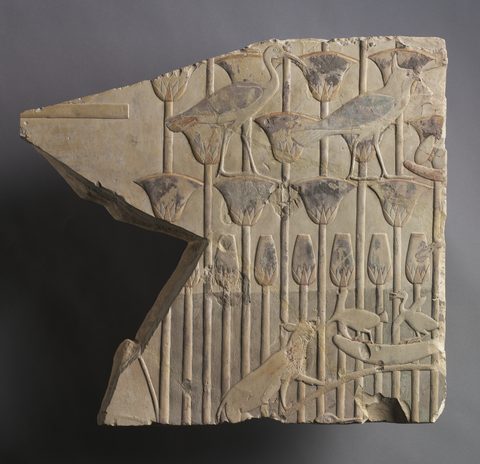
Round 8. Marsh Scene with Cat and Birds
Choices: 1300s BCE, 900s BCE, 600s BCE, 100s BCE.
Show the answer
The 600s BCE. The museum dates it c. 667-647 BCE, in the 600s BCE. Unknown maker, Egypt, Cleveland Museum of Art, CC0.
Carved in limestone around 667 to 647 BCE, this Egyptian marsh scene shows a cat creeping up on birds in the papyrus.
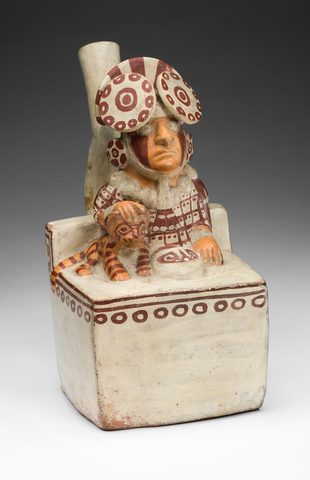
Round 9. Vessel in the Form of a Seated Ruler with a Pampas Cat
Choices: 400s CE, 700s CE, 900s CE, 1000s.
Show the answer
The 400s CE. The museum dates it 250-550 CE; the middle of that range falls in the 400s CE. Moche, Art Institute of Chicago, CC0.
This Moche vessel from 250 to 550 CE shows a seated ruler with his striped pampas cat front and center.
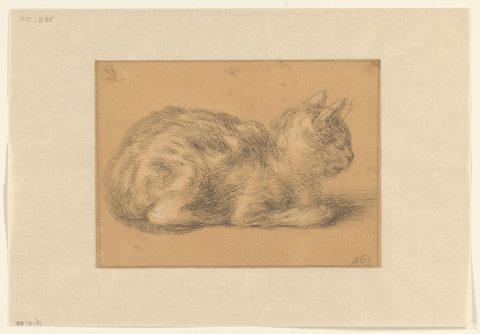
Round 10. Zittende kat, naar rechtsIn English: Seated cat, facing right
Choices: 1300s, 1500s, 1600s, 1800s.
Show the answer
The 1600s. The museum dates it 1617 - 1681, in the 1600s. Cornelis Saftleven (possibly), Rijksmuseum, Public domain.
Possibly by Cornelis Saftleven, this black and white chalk cat facing right looks soft enough to pet.
Frequently asked questions
Does the game keep my score?
No. It runs in your browser and saves nothing. Share your score opens your device's share menu, or copies a short summary, with a filled dot for each right answer and a hollow one for each miss.
More from the Cat Museum
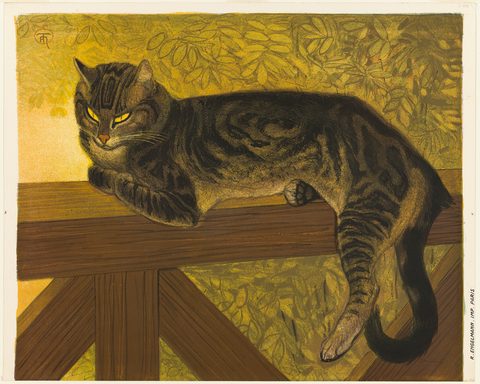 The Cat MuseumAll 246 works, with filters for era, medium and region.
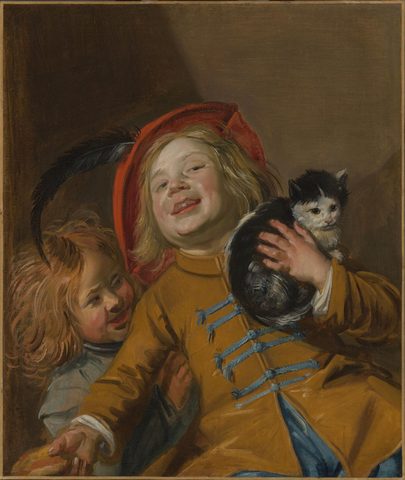 Cats in European artForty works from about 1495 to 1930, with a note on each.
Pictured on the cards: Summer: Cat on a Balustrade, Théophile-Alexandre Pierre Steinlen, 1909, Art Institute of Chicago, CC0; Two Children with a Cat, Judith Leyster, c. 1630, Rijksmuseum, Public domain.

Christopher writes and runs Cat Trivia Games. Every picture here links to the museum record it comes from, and the sources are listed below. How the site is made and corrected is on the editorial policy page. More about the author.
References
- The Metropolitan Museum of Art. Open Access dataset, released under CC0; collection images covered by the policy carry the CC0 icon. back
- Rijksmuseum. Data services: most digitized objects in the public domain since 2013. back
- National Gallery of Art. Open data program; its data dictionary flags open access images, which have no usage restrictions. back
- Art Institute of Chicago. Open Access Images: works believed to be in the public domain, under CC0. back
- The Cleveland Museum of Art. Open Access API: data released under CC0, with CC0 images for the works marked CC0. back
- Creative Commons. CC0 1.0 Universal (public domain dedication). back
- Creative Commons. Public Domain Mark 1.0. back
Written by Christopher Fox under our editorial policy. Artworks and records belong to the museums named on each card; this site is not connected with them.