 Cat Trivia Games
50 Cat Facts for Kids
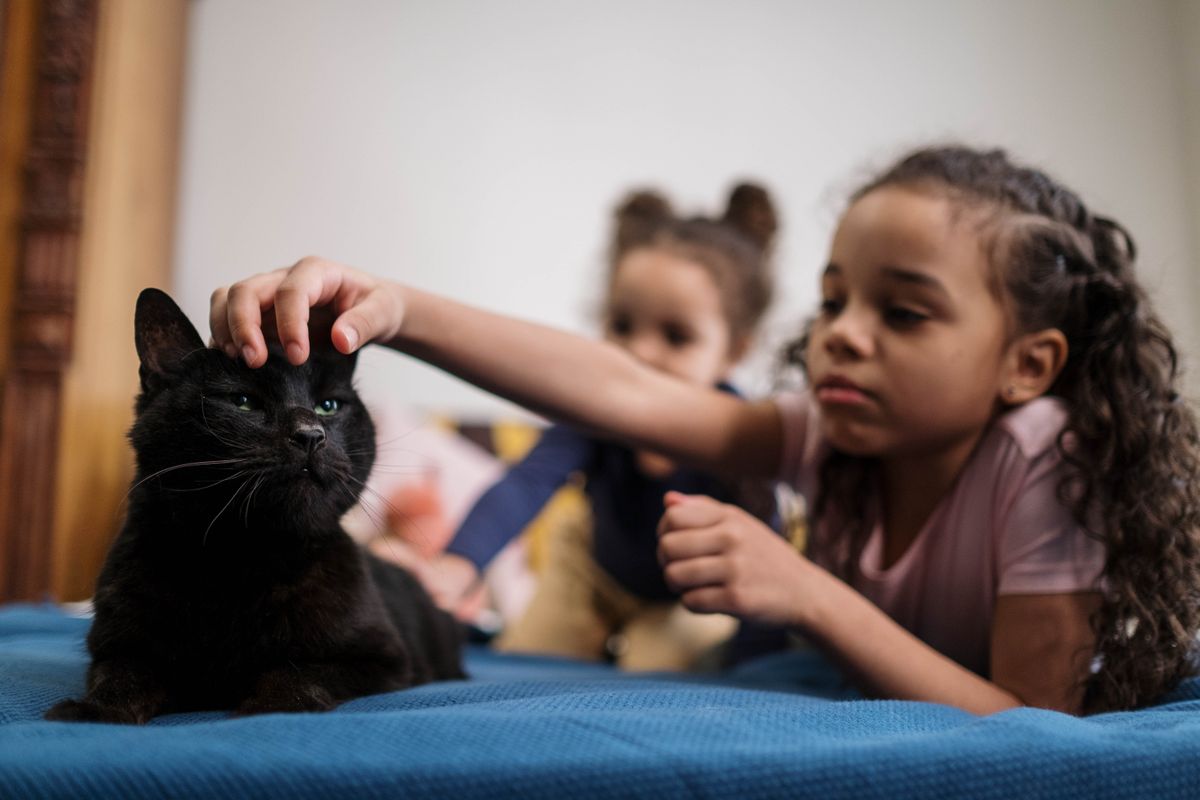
Why do cats have whiskers? Can they see in the dark? These 50 short facts are made for curious kids. Read them together, choose a favorite and see how many you remember later.
A cat's body
- A cat has about 230 bones. An adult human usually has 206 bones.1
- Most cats have 22 or 23 bones in their tail. The tail helps a cat balance when it moves quickly.12
- Cats walk on their toes, not on flat feet like we do.2
- Most cats have 18 toes: five on each front paw and four on each back paw.2
- Some cats are born with extra toes. They are called polydactyl cats.2
- A cat's collarbones are tiny and not joined to its other bones, so its shoulders can move a lot. Cats can still get stuck in tight spaces, though.1
- Cats have a "righting reflex" that helps them twist in the air to land on their feet. Most kittens have it by about seven weeks old. It does not keep a cat safe in a fall.3
- A resting cat's heart beats about 150 to 180 times a minute. That is more than twice as fast as a grown-up's heart.2
- A cat's tongue is covered in tiny stiff hooks that point backward. Each one is hollow at the tip and carries spit into the fur when the cat grooms.4
Seeing, hearing, smelling
- Cats see much better than people in dim light. A shiny layer at the back of the eye helps, and it is why cat eyes shine in photos.56
- Cats need some light to see. In a completely dark room, a cat cannot see either.6
- Whiskers help cats notice nearby objects. Cats can still get stuck in tight spaces.7
- Whiskers do not only grow on the face. Cats have them above the eyes, on the chin and on the back of the front legs.7
- Most cats have 12 whiskers on each cheek, in four rows.7
- Cats have a third eyelid in the inside corner of each eye. It can slide across to protect the eye.5
- A cat's nose has up to 200 million cells that detect smells. Yours has about 5 million.8
- Cats can hear much higher sounds than people can, which helps them find prey.910
- Cats have a special smell organ in the roof of the mouth. The funny open-mouth face a cat sometimes makes while sniffing is called the flehmen response.1112
- Cats cannot taste sweet things the way we do, because one of the genes for tasting sweetness does not work in cats.13
How cats act
- Cats sleep about 12 to 16 hours a day.14
- Many cats are most active around dawn and dusk.14
- When a cat pushes its paws in and out on a soft blanket, people call it "making biscuits." Kittens do it while nursing, and many grown cats keep doing it.15
- A slow blink from a cat is a friendly signal. In one study, cats were more likely to come closer to a person who slow-blinked at them.16
- Cats usually bury their poop in the litter box. Outdoors, a cat sometimes leaves it uncovered at the edge of its territory, as a message to other cats.11
- When a cat rubs its head on you, it leaves a little of its scent. This is called bunting.11
- Cats often purr when they are relaxed, but they sometimes purr when they are hurt or scared too.17
- A tail held straight up is a friendly hello.11
- A cat crouching low and thumping its tail on the ground is feeling defensive, so give it space.11
- Nobody knows for sure why cats chatter at birds through the window.18
Cat talk and cat words
- Kittens meow to their mothers. Grown cats rarely meow at each other, but they meow a lot at people.11
- Mother cats call their kittens with a soft "chirrup."11
- Researchers have counted about 19 different sound patterns that cats make.18
- Ears facing forward usually mean a cat is relaxed. Ears pressed flat often mean it is frightened.11
- A group of cats can be called a clowder.19
- Kittens born together are called a litter. "Kindle" is an old, rare word for a group of kittens.19
- A male cat is often called a tom, and a female cat is often called a queen.20
- Tabby is a coat pattern, not a breed. Cats of many breeds, and mixed-breed cats too, can be tabbies.21
Kittens
- Kittens are born with their eyes closed. They open them when they are about 8 to 12 days old.6
- Kittens can purr when they are just two days old.17
- Kittens may sleep up to 20 hours a day.14
- A litter usually has two to five kittens.22
Cats in history
- Cats and people have lived together for thousands of years. One of the oldest signs is a cat buried near a person on the island of Cyprus, about 9,500 years ago.20
- Scientists think wild cats first came to early farming villages to hunt the mice there.20
- Pet cats come from a wild cat called the African wildcat.20
- Ancient Egyptians linked cats with a goddess named Bastet.23
- A Greek historian wrote that in ancient Egypt, killing a cat was treated as a serious crime.24
- Sailors kept cats on ships to catch the mice and rats that chewed ropes and ate the food.25
Record breakers
- The oldest cat ever recorded was Creme Puff from Austin, Texas. She lived to be 38 years and 3 days old.26
- The record for the most toes on a cat is 29, held by a cat named Erebus. The record was measured in 2026.27
- The loudest cat purr on record measured 67.8 decibels. Two cats share the record: Smokey and Merlin.28
 Oldest cat ever
Born August 3, 1967. Lived until August 6, 2005, with her owner, Jake Perry. That is the longest life Guinness World Records has verified for a cat.26
A three-question mini quiz
Guess first, then tap to see the answer.
1. What is a baby cat called?
A kitten.
2. Do cats need some light to see?
Yes. Cats see well in dim light, but they cannot see in complete darkness.
3. Is tabby a breed or a coat pattern?
A coat pattern. Cats of many breeds, and mixed-breed cats too, can be tabbies.
Key takeaways
- A cat has about 230 bones, sleeps 12 to 16 hours a day and needs some light to see.
- Let a cat sniff your hand and come to you before you pet it.
- Every fact has a numbered source in the list at the bottom of the page.
Frequently asked questions
What is the best way to say hello to a cat?
Hold out your hand and keep it still. If the cat wants to say hello, it will come over and sniff it. Then you can gently stroke its cheeks or chin. If it does not come over, it does not want to be touched right now, and that is okay. That advice comes from Cats Protection, a cat charity.29
Do cats really have nine lives?
No, a cat has one life. "Nine lives" is an old saying about how good cats are at getting out of trouble, and in some countries the saying gives them seven or six.
Where do these facts come from?
Each fact has a small number next to it. The number matches a source in the list at the bottom, such as a vet school, a cat charity or Guinness World Records. If you think a fact is wrong, ask a grown-up to tell me; my email is on the editorial policy page.
Pick three facts and quiz someone at home. Then swap roles and see who remembers more.
Up next
Christopher writes and runs Cat Trivia Games. Each fact here links to its source, and how the site is made and corrected is on the editorial policy page. More about the author.
References
- Catster. How many bones do cats have? back
- Wikipedia. Cat anatomy. back
- VCA Animal Hospitals. True or false: cats always land on their feet. back
- Noel, A. C. and Hu, D. L., PNAS (2018). Cats use hollow papillae to wick saliva into fur. back
- Merck Veterinary Manual. Eye structure and function in cats. back
- PetMD, with veterinary ophthalmologist Paul Miller. How do cats see the world? What to know about cat vision. back
- VCA Animal Hospitals. Why do cats have whiskers? back
- National Geographic. Here's how your cat experiences the world. back
- VCA Animal Hospitals. Why do cats stare at nothing? (cat and human hearing). back
- ASPCA. Aggression in cats (how cats find prey). back
- International Cat Care. Cat communication. back
- PetMD. What is the flehmen response in cats? back
- Scientific American. Strange but true: cats cannot taste sweets. back
- PetMD. Why do cats sleep so much? back
- Hart, H., DVM, PetMD. Why do cats knead? back
- Humphrey, T. et al., Scientific Reports (2020). The role of cat eye narrowing movements in cat-human communication. back
- Sung, W., DVM, DACVB, PetMD. Why do cats purr? 5 meanings behind a purring cat. back
- International Cat Care. Why do cats..? (chattering, cat sounds). back
- Wikipedia. List of animal names (words for groups of cats and kittens). back
- Wikipedia. Cat (names, history and domestication). back
- Wikipedia. Tabby cat. back
- Wikipedia. Kitten. back
- Smithsonian Magazine. A brief history of house cats. back
- Wikipedia. Cats in ancient Egypt. back
- Wikipedia. Ship's cat. back
- Guinness World Records. Oldest cat ever. back
- Guinness World Records. Most toes on a cat. back
- Guinness World Records. Loudest purr by a domestic cat. back
- Cats Protection. How to pick up a cat (saying hello first). back
Written by Christopher Fox under our editorial policy.