 Cat Trivia Games
iOS App
How to Host a Cat Trivia Night
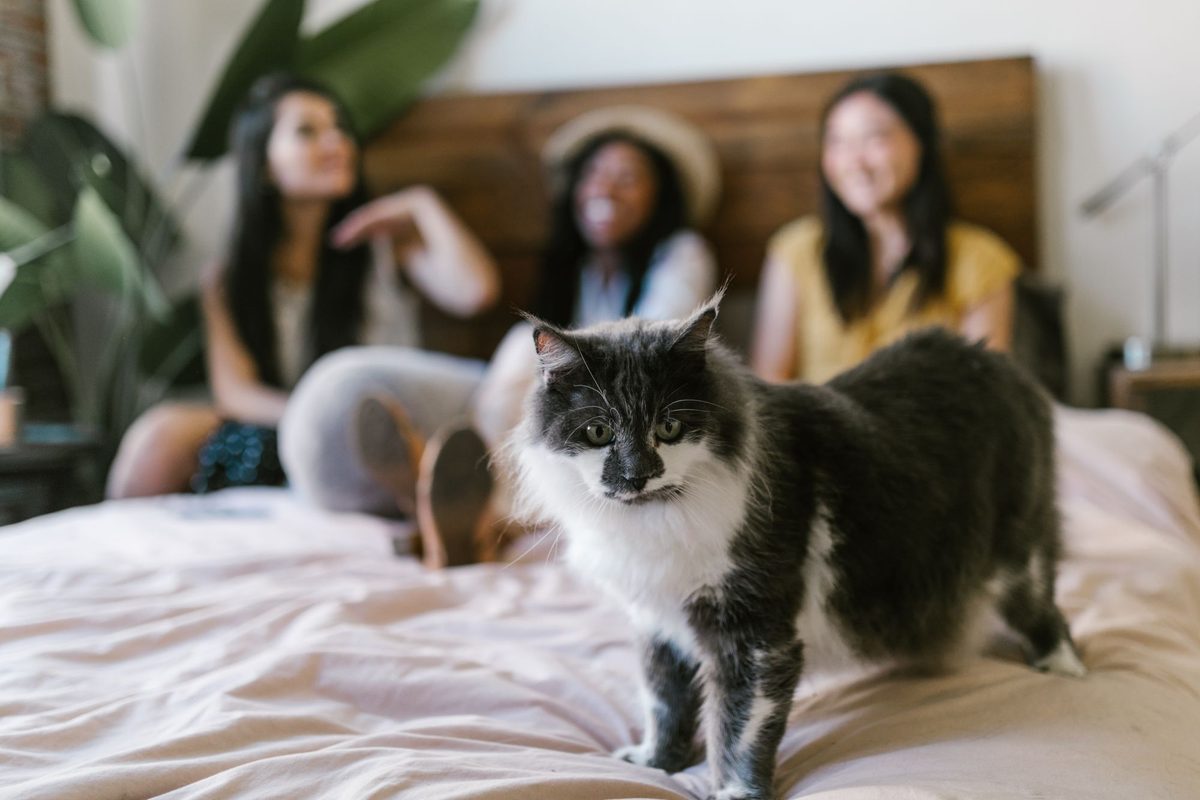
To host a cat trivia night, run five rounds of ten questions for teams of two to six. Read each question twice, allow about 30 seconds per written answer, and mark each round before the next. With a break, that takes about two hours. Make one round a breed picture round, keep a closest-number question for ties, and give any entry fees to a local cat shelter.
Five rounds of ten in about two hours
Every round below comes from pages on this site, with the hardest last. Written answers let a quiet table score as easily as a loud one.
| Round | Theme | Where to find the questions |
|---|---|---|
| 1 | Breeds warm-up | Round 1 of the printable cat trivia pack (answer key at the end) |
| 2 | Behavior and body language | Round 2 of the pack, or easy and medium behavior questions from the 220 questions and answers page |
| 3 | Picture round: name the breed | Photos from the breed guides; practice first with Guess the Breed |
| 4 | Bodies, senses and history | Five each from rounds 3 and 4 of the pack, or hard body and history questions from the 220 page |
| 5 | Hard final | Multiple-choice questions from hard cat trivia, then one from the 220 page's legendary bonus round |
| Swap in December | Christmas | A holiday round from Christmas cat trivia, with its own answer key |
| Tie-breaker | Closest number wins | The pack's numbers round, or the three below |
| Bonus | Speed round on phones | A Cat Trivia Battle room |
The pack and the 220 page share no questions, so both work on one night. A running order with ten minutes to spare:
- 0:00 Welcome, team names and rules.
- 0:10 Round 1, then swap sheets and mark.
- 0:25 Round 2.
- 0:40 Round 3, the picture round.
- 0:55 Break, scores so far and a raffle.
- 1:10 Round 4.
- 1:25 Round 5, the hard final.
- 1:40 Final scores, any tie-breaker, prizes.
Fifteen minutes a round gives each question about a minute with its second reading, plus five minutes to mark. A big or noisy room needs longer.
Scoring, a phone round and tie-breakers
Each right answer scores one point, and equivalent wording counts, such as "Siamese cat" for "Siamese". Decide beforehand whether spelling counts in the picture round, and post scores after every round.
For a phone round, open a Cat Trivia Battle room. It deals the same ten questions to every phone at once, 15 seconds each, for up to eight players. A bigger crowd plays one phone per team, with the room code on a screen. Speed scores too, so make it a bonus round worth, say, five points.
To break a tie, ask for a number. Each tied team writes one guess and the closest wins; if two are equally close, ask another. Three from Guinness World Records:
- Mice. Towser, a tortoiseshell at the Glenturret Distillery near Crieff in Perth and Kinross, is credited with an estimated 28,899 mice, about three a day, before she died in 1987.1
- Length. The longest domestic cat ever, a Maine Coon named Mymains Stewart Gilligan (Stewie), measured 123 cm (48.5 in) in Reno in 2010.2
- Toes. Erebus, a cat in Kaukauna, Wisconsin, had 29 toes when measured on 13 May 2026. The record had been 28 since 2002, so older quizzes may give 28.3
A picture round from the breed guides
Show ten numbered breed photos on a screen or a printed sheet per team, and ask for each breed. Choose breeds you can tell by shape, so the photo still works on a dim projector or a black and white printer:
- American Curl: ears that curl back, away from the face.4
- Japanese Bobtail: a short pom-pom tail, which the Cat Fanciers' Association says comes from a dominant gene, not cropping, and is as unique as a fingerprint.5
- Cornish Rex: a soft, wavy, curly coat.6
- Sphynx: the breed the same registry calls the "hairless" cat.7
Keep coat color out of the answers. About 1 in 12 men have color vision deficiency, and the most common type makes red and green hard to tell apart.8
Copy each photo's credit onto your slide or sheet. Most breed photos here are free-licensed images from Wikimedia Commons, credited under each photo and on the photo credits page. Creative Commons recommends an attribution with title, author, source and license (TASL).9
Quick quiz: how well do you know cat breeds?
Ragamuffins can inherit hypertrophic cardiomyopathy (HCM). At roughly what age do affected cats typically begin showing signs?
Answer: By 1-2 years of age. In Ragamuffins, HCM typically produces signs by 1 to 2 years of age. The responsible genes have been identified, so genetic testing is available and carriers should not be bred. Source
Sphynx cats come in nearly every feline color and pattern. Which of these is NOT a coat pattern found in domestic cats?
Answer: Merle. Colorpoint, tabby, and solid are all recognized cat coat patterns, and the Sphynx is accepted in every color and pattern. Merle, a patchy mottled pattern produced by the canine PMEL gene, occurs in dogs but not in domestic cats. Source
The American Bobtail breed traces back to a bobtailed brown tabby stray named Yodie, discovered in which U.S. state?
Answer: Arizona. CFA history credits Yodie, a bobtailed brown tabby stray found in Arizona in the late 1960s, as the foundation cat breeders used to develop the American Bobtail. Source
Shelter fundraisers and cat cafe nights
The entry fee turns a trivia night into a simple fundraiser. In 2025, 3 million cats entered US shelters and rescues, and about 2.2 million were adopted.10 Ask the shelter what it needs first, and take entry in cash or items from its wish list.
Ask local businesses to donate small prizes for a thank-you from the front of the room. A bag of cat treats for last place can go straight into the shelter's donation box.
At a cat cafe, plan the quiz around the cats. In a 2025 study of a Swedish cat cafe, a researcher watched 27 adoptable cats for 227 hours over 70 days. The cats favored high places and used the top shelves more when the cafe was busy, and for 44.4% of the observation time there was no contact between cats and visitors.11 Keep the quiz on the human side of the room, leave shelves and back rooms clear, and agree on noise and numbers with the staff.
For a cafe night's opening question, Guinness World Records lists Kitten Garden in Taipei (also called Cat Flower Garden), open since 1998, as the oldest cat cafe still in existence as of 9 June 2022.12
Large print, a microphone and step-free access
Read every question twice and show it on a screen or a printed sheet too. More than 25% of people older than 60 have disabling hearing loss.13 A microphone helps even in a small room.
Print handouts and answer sheets on non-glossy paper in a sans serif font such as Arial, 14 point or larger, with no italics, underlining or large blocks of capitals. The UK Association for Accessible Formats sets 12 point as the clear print minimum (14 ideal) and 16 point for large print (18 ideal).14 Keep a few large print copies by the door.
Check for step-free access and seats with a clear view of the screen, and offer a table away from the speakers. The paper rounds need no smartphone, and one phone per team covers the bonus round.
Frequently asked questions
When is a good date for a cat trivia night?
International Cat Day is 8 August. International Cat Care, which calls itself the day's custodian, uses it to share free cat care resources.15 A shelter may have its own fundraising calendar, so ask before booking a venue.
Can I use the printable pack at a paid fundraiser?
Yes. The printable pack is free for fundraisers, schools and libraries, and a link back to it helps other hosts find it.
What if more than eight teams turn up?
A battle room holds eight players, so with more teams, play the phone round as a final for the top eight after round 5. Rooms close 30 minutes after the last player leaves, and player names are deleted.
Up next

Christopher writes and runs Cat Trivia Games. The sources for this article are listed below, and how the site is made and corrected is on the editorial policy page. More about the author.
References
- Guinness World Records. Greatest mouser. back
- Guinness World Records. Longest domestic cat ever. back
- Guinness World Records. Most toes on a cat. back
- The Cat Fanciers' Association. American Curl. back
- The Cat Fanciers' Association. Japanese Bobtail. back
- The Cat Fanciers' Association. Cornish Rex. back
- The Cat Fanciers' Association. Sphynx. back
- National Eye Institute. Color blindness. back
- Creative Commons. Recommended practices for attribution. back
- ASPCA. U.S. animal shelter statistics (2025). back
- Hirsch E. N., Navarro Rivero B., Andersson M. (2025). Cats in a cat café: individual cat behavior and interactions with humans. Animals 15(22): 3233. back
- Guinness World Records. Oldest cat café still in existence. back
- World Health Organization. Deafness and hearing loss (fact sheet, 3 March 2026). back
- UK Association for Accessible Formats. Creating clear print and large print documents (G003, PDF). back
- International Cat Care. International Cat Day. back
Written by Christopher Fox under our editorial policy.