 Cat Trivia Games
iOS App
How Do Cats Land on Their Feet? Inside the Righting Reflex
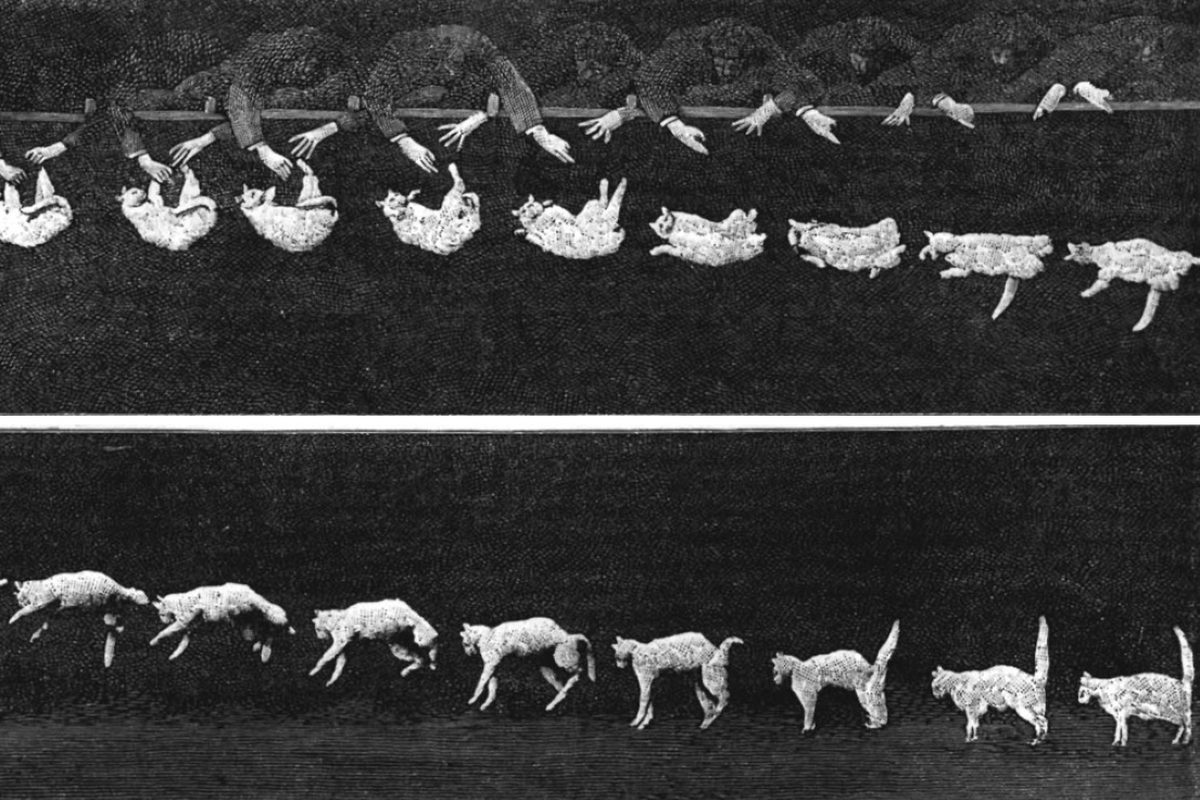
Cats land on their feet with a midair twist called the righting reflex. Balance organs in the inner ear sense which way is down, and the cat turns its front half, then its back half, each bracing against the other, so it needs nothing to push off. Kittens have the reflex by five to seven weeks. It can fail, and it does not make a fall safe.
How the righting reflex works
The reflex relies on the ear's vestibular apparatus, which handles balance and orientation, and a flexible spine that lets the body rotate.1 The inner ear also readies the landing: when a 1976 study dropped six cats from 50 cm, muscle activity began as early as 15 milliseconds after release, through a reflex traced to the otolith organs. A later phase near touchdown did not depend on the inner ear, and smooth landings needed both.2
Étienne-Jules Marey's 1894 photographs show the twist in two halves. The upside-down cat arches its back toward the ground, then reverses the curve while twisting along the spine, so front and back turn in opposite directions. At first the front half does nearly all the turning, front legs tucked to the neck, while the back legs stick out almost at right angles and resist the opposite turn. After about 180 degrees the legs swap roles, and the back half follows.3
The reflex does not work in every fall. Overweight cats are much less likely to right themselves.1 A short fall may not leave time to turn, and older or less agile cats may not manage it.4
What Marey's 1894 photographs showed
Marey's puzzle was mechanical: a falling animal has nothing outside itself to push against. His note for the Paris Academy of Sciences session of October 29, 1894, uses the frames to rule out two theories. The cat did not start turning until its back twisted, so it had not pushed off the hands holding it, and any real effect from the air would have turned it the other way. Marey credited the explanation, that the cat braces against the inertia of its own body one half at a time, to Guyou, a fellow Academy member.3
The Science Museum Group holds a falling-cat film by Marey, a French scientist and photographer, one of four films he took between 1890 and 1894. A print from it has 36 frames, dated to about 1892, at 12 frames per second.5
When Nature printed the pictures on November 22, 1894, it said the cat had been held by its feet and let go. It added: "The expression of offended dignity shown by the cat at the end of the first series indicates a want of interest in scientific investigation."6
Why physicists argued about the falling cat
The photographs seemed to break a textbook rule. Delaunay's Traité de mécanique rationnelle said a living being isolated in space and at rest, with no outside force on it, could not start rotating about its center of gravity.3
- October 29, 1894. Guyou shows the turn only appears to break the theorem of areas. The half with outstretched legs always turns less than the half with tucked legs, so the total stays at zero while the cat still turns over. Maurice Lévy adds that a cat can use its head, neck, tail and legs to reduce its moment of inertia almost at will.3
- November 5, 1894. Marcel Deprez recalls that a cat he once dropped belly up onto a cushion always landed on its feet. Lacking a camera for instant photography, he had repeatedly urged Marey to photograph it. The result, he says, exposes an error by Delaunay and every author of a rational mechanics treatise.3
- 1935. Rademaker and ter Braak propose a specific strategy for the flip.7
- 1969. Kane and Scher model the cat as two identical rigid bodies joined by a special "no-twist" joint.7
- 1993. Richard Montgomery applies gauge theory to the Kane and Scher cat, a free-falling body with zero angular momentum that reorients by changing shape, a problem he says gymnasts and satellites share.7
- 2019. Physicist Gregory Gbur's Falling Felines and Fundamental Physics traces the question into mathematics, geophysics, neuroscience and human space exploration. The solution is known, its publisher says, but "the finer details still inspire heated arguments."8
Quick quiz: how well do you know cat biology?
What is the relationship between claw scratching and interdigital gland secretion in cats?
Answer: Scratching pressure activates secretion release through paw pads. When cats scratch surfaces, their claw movements apply pressure to the paw pads, which activates the interdigital sebaceous glands and causes them to deposit their pheromone-containing secretions. This creates a combined visual and chemical message that marks territory more effectively than either method alone. Source
What is the scientific term for a species, like the cat, in which mating itself triggers the release of an egg?
Answer: Induced ovulator. Cats are 'induced ovulators,' meaning ovulation is triggered by the physical stimulus of mating rather than happening on its own each cycle. Source
What is the typical incubation period (time from infection to symptom onset) for feline herpesvirus 1 and feline calicivirus?
Answer: 2 to 10 days. Both FHV-1 and FCV have an incubation period of approximately 2 to 10 days. During this time, infected cats may shed virus before showing any signs of illness, which is why exposure to infected cats can lead to infection even if the source cat appears well. Source
Kittens develop the reflex by five to seven weeks
In a 1984 study that followed kittens from birth to 7 weeks, air righting, the midair twist, developed by the fifth week and body righting peaked in the third. The reflexes matured in order from head to tail.9 VCA says most kittens have the righting reflex by seven weeks.1
Having the reflex does not keep young cats safe. In a Zagreb study of 119 cats treated after high falls, 59.6% were under a year old.10 International Cat Care says most injured cats are young, presumably from inexperience and a more playful, curious nature.4
What the 1987 high-rise study showed
In the 1987 New York study, 90% of the cats had chest trauma and 90% of those treated survived. Wayne Whitney and Cheryl Mehlhaff, veterinarians in the Animal Medical Center's surgery department, reported 132 cats with high-rise syndrome in the Journal of the American Veterinary Medical Association in December 1987.1112 Of the chest cases, 68% had bruised lungs and 63% had pneumothorax (air around the lungs). Limb fractures showed up in 39%, and 37% needed emergency, life-sustaining treatment.11
The New York cats fell farther on average than those in later studies: 20.1 m, against 8.8 to 12.4 m, according to a 2025 Berlin study. Its authors say the gap likely reflects study design and city differences such as New York's skyscrapers.13 The 1987 study put terminal velocity at about 60 mph (97 km/h) for an average-sized cat with its legs spread, against about 120 mph (193 km/h) for an average man.12
Only cats brought to the clinic were counted, so the study could not show that falls are safe or how many falling cats die.12 The Berlin data has the same gap: cats that died at the scene or never reached a vet are missing.14 Whether higher falls hurt less is unsettled. A 1991 paper by Kapatkin and Matthiesen, cited in the Zagreb study, suggests severity rises up to the seventh story and then stops rising.10 Later studies disagree.14
| Study | Cats | Survived | Fall height and injuries |
|---|---|---|---|
| New York, published 1987 (Whitney and Mehlhaff) | 132 over 5 months | 90% of treated cats11 | A curved pattern, per a 2004 paper10 |
| Zagreb, 1998 to 2001 (Vnuk and colleagues, 2004) | 119 over 4 years; average fall four stories | 96.5% | No definite overall pattern; more severe injuries and chest trauma from the seventh story up10 |
| Berlin, 2004 to 2013 (Candela Andrade and colleagues, 2025) | 1,125 falls of 4 m or more | 87% | Severity rose linearly with height. Survival was above 80% for falls up to 21 m and about 60% for the 22 falls above that14 |
| Tehran, 2023 to 2024 (Haghi and colleagues, 2026) | 120 over 12 months; most often from the third floor (29.1%) | 89.2%, or 92.5% leaving out euthanized cats | No significant link between fall height and injury severity15 |
Landing surface mattered in the Berlin data. Where it was recorded, 75.2% of cats that hit a hard surface were severely injured, against 50% on a soft one.14
If a cat falls
A fall from a height usually needs emergency treatment, so contact your veterinary team even if the cat seems unhurt. Injuries can include broken legs and jaws, ligament damage and internal injuries to the bladder or lungs.4
International Cat Care calls high-rise syndrome completely avoidable by keeping cats away from places they can fall from. Window limiters, mesh over open windows and cat-proof balcony nets cut the risk, since cats, kittens especially, can squeeze through very small gaps.4 Test yourself on the myth in the cat myth quiz.
Frequently asked questions
Do other animals land on their feet?
Yes. Marey checked rabbits and dogs in 1894.3 Aerial righting has also been described in guinea pigs, rats and primates, and geckos rotate their large tails to reorient their bodies in midair.16
What is the highest fall a cat has survived?
Robinson (1976), cited in the 2004 Zagreb study, gave the highest recorded survivable falls as 18 stories onto a hard surface, 20 onto shrubbery and 28 onto an awning.10 A cat in the 1987 New York study fell 32 stories onto concrete and was released after 48 hours with a chipped tooth and a collapsed lung.12
Up next



Christopher writes and runs Cat Trivia Games. The sources for this article are listed below, and how the site is made and corrected is on the editorial policy page. More about the author.
References
- VCA Animal Hospitals. True or false: cats always land on their feet. back
- Watt DG. Journal of Neurophysiology, 1976. Responses of cats to sudden falls: an otolith-originating reflex assisting landing. back
- Comptes rendus de l'Académie des sciences, vol. 119 (1894): Marey, pp. 714 to 717; Guyou, pp. 717 to 718; Lévy, pp. 718 to 721; Deprez, from p. 767 (session of November 5). Des mouvements que certains animaux exécutent pour retomber sur leurs pieds (full volume, Internet Archive). back
- International Cat Care. High-rise cats. back
- Science Museum Group Collection. Chronophotographic Film of Cat Falling, Étienne Jules Marey. back
- Nature, vol. 51, pp. 80 to 81 (November 22, 1894). Photographs of a tumbling cat. back
- Montgomery R. Fields Institute Communications, vol. 1, 1993. Gauge theory of the falling cat. back
- Yale University Press. Falling Felines and Fundamental Physics, by Gregory J. Gbur (2019). back
- Sechzer JA, Folstein SE, Geiger EH, Mervis RF, Meehan SM. Experimental Neurology, 1984. Development and maturation of postural reflexes in normal kittens. back
- Vnuk D, Pirkić B, Matičić D, et al. Journal of Feline Medicine and Surgery, 2004. Feline high-rise syndrome: 119 cases (1998 to 2001). back
- Whitney WO, Mehlhaff CJ. Journal of the American Veterinary Medical Association, 1987. High-rise syndrome in cats. back
- BBC News, Daniel Nasaw (March 23, 2012). How do cats survive falls from great heights? back
- Candela Andrade M, Slunsky P, Nerlich A, Aguilera-Rojas M, Brunnberg L. Journal of Feline Medicine and Surgery, 2025. High-rise syndrome in cats (part 1): epidemiology and risk factors. back
- Candela Andrade M, Slunsky P, Nerlich A, Aguilera-Rojas M, Brunnberg L. Journal of Feline Medicine and Surgery, 2025. High-rise syndrome in cats (part 2): injury patterns and survival rate. back
- Haghi P, Soroori S, Molazem M, et al. Veterinary Medicine and Science, 2026. Radiographic and ultrasonographic study of the etiology of high-rise syndrome in cats. back
- Jusufi A, Zeng Y, Full RJ, Dudley R. Integrative and Comparative Biology, 2011. Aerial righting reflexes in flightless animals. back
This is general information, not veterinary advice. Written by Christopher Fox under our editorial policy.