 Cat Trivia Games
iOS App
Ship's Cat History: Simon, Mrs Chippy and Unsinkable Sam
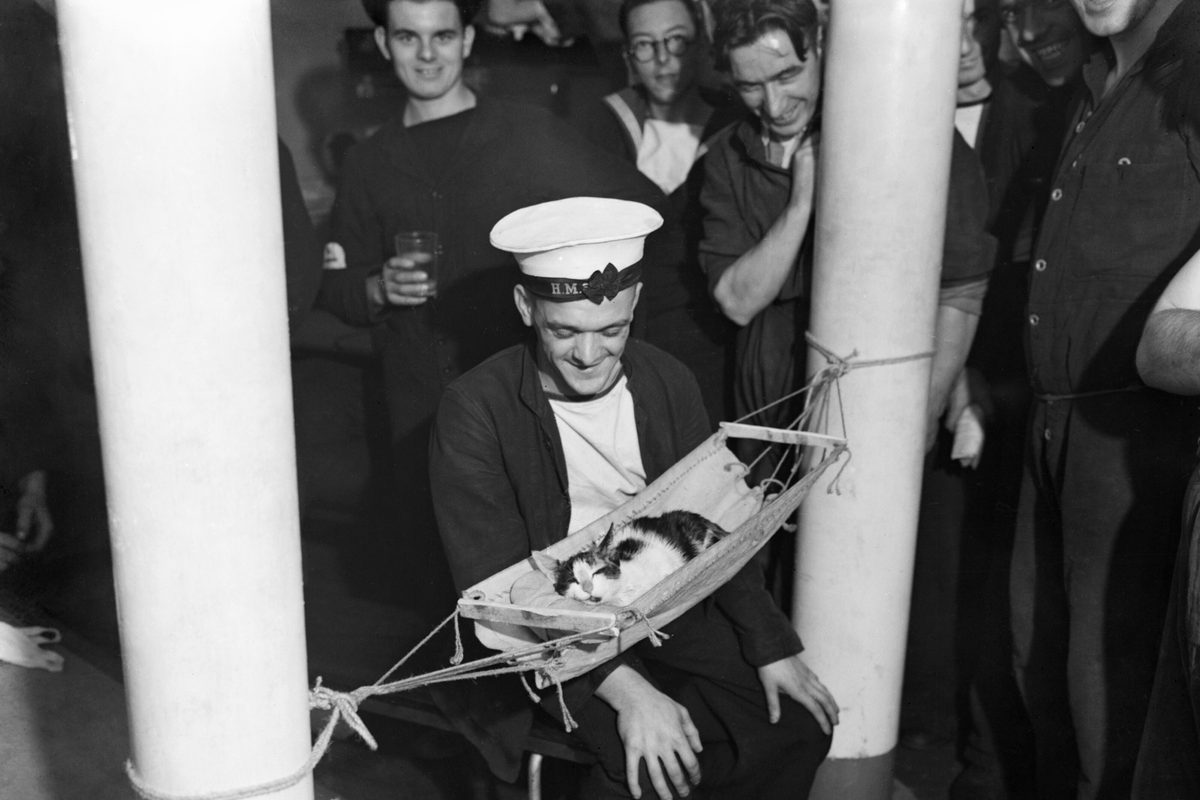
A ship's cat was kept aboard to kill the rats and mice that spoiled the crew's food, chewed gear and spread disease. Crews also valued cats for company and luck. Simon of HMS Amethyst is the only cat to receive Britain's PDSA Dickin Medal, and the Royal Navy banned cats from its ships in 1975.
Why ships carried cats
Rats and mice ruined the crew's food, chewed equipment and spread disease, and a cat was a cheap, effective fix.1 In the age of sail, a rat in the gunpowder could also leave a flammable trail of powder as it ran.2 The job used the hunting drive behind cats bringing prey home.
Egyptian tomb paintings show cats hunting from boats on the Nile.1 A 2017 ancient-DNA study found that the domestic cat's spread across the Old World gained momentum in the Classical period, apparently along human sea and land trade routes.3
The earliest cats known from what is now the United States were most likely ship's cats. A 2025 study examined an adult and a juvenile cat from the Emanuel Point II wreck, one of 11 Spanish ships under Tristán de Luna y Arellano hit by a hurricane in Pensacola Bay, Florida, on 19 to 20 September 1559.4 Isotopes from the adult point to a diet of fish and possibly domestic meat, apparently without heavy reliance on rats. The authors suggest the cats' main job was probably catching rats, and since the adult ate much like the sailors, it may also have been a companion.4
In the First World War, thousands of stray cats in British cities were rounded up for the military. Royal Navy cats got a weekly "victualing allowance" of 1 shilling and 6 pence for canteen treats, and a large warship could carry up to two dozen cats, each with its own territory.1
Ship's cats on the record, 1559 to 1975
| Date | Cat | Ship | What the record says |
|---|---|---|---|
| 19 to 20 September 1559 | Two unnamed cats | Emanuel Point II (Spanish) | Most likely the earliest cats in what is now the US4 |
| 1799 | Trim | HMS Reliance, then Investigator | Born aboard Reliance; sailed around Australia with Matthew Flinders5 |
| 28 May 1914 | Emmy | RMS Empress of Ireland | Ran off twice the day before the ship sank, says Derek Grout6 |
| 1914 to 1918 | Strays from British cities | Royal Navy | Thousands rounded up for the military1 |
| 29 October 1915 | Mrs Chippy | Endurance | Shot after the ice crushed the ship, as Shackleton's diary records7 |
| 27 May to 14 November 1941 | Oscar, later "Unsinkable Sam" | Bismarck, HMS Cossack, HMS Ark Royal | Said to have survived all three; doubted by the museum holding his portrait8 |
| August 1941 | Blackie, renamed Churchill | HMS Prince of Wales | Stroked by Churchill at his meeting with Roosevelt9 |
| 22 April to 4 August 1949 | Simon | HMS Amethyst | Wounded but kept killing rats; later awarded the Dickin Medal10 |
| 1975 | All | Royal Navy | Cats banned for health and safety reasons11 |
Two famous stories, checked against the record
Unsinkable Sam. The National Maritime Museum in Greenwich holds a pastel of him by Georgina Shaw Baker, and its catalog notes doubts about his Bismarck origins. In the story, HMS Cossack's crew pulled him from a plank after the Bismarck sank on 27 May 1941 and named him Oscar. He survived the torpedoing of Cossack that October and of Ark Royal in November, and died in a Belfast seamen's home in 1955. No Bismarck survivor's account mentions him. Of two photos said to show him, one is a tabby and the other wears a collar tag reading "HMS Amethyst 1949", Simon's ship.8
Herman's passport. Herman was real and patrolled the port of Baltimore for the US Coast Guard from 1943, and a "passport" for him circulates online. Snopes found it was standard military identification of the time, sometimes issued to cats for crew morale.2
Simon, the Dickin Medal cat
Simon was the ship's cat of HMS Amethyst, which came under People's Liberation Army artillery fire on the Yangtze River in 1949, during the Chinese Civil War. A shell killed the captain, Lieutenant Commander Skinner, and left Simon with shrapnel in his legs and burns to his back and face. The ship took more than 50 direct hits and was stranded mid-river for almost 10 weeks.10
The heat brought rats to the crew's limited food, and the wounded Simon kept hunting. When he killed a particularly vicious rat nicknamed Mao Tse-tung, which had raided the stores again and again, the crew promoted him to "Able Seaman". His Amethyst campaign ribbon citation credited him with ridding the ship "of pestilence and vermin" from 22 April to 4 August, and his Dickin Medal citation reads: "Served on HMS Amethyst during the Yangtse Incident, disposing of many rats though wounded by shell blast."10
Simon reached Plymouth with the ship on 1 November 1949 and died in quarantine three weeks later. Crewman Stuart Hett sorted hundreds of pieces of his fan mail, and Simon was buried with full military honours at the PDSA Animal Cemetery in Ilford, Essex.12 PDSA counts him as the only cat among its medal's recipients.13
Quick quiz: how well do you know cat history?
Which term describes the retention of juvenile features into adulthood?
Answer: Neoteny. Neoteny means physical or behavioral development is slowed or delayed, so traits normally seen only in juveniles, like a rounder face or a playful temperament, persist into adulthood. It's a major driver of the look and behavior of many domesticated animals, cats included. Source
Who is Lucifer the cat's owner in Disney's Cinderella?
Answer: Lady Tremaine. Lucifer is the pampered, mischievous pet cat belonging to Cinderella's stepmother, Lady Tremaine. Source
Why are almost all calico cats female rather than male?
Answer: Females have two X chromosomes carrying color genes while males have only one. Calico coloring requires a cat to carry both the orange (red) and black coat color genes. Because these color genes are located on the X chromosome, females with two X chromosomes can carry both alleles. Males typically have only one X chromosome, so they can express only one color. This X-linked inheritance pattern makes calicos almost exclusively female. Source
Three more ship's cats: Mrs Chippy, Blackie and Trim
Mrs Chippy on the Endurance
Mrs Chippy, a male tabby despite the name, belonged to Harry "Chippy" McNeish, carpenter on Ernest Shackleton's 1914 to 1916 Trans-Antarctic Expedition.14 After the ice crushed the Endurance, Shackleton's diary entry for 29 October 1915 reads: "This afternoon Sallie's three youngest pups, Sue's Sirius, and Mrs. Chippy, the carpenter's cat, have to be shot. We could not undertake the maintenance of weaklings under the new conditions."7
McNeish never forgave Shackleton. Baden Norris, emeritus curator of Antarctic history at Canterbury Museum, visited a very old and ill McNeish as a boy and could remember him saying only that "Shackleton had shot his cat". In 2004 the New Zealand Antarctic Society raised NZ$6,000 for a life-sized bronze of Mrs Chippy by sculptor Chris Elliott, to sit on McNeish's grave in Karori Cemetery, Wellington.14
Blackie and Churchill
Blackie was the ship's cat on HMS Prince of Wales, where Winston Churchill met President Roosevelt off Newfoundland in August 1941. During the American anthem, Blackie headed for the American ship alongside and Churchill bent to stroke him. The Cats Protective League's magazine said Churchill should have offered his hand first and awaited "a sign of approval before taking liberties." The crew renamed the cat Churchill.9
Japanese aircraft sank Prince of Wales off Malaya in December 1941.15 The Finest Hour account says the cat reached Singapore with survivors and was left behind in the February 1942 evacuation.9 Its author, Fred Glueckstein, told Churchill historian Richard Langworth his source was Angus Konstam's Naval Miscellany, which says the cat swam ashore and was found by British servicemen.15
Trim and Matthew Flinders
Trim was born aboard HMS Reliance in 1799 and sailed around Australia with the navigator Matthew Flinders on Investigator.5 Flinders's 1809 tribute says Trim fell overboard as a kitten, learned to swim and climbed back up a rope thrown to him. He was jet black with four white feet, a white under lip and a white star on his chest, and weighed 10 to 12 pounds. After surviving a shipwreck on a coral reef, he was lost on Île de France, where Flinders was held prisoner, and a reward of ten Spanish dollars in the island's gazette did not bring him back.16
What sailors believed about cats
Early sailors believed a cat's tail could control the weather, and a twitching tail meant an angry cat about to send a storm. A cat that chose to come aboard before a voyage was good luck. A longtime ratter jumping ship just before sailing meant disaster, and two cats fighting on the pier meant an angel and a devil were battling for the crew's souls.1
Emmy, the orange cat of the liner Empress of Ireland, jumped off in Quebec City before the ship sailed, says Derek Grout, author of two books on the liner. She was brought back, then ran off again and left her kittens behind. The next day the liner sank in 14 minutes after a collision, and 1,012 people died. "Sailors regard that as a terrible omen," Grout told The Canadian Press.6
Cats were also believed to consort with witches, and that belief survives in black cat superstitions. On ships, cats were well regarded and often thought lucky, especially cats with extra toes.4
Why ship's cats disappeared
After the Second World War, better fumigation and pest control left cats less work, and quarantine tightened. Before the 1950s many countries exempted ship's cats from quarantine, so they could wander foreign ports. Postwar laws kept a cat aboard until it had served a long quarantine, and a captain whose cat slipped ashore could be heavily fined or even arrested.1
In the US, ship's cats became a political target. Members of Congress pushing for defense cuts ridiculed the Navy's admirals after one ship was found to have used a three-man committee to plan its mascot cat's funeral.1 The Royal Navy banned cats from its ships in 1975 for health and safety reasons.11
Frequently asked questions
Do any navies still keep ship's cats?
Rarely. National Geographic reported in 2023 that the US Navy does not explicitly ban cats, but almost never grants the special permission a sailor needs to bring one aboard. Most navies are similar, except Russia.1
How many animals have won the Dickin Medal?
PDSA says the medal has been awarded 75 times since 1943, plus one honorary medal in 2014. The recipients are 38 dogs, 32 pigeons, 4 horses and 1 cat, Simon.13
Up next


Christopher writes and runs Cat Trivia Games. The sources for this article are listed below, and how the site is made and corrected is on the editorial policy page. More about the author.
References
- Scot Christenson, National Geographic (2023). The forgotten history of cats in the navy. back
- Jack Izzo, Snopes (2023). Did navies issue passports to cats? back
- Ottoni, C., et al. (2017). The palaeogenetics of cat dispersal in the ancient world. Nature Ecology and Evolution 1, 0139. back
- Welker, M. H., Bratten, J. R. and Guiry, E. (2025). Exploring the arrival of domestic cats in the Americas. American Antiquity 90(2). back
- Royal Museums Greenwich. Matthew Flinders (Matthew Flinders's cat). back
- Andy Blatchford, The Canadian Press, in The Globe and Mail (2014). Empress of Ireland, Canada's Titanic, finally getting its due after 100 years. back
- Ernest Shackleton (1919). South: The Story of Shackleton's Last Expedition, 1914 to 1917 (entry for October 29, 1915). Project Gutenberg. back
- Royal Museums Greenwich, National Maritime Museum. Oscar, cat from the German battleship Bismarck (PAJ2744), pastel by Georgina Shaw Baker. back
- Fred Glueckstein, Finest Hour 139, International Churchill Society. "Cats look down on you": Churchill's feline menagerie. back
- PDSA. Simon, DM 54: PDSA Dickin Medal recipient booklet (PDF). back
- Forces News, British Forces Broadcasting Service (2018). Ten of the most important ship's cats of all time. back
- BBC News (2007). Wartime hero cat Simon remembered. back
- PDSA. The PDSA Dickin Medal. back
- BBC News (2004). Antarctic hero "reunited" with cat. back
- Richard M. Langworth (2017). A love of the hot-water bottle: wartime anecdotes (Blackie, and the source of his survival story). back
- Matthew Flinders (1809), Royal Museums Greenwich, Flinders papers FLI/11. Biographical tribute to his cat Trim. back
Written by Christopher Fox under our editorial policy.