 Cat Trivia Games
iOS App
The Yule Cat: Iceland's Christmas Cat Legend
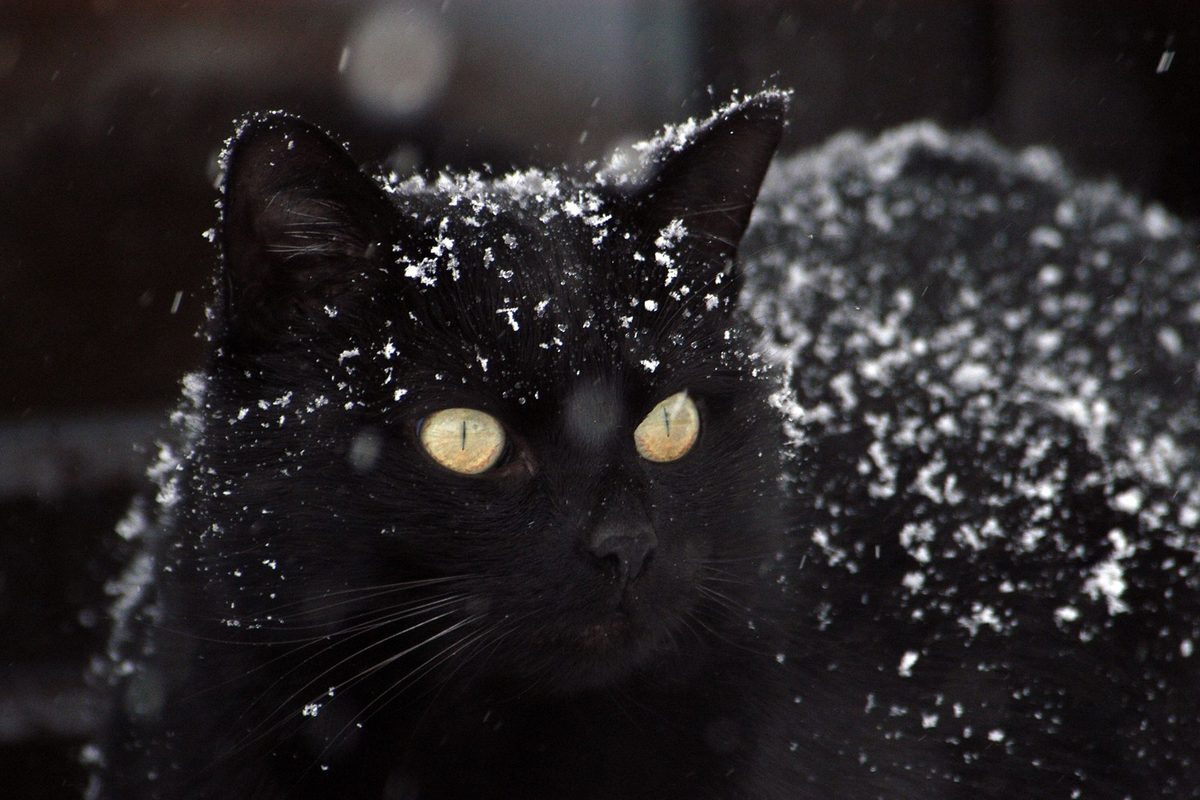
The Yule Cat, Jólakötturinn in Icelandic, is a huge cat from Icelandic folklore said to eat anyone who gets no new clothes for Christmas, or at least to take their Christmas food. The oldest written mention I found is from 1860, a detailed account was printed in 1864, and the version that lives on today comes from a 1932 poem by Jóhannes úr Kötlum.
What the Yule Cat does
In the oldest detailed account, the cat spared anyone with a new garment for Christmas Eve and took everyone else. Jón Árnason's Icelandic folk tales (volume 2, Leipzig, 1864) describe the jólaköttur as a monster abroad at Christmas. Anyone who got nothing new "went into the Yule Cat" (fóru allir í jólaköttinn), and it took them, or at least their jólarefur, each household member's Christmas Eve share of meat, fat and other food.1 Jón Árnason wrote "took" and added "(ate?)", so even this early account was unsure the cat ate people.1
The threat was tied to work. Children and farm servants competed to earn some new clothing from the heads of the household before Christmas.1 A footnote adds two regional versions. In the north some said "dressed the Yule Cat" instead, and in Borgarfjörður anyone who got nothing new was also supposed to carry a ram's horn full of urine on Christmas Eve to their birthplace and splash it into the bed they were born in. Jón Árnason suggested these penances were a goad for children lazy about learning and about finishing their tasks before Christmas.1
The phrase is still used. Reykjavík city's page calls that fate að fara í jólaköttinn, going into the Yule Cat, and says children and adults alike had better avoid it, for example by earning at least one pair of socks.2
How old the Yule Cat is in writing
By 1860 the Yule Cat was in writing. Ritmálssafn, the historical dictionary collection of the Árni Magnússon Institute for Icelandic Studies, holds 18 written examples of the word jólaköttur. The earliest-dated is a line in the 1860 volume of Norðri, a fortnightly paper, about giving children some clothing before Christmas "so they don't go into the Yule Cat".3
I found no written evidence for a much older origin. Smithsonian Magazine wrote in 2016 that the story "likely dates back to the Dark Ages, though the oldest written accounts are from the 19th century", without a source for the first part.4 Reykjavík city's page says the cat descends from similar animal figures in other Nordic countries, such as the Yule goat, but gives no evidence and also says it is impossible to say where the cat really comes from.2 In 2023 NPR, citing a University of Iceland folklore project, dated the tale "back to at least 1932".5 The written record is at least 72 years older.
| Year | Where | What it says |
|---|---|---|
| 1860 | Norðri, a fortnightly paper | Children get clothing before Christmas "so they don't go into the Yule Cat"3 |
| 1864 | Jón Árnason's folk tales, volume 2, page 570 | The cat takes anyone with no new garment, or at least their Christmas food; the ram's horn penance1 |
| 1897 to 1898 | Nýja öldin, a newspaper | Give the kids "some new bit of clothing, so they don't end up in the Yule Cat"3 |
| 1932 | Jólin koma, poems by Jóhannes úr Kötlum | The poem "Jólakötturinn": a huge cat that hunts people, not mice6 |
| 1944 to 1960 | Kristleifur Þorsteinsson, Úr byggðum Borgarfjarðar | A way out: carry a ram's horn on your toe to the bed you were born in3 |
| 1987 | The album Hvít er borg og bær | Björk sings the poem to a melody by Ingibjörg Þorbergs7 |
| 2018 | Lækjartorg square, Reykjavík | The city's first LED Yule Cat goes up2 |
The 1932 poem by Jóhannes úr Kötlum
Today's image of the Yule Cat comes from "Jólakötturinn", a poem of 16 four-line verses in Jólin koma (Christmas Is Coming), the 1932 children's book by Jóhannes úr Kötlum.658 In a biographical essay on the poet (1899 to 1972), Silja Aðalsteinsdóttir calls it his most popular book and says the image he gave Grýla, the Yule Lads and the Yule Cat is the one that lived on, now competing with foreign figures such as Santa Claus.9
The poem opens "You all know the Yule Cat", calls it enormous, and says nobody knew where it came from or went. Everyone knew "he hunted people but did not want mice".6
The cat preys on poor people with no new garment for Christmas, takes all their Christmas food and usually eats it himself. So the women work the carding combs, loom and spinning wheel to knit a brightly colored garment or a little sock. On Christmas Eve, when the cat peers in, the children hold their parcels: some have an apron, some have shoes, and that is enough, because the cat can eat no one who got some garment.6 Near the end the poem stops calling the cat "he" and switches to kisa, an everyday word for a cat, and "she".6
The last verses suggest readers might help. The poet does not know whether the cat still exists, but her trip would be a poor one if everyone got some garment next time, and perhaps there are still children who get nothing.6 In December 2007 Morgunblaðið reported the book was in its 24th printing, 75 years after it first came out, and at the top of the poetry bestseller list.8
Quick quiz: how well do you know cat history?
By Byzantine legend, cats were shipped to Cyprus in 328 AD mainly to control what?
Answer: Venomous snakes. The legend says Helena of Constantinople sent shiploads of cats to fight a snake infestation plaguing the land around a coastal monastery. Source
CFA's Championship class is limited to unaltered pedigreed cats over what minimum age?
Answer: Eight months. CFA defines Championship competition as open to unaltered pedigreed cats over eight months old, distinguishing it from the Kitten and Premiership classes. Source
Canada's national purebred cat registry, the Canadian Cat Association (CCA-AFC), was founded in which decade?
Answer: 1960s. A small group of Canadians met in 1960 to form a domestic registry for purebred cats, giving Canada its own national alternative to foreign associations. Source
The Yule Cat light display in Reykjavík
Since 2018 an LED Yule Cat has stood on Lækjartorg square in central Reykjavík at Christmas. It is about five meters tall and six meters wide, lit by 6,500 LEDs, and was designed by the city with MK Illumination, an Austrian company, and Garðlist.2 The Reykjavík Grapevine reported in 2018 that MK Illumination designed and built it, Garðlist owns it and the city rents it for 3.4 million Icelandic krónur a year. Citing Vísir, it put the first year's total at 4.4 million, the extra million for reusable installation parts.10
The cost brought the legend's point about poverty into city politics. In a Facebook post criticizing the city's priorities, Socialist Party council member Sanna Magdalena Mörtudóttir argued that poverty deprives children of new clothes and that the city, as the country's largest employer of minimum-wage workers, could clothe many children by raising their parents' pay.10
The lighting is a public event. In late November 2018 city council president Dóra Björt Guðjónsdóttir lit the new cat, the children's choir Graduale Futuri sang, and Grýla and Leppalúði gave interviews, along with the cat itself.11 In 2022 the city said the cat would stay on the square until after New Year,12 and in 2024 it announced the lighting for Saturday, November 16, at 5 pm, with Grýla, Leppalúði and a brass band.2
The Yule Cat is the theme of the December 21 door in the cat trivia advent calendar.
Frequently asked questions
Is the Yule Cat Grýla's pet?
That is how it is often told today. Smithsonian Magazine names its owners as the trolls Grýla and Leppalúði and their 13 children, the Yule Lads.4 Reykjavík city calls this an often-repeated claim and says it is impossible to say whether the cat really lives with them.2 Neither Jón Árnason's 1864 account nor the 1932 poem makes the cat anyone's pet.16
Is it the Yule Cat or the Christmas Cat?
Both names are used in English. NPR translates Jólakötturinn as Yule Cat,5 and The Reykjavík Grapevine calls it the Christmas Cat.13
What does the Yule Cat look like?
The poem gives it glowing eyes, whiskers as sharp as spikes, a high arched back, claws on furry paws and a strong tail, but no color.6 Tryggvi Magnússon drew the book's pictures, which the poet's son Svanur Jóhannesson praised. A Morgunblaðið writer who heard the book read at nursery school in the years around and after 1960 remembered its cat as a gray-striped beast with a huge arched back, hissing with its claws out.8
Up next

Christopher writes and runs Cat Trivia Games. The sources for this article are listed below, and how the site is made and corrected is on the editorial policy page. More about the author.
References
- Jón Árnason (collector). Scan by the National and University Library of Iceland. Íslenzkar þjóðsögur og æfintýri, volume 2 (Leipzig: J. C. Hinrichs, 1864), page 570. back
- Reykjavík City, November 15, 2024. Öll velkomin þegar kveikt verður á jólakettinum (lighting of the Yule Cat). back
- Árni Magnússon Institute for Icelandic Studies, Ritmálssafn Orðabókar Háskólans. Jólaköttur: historical dictionary entry with 18 written examples, 1860 to the 20th century. back
- Danny Lewis, Smithsonian Magazine, December 19, 2016. Each Christmas, Iceland's Yule Cat takes fashion policing to the extreme. back
- Dustin Jones, NPR, December 23, 2023. You've heard of Santa, maybe even Krampus, but what about the child-eating Yule Cat? back
- Jóhannes úr Kötlum, on johannes.is. Jólakötturinn (poem text, from Jólin koma, 1932). back
- Páll Svansson, on johannes.is. Tónlistin (recordings of the poems). back
- Bergþóra Jónsdóttir, Morgunblaðið, December 20, 2007, reprinted on johannes.is. Jólin koma: aftur og enn á ný. back
- Silja Aðalsteinsdóttir, on johannes.is. Æviferill (biographical essay on Jóhannes úr Kötlum). back
- Colin Arnold Dalrymple, The Reykjavík Grapevine, November 27, 2018. Christmas Cat cost causes controversy. back
- Miðborg Reykjavíkur press release, on johannes.is, November 26, 2018. Jólakötturinn á ferli í skammdeginu. back
- Reykjavík City, November 17, 2022. Jólakötturinn mætir á Lækjartorg. back
- Haukur S. Magnússon, The Reykjavík Grapevine, December 10, 2008. The Christmas Cat. back
Written by Christopher Fox under our editorial policy.