 Cat Trivia Games
iOS App
Why Do Cats Like Catnip?
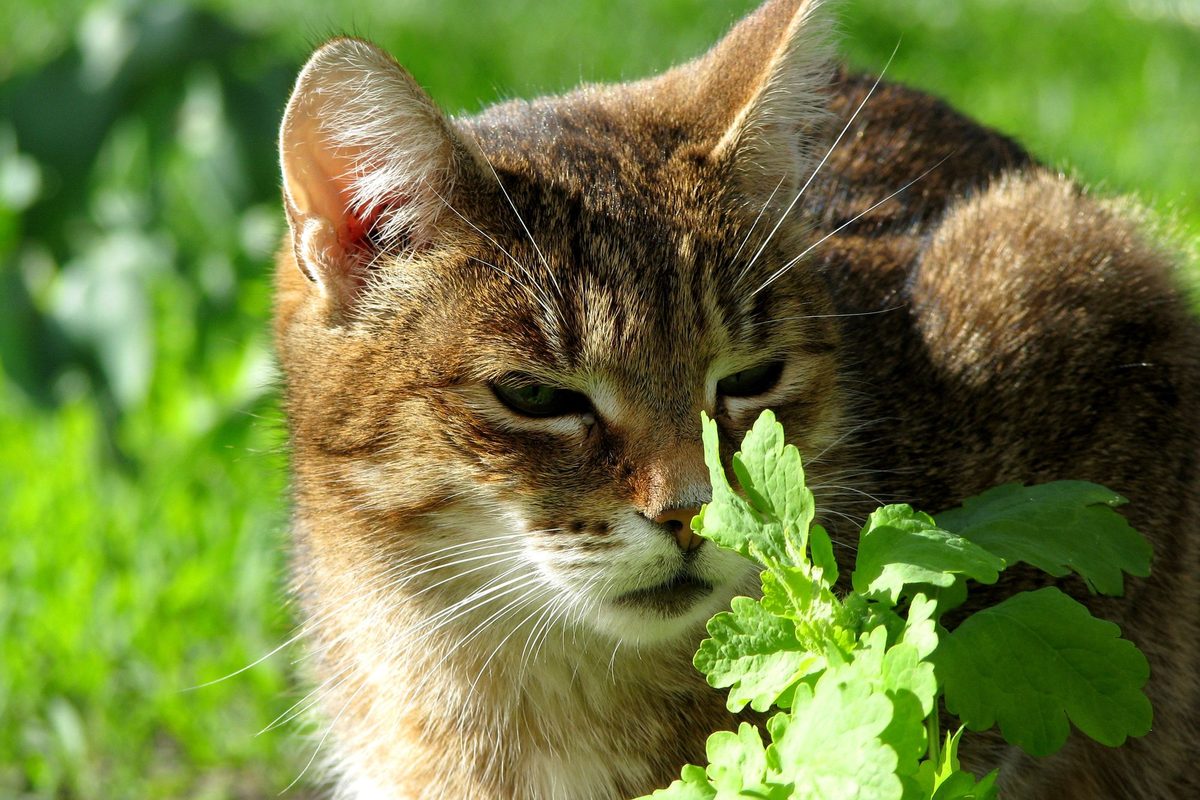
Cats like catnip for its smell. The plant gives off nepetalactone, and a responding cat sniffs, licks and chews it, rubs its face on it and rolls, usually for 5 to 15 minutes.1 About one cat in three does not react,2 and the trait runs in families.3 In a 2021 study, a similar compound in silver vine raised cats' blood levels of beta-endorphin, one of the body's own opiates, and rubbing on it cut mosquito landings.1
What catnip does to a cat
Catnip works on cats through smell, not taste.2 The plant, Nepeta cataria, is a hardy perennial herb in the mint family, Lamiaceae, with oregano, thyme and basil.4 Its nepetalactone has been found to repel insects, and like several plants it releases airborne compounds that repel plant-eating insects or attract their predators.2 Neil Todd of Harvard wrote in 1962 that one part in a billion, or even 100 billion, may be enough to set off a response.3
Todd described four stages: sniffing; licking and chewing with head shaking; chin and cheek rubbing; and a head-over roll with body rubbing. Only 3 of his 58 responding cats broke that order, by skipping the licking.3 Some cats also drool or kick the plant with their hind feet. In a 2017 study of 100 California cats, researchers saw something they believed was new: the skin over some cats' lower backs rippled for a few seconds.2 Cats rub their faces on people too; see why cats headbutt you.
After responding, a cat usually ignores catnip for an hour or more.1 The 2017 authors call the response not sexual,2 and adult males and females respond alike.1 All 100 cats in that study were neutered, and 68% still responded.2
The 2021 study links the response to the opioid system, which in humans is involved in reward and euphoria. Beta-endorphin rose in the blood of five cats exposed to nepetalactol, the main active compound in silver vine leaves. In six cats, naloxone, which blocks mu-opioid receptors, cut the rubbing and rolling short.1
Why some cats ignore catnip
About a third of cats ignore catnip. In the 2017 study 32 of 99 did, and three earlier studies, pooled, found 53 non-responders among 170 cats (31%).2 Todd's count in Boston, 58 responders among 84 strays and other cats (69%), was a minimum, he wrote, because the cats could not all be tested alike or retested.3
Todd's pedigree pointed to an autosomal dominant trait: one copy of the gene is enough, and it is not on the sex chromosomes. Among related cats in his colony and the Siamese studs bred to them, two responding parents twice produced a non-responder.3 The 2021 silver vine researchers wrote that this strongly suggests one or a few genes are responsible, and proposed a genome-wide study to find them.1
A 2011 master's thesis at the University of California, Davis, found no clear single-gene pattern in two research colonies: 180 cats tested with dried catnip and 30 with catnip spray. Heritability, from 0 to 1, measures how well genetic differences explain differences in a trait, in the group and setting measured.5 For the cheek rub and head-over roll together, it was 0.794 in the larger colony and 0.511 in the smaller. Many retested cats changed their response: 29 of 77 and 19 of 30.4
Age and temperament made little difference in the 2017 study. Older cats responded about as often as younger ones, though more of their catnip responses were mild (35% against 12%), and shy cats responded as often and as strongly as friendly ones.2
Quick quiz: how well do you know cat behavior?
What does a cat's tail typically do just before it pounces on a toy or prey?
Answer: Twitching fast at the tip. As predatory focus builds, a stalking cat's rear end may sway and the tip of its tail twitches rapidly. A release of pent-up energy in the instant before the strike. Source
What does a cat's trill usually mean?
Answer: A friendly hello. A trill is a short, high-pitched, closed-mouth sound - something between a meow and a purr - that cats commonly use to greet a person or another cat they know and like. Source
What does chattering at birds through a window usually mean?
Answer: Hunting frustration. Chattering tends to appear when a cat spots prey it can't reach - the jaw-chatter blends predatory excitement with the frustration of being unable to pounce. Source
Rubbing may keep mosquitoes away
Rubbing seems to leave the plant's insect-repelling compound on a cat's fur. Researchers at Iwate University in Japan and the University of Liverpool reported this in Science Advances in 2021. On Tashirojima, Japan's informal "cat island", 17 of 30 feral cats rubbed their faces on test papers, nearly always on the one treated with nepetalactol. An Amur leopard, two jaguars and two Eurasian lynx at Japanese zoos rubbed and rolled on it too, while eight dogs and ten mice ignored it.1
Cats responded to wipes from cats that had rubbed the treated paper, but not to those from cats kept away from it. In a test with six pairs of anesthetized cats, nepetalactol-treated heads drew on average half the Aedes albopictus mosquito landings of untreated ones, and cats that had rubbed on silver vine leaves were also avoided. The authors reason that many cats hunt by stalking and waiting still in ambush, so repelling mosquitoes and the diseases they carry would likely be a strong advantage. That part was not tested.1
A 2022 follow-up in iScience found that licking and chewing release more of the compound. Cats swallowed little if any plant, but silver vine leaves they damaged gave off about 10 times as much iridoid, nepetalactone's compound family, as intact leaves, and hand-crumpled catnip leaves over 20 times as much. Against mosquitoes, though, a synthetic mix matching damaged catnip worked only at the highest dose tried and only after 20 minutes, while a damaged silver vine mix worked at a quarter of that dose.6
Catnip repels mosquitoes through TRPA1, an irritant receptor, according to a separate 2021 study: mosquitoes lacking the receptor were no longer repelled, and flies lacking it ignored nepetalactone. Catnip did not activate the human version.7
Silver vine, honeysuckle and valerian
In the 2017 study, most cats that ignored catnip responded to silver vine. In spring 2016, Sebastiaan Bol and colleagues offered catnip, silver vine (Actinidia polygama), Tatarian honeysuckle (Lonicera tatarica), valerian root (Valeriana officinalis) and an empty control, each several times, to 100 cats in Riverside, California. Of the 100 cats, 94 responded to at least one plant and 6 to none.2
| Plant and form tested | Cats that responded | Of 31 cats that ignored catnip | Selected compounds (micrograms per gram, dried) |
|---|---|---|---|
| Catnip, dried leaves and flowers | 68% | Not applicable | Nepetalactone (main form) 1,010; actinidine 112 |
| Silver vine, powdered dried fruit galls | 79%, more intense than catnip | 22 (71%) | Actinidine 290; iridomyrmecin 167; four isodihydronepetalactone isomers, 141 to 315 each; nepetalactone 32 |
| Tatarian honeysuckle, sawdust and wood | 53% | 10 (32%) | Actinidine 108; nepetalactone 132 |
| Valerian, dried root | 47% | 6 (19%) | Actinidine 172; iridomyrmecin 31; nepetalactone 52 |
Silver vine galls are swellings caused by the gall midge Pseudasphondylia matatabi. In a side test, 8 of 9 cats responded to dried galls and none to normal dried fruit. The authors suggest that actinidine, far more plentiful in the three alternatives than in catnip, may partly explain why cats that ignore catnip respond to them.2
On practical grounds, the authors call catnip cheap and easy to grow, silver vine pricier and mostly from East Asia, valerian strong-smelling, and honeysuckle wood possibly the hardest to find but long-lasting. Of 38 veterinarians they asked in the USA and Australia, 36 had not heard of silver vine or Tatarian honeysuckle, and none of the 6 veterinary technicians they asked had.2
Cats and catnip: a timeline
- 1638: Johannes Franck's Swedish botanical work Speculum botanicum calls catnip lössegräs, loosely "lice grass", for its use against insects.7
- 1704: A Japanese botanist writes the first report of cats responding to silver vine.1
- 1759: British botanist P. Miller gives the first report of cats responding to catnip.1
- 1859: An ukiyo-e picture shows a folk story in which mice fight cats by intoxicating them with silver vine.1
- 1906: A letter in Science describes cats taking to silver vine as a new "cat delicacy" after Harvard's arboretum imported it from China.2
- Early 1940s: S. M. McElvain and colleagues identify nepetalactone as catnip's active compound in a test with seven adult lions.2
Frequently asked questions
Do big cats like catnip?
Lions, jaguars, leopards and snow leopards appear to respond, but most tigers do not: at Big Cat Rescue in Tampa, Florida, one of nine tigers responded mildly to catnip and five backed away from silver vine. Four of the five bobcats there responded to silver vine and one to catnip, hugging the bag to their heads as they rubbed and rolled, sometimes for over 15 minutes.2 Of 21 cat species tested so far, 13 respond to catnip, out of 41 living species.1
Is catnip safe for cats?
Catnip is on the ASPCA's current list of plants toxic to cats: it can cause vomiting and diarrhea and makes some cats sedated and others stimulated.8 The 2017 authors wrote that catnip is generally believed to be neither addictive nor harmful, and that none of their four plants was on the ASPCA's list at the time.2 A 1969 study cited by the 2022 team found no marked behavioral or physiological effects from nepetalactone given by mouth.6
When do kittens start responding to catnip?
Usually not before six to eight weeks, Todd wrote, and the response may not develop fully until three months. Young kittens often avoid catnip at first, though he recorded one nursing kitten, six to seven weeks old, giving a full response.3 He did not publish experimental data for those ages.4
Up next

Christopher writes and runs Cat Trivia Games. The sources for this article are listed below, and how the site is made and corrected is on the editorial policy page. More about the author.
References
- Reiko Uenoyama, Tamako Miyazaki, Jane L. Hurst and others, Science Advances 7 (2021). The characteristic response of domestic cats to plant iridoids allows them to gain chemical defense against mosquitoes. back
- Sebastiaan Bol, Jana Caspers, Lauren Buckingham and others, BMC Veterinary Research 13 (2017). Responsiveness of cats (Felidae) to silver vine (Actinidia polygama), Tatarian honeysuckle (Lonicera tatarica), valerian (Valeriana officinalis) and catnip (Nepeta cataria). back
- Neil B. Todd, Journal of Heredity 53 (1962), PDF copy. Inheritance of the catnip response in domestic cats. back
- Natalie A. Villani, master's thesis, University of California, Davis (2011), committee chair Leslie A. Lyons, PDF copy. Heritability and characteristics of catnip response in two domestic cat populations. back
- MedlinePlus Genetics, U.S. National Library of Medicine. What is heritability? back
- Reiko Uenoyama, Tamako Miyazaki, Masaatsu Adachi and others, iScience 25 (2022). Domestic cat damage to plant leaves containing iridoids enhances chemical repellency to pests. back
- Nadia Melo, Matthew Capek, Oscar M. Arenas and others, Current Biology 31 (2021). The irritant receptor TRPA1 mediates the mosquito repellent effect of catnip. back
- ASPCA Animal Poison Control. Catnip (Nepeta cataria) plant entry. back
This is general information, not veterinary advice. Written by Christopher Fox under our editorial policy.