 Cat Trivia Games
iOS App
Cat Slang Meaning: Blep, Mlem, Loaf, Zoomies and More
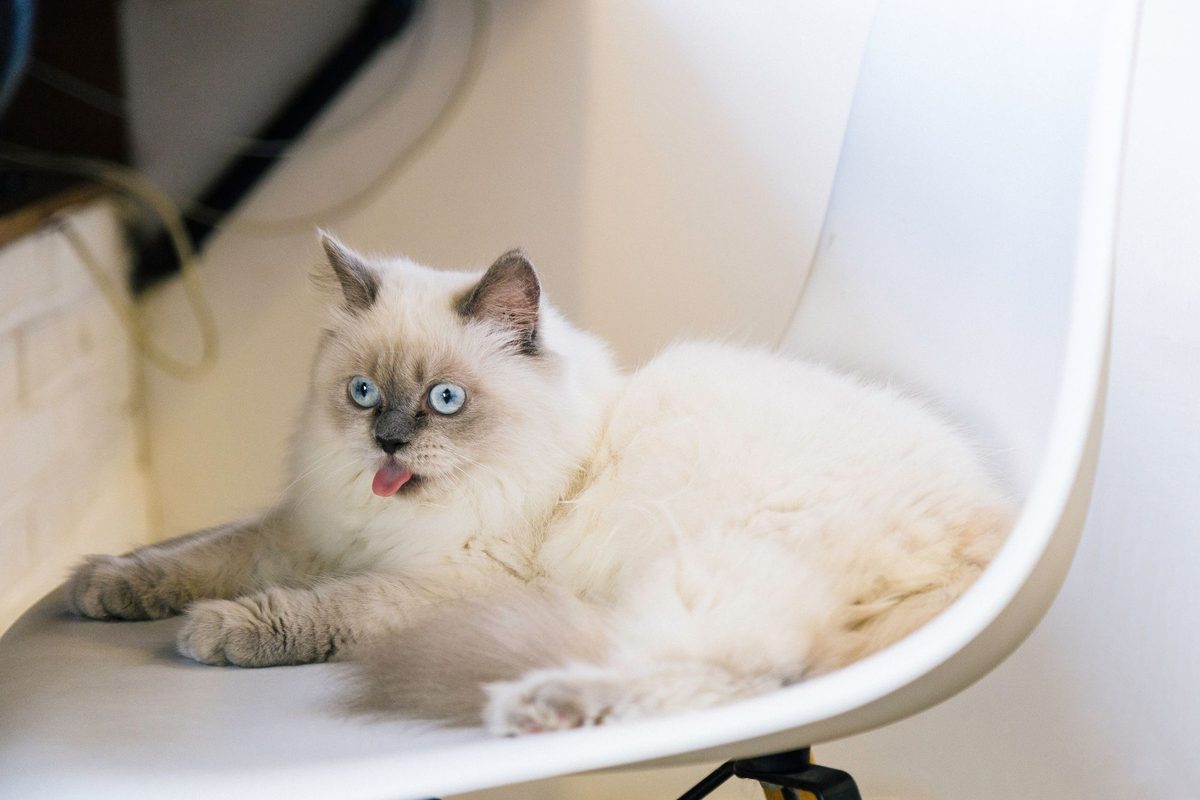
Cat slang is internet shorthand for everyday cat behavior. A blep is a tongue tip left poking out, a mlem is a quick lick, a loaf is a cat sitting with paws and tail tucked under, and zoomies are sudden bursts of running. Making biscuits means kneading, a bonk is a head bump, a sploot is lying flat with the hind legs stretched back, and a chonk is a chubby cat.
The cat slang dictionary
Dates are the earliest uses Dictionary.com's slang editors found, so some words may be older.
| Word | What it means | The behavior science |
|---|---|---|
| Blep | A tongue tip left out, as if by accident. A subreddit by that name existed from 2014.1 | Relaxed muscles, or the flehmen response, dental disease or respiratory infection.2 |
| Mlem | A lick, usually a quick, intentional one of the nose or mouth.1 Earliest use found: February 2015.3 | House cats lap water about four times a second.4 |
| Loaf | Sitting with all four paws and the tail tucked under. | A relaxed position that keeps the feet warm.5 |
| Zoomies | A sudden burst of hyperactivity, said of pets since at least the early 2000s.6 | Formally FRAPs, possibly rooted in predatory instinct.67 |
| Making biscuits | Kneading: pressing the front paws in and out on something soft. | Starts with nursing kittens, and may leave scent from glands in the paws.8 |
| Bonk | A head bump against a person or an object. | Called bunting. It leaves scent from glands on the cheeks, forehead and chin.9 |
| Slow blink | A series of half-blinks ending in narrowed or closed eyes. | Cats narrowed their eyes more after owners slow blinked at them.10 |
| Sploot | Belly down, hind legs stretched flat behind. Said of pets since at least 2012.11 | A full-body stretch, or a way to cool off on cold tile.12 |
| If I fits, I sits | Settling into any box, basket or outline a cat can squeeze into. | Hiding boxes eased new shelter cats' stress, and some cats sat in an illusory square.1314 |
| Chonk | An affectionate word for a chunky or slightly overweight animal. Took off in August 2018.15 | A 2022 US survey classified 61% of cats as overweight or having obesity.16 |
Tongue words: blep and mlem
Dictionary.com separates the two by intent: a blep is tongue stuck out "as if inadvertently," and a mlem is a lick, usually an intentional one.1 Blep came first, as the name of a subreddit for pictures of blepping cats from 2014.1 Mlem turns up in February 2015, captioning a video of a cat lapping water on Imgur and Reddit. Some commenters thought it came from Yoshi's licking sound in the Super Mario games.3
Each lap pulls up a column of water. Researchers at MIT showed in Science that the cat curls its tongue tip back so only the top surface touches the water, pulls up fast, and closes its mouth on the top of the column. Big cats, with larger tongues, lap more slowly than house cats.4
The tongue also grooms. A 2018 study of six species, from house cats to lions, found U-shaped hollows at the tips of the tongue's spines, called papillae, that wick saliva onto the fur. Cats spend up to a quarter of their waking hours grooming.17
A blep can be simple relaxation: when a cat's muscles loosen, so can its tongue. Other causes include dental disease, respiratory infection and the flehmen response, which helps cats sample scents through the vomeronasal (Jacobson's) organ. Hill's says drooling with the tongue out can be harmless right after a meal; otherwise, call a veterinarian right away.2 A cat breathing with difficulty or with an open mouth needs a veterinarian right away.18
Body shapes: loaf, sploot and chonk
Cats in a loaf are relaxed, veterinary behaviorist Bonnie Beaver told PetMD, and tucking protects the feet and lower legs, which have little fat covering, from cold. A loafing cat can also move more quickly than one lying on its side. A face-down or hunched loaf may mean a cat is very tired or unwell, and a sudden increase in loafing may signal fever or illness.5
A sploot is the flat version, with the hind legs stretched straight back. The word is most associated with corgis, and lexicographer Grant Barrett has suggested it may play on "splat." Variants include the half sploot and the reverse sploot, done lying on the back.11 Cats sploot too, and sudden splooting in a senior pet may be a sign of osteoarthritis.12
Chonky took off in August 2018. The CHONK chart, a joke cat body-fat chart, ran from "A Fine Boi" to "A Heckin' Chonker" to "OH LAWD HE COMIN."15 In the Association for Pet Obesity Prevention's 2022 US survey, veterinary professionals scored cats on a 1 to 9 body condition scale and rated 28% as overweight and 33% as having obesity. Yet 28% of cat owners called their cat's body condition "normal" when it had been scored 6 to 9.16
Quick quiz: how well do you know cat behavior?
According to the Feline Grimace Scale, at what score is rescue analgesia (pain medication) typically needed?
Answer: 4 or above. A Feline Grimace Scale score of 4 or higher indicates the cat is in pain and requires pain relief intervention. This threshold was established during the scale's development and validation. Source
According to veterinary behaviorists, what circumstance most commonly sparks territorial aggression between cats?
Answer: Bringing a new cat into the household. Established cats often perceive a newcomer as a threat to their territory and resources, which is why introducing a new cat is the most frequently cited trigger of aggression in multi-cat homes. Source
According to veterinary research, what characterizes the first stage of feline grief after a companion cat dies?
Answer: Increased vocalization, pacing, and searching throughout the house. The first stage of feline grief is relatively short, characterized by increased vocalization, pacing, and searching. Cats may look out windows or sniff while moving through the house, apparently attempting to find the missing companion. Source
Biscuits, bonks and slow blinks
Making biscuits is kneading. Kittens knead their mother's mammary glands to stimulate milk flow, kneading may also activate scent glands in the paws, and adult cats may direct the kitten behavior at their owners. As veterinarian Susan Nelson told Scientific American, "Some of these are just theories because we don't know."8 Why cats knead covers sharp claws and when to ask a vet.
A bonk is bunting. Glands on a cat's cheeks, forehead and chin contain pheromones, so a head bump leaves scent on you. Cats in a group that bunt one another build a shared colony scent.9 Head pressing, a long push of the head against a wall or object, is different and could point to a serious neurologic condition.9 More is in why cats headbutt you.
Cats narrowed their eyes more often after their owners slow blinked at them than when the owners were present but did not interact, in a 2020 study of 21 cats from 14 households. In a second experiment, cats were more likely to approach an unfamiliar researcher after a slow blink than after a neutral face.10 The authors wrote that slow blinks "may function as a form of positive emotional communication between cats and humans," and may have begun as a way to interrupt an unbroken, potentially threatening stare.10
In a follow-up with 18 shelter cats, those that closed their eyes more often and for longer in response to human slow blinks were rehomed faster. Cats identified as needing desensitization to people tended to spend more time slow blinking back.19 Stares have their own page: why your cat stares at you.
Zoomies and if I fits, I sits
Zoomies have a formal name: frenetic random activity periods, or FRAPs.6 Veterinary behaviorist Alison Gerken told PetMD they "may originate from cats' natural predatory instincts," with sprints and sharp turns that look like hunting, and that young cats, especially kittens, tend to have frequent and intense ones. They often come in the early morning or evening, when cats are most active.7
If a cat's zoomies change suddenly, it may signal hyperthyroidism or mobility problems and is worth mentioning to a vet.7 Hyperthyroidism mostly affects middle-aged and older cats. The Cornell Feline Health Center lists weight loss, increased appetite and increased thirst and urination as its most common signs, and it can also cause hyperactivity.20
Newly arrived shelter cats given a hiding box settled faster in a 2014 Dutch shelter trial. Among the 19 cats, those with a box had lower stress scores on days 3 and 4. Both groups reached the same level, the box group around day 3 and the others by day 14.13
A later citizen science study, titled after the meme, tested whether cats sit in illusory squares. Owners taped shapes to the floor, including a Kanizsa square: four Pac-Man-like cut-outs that suggest a square. Of 500 cats signed up, 30 completed all the trials. Nine sat inside a shape at least once, 16 times in total: eight in a real square, seven in the illusory one and once in the control shape.14 The authors suggest cats treat the illusion much like a real square, but with 30 finishers and lighting that may have varied between homes, it is a first look.14
Frequently asked questions
What is DoggoLingo?
It is the internet dialect behind blep, mlem, sploot and chonky. Dictionary.com describes it as slang that celebrates dogs, cats and other animals through playful misspellings and onomatopoeia, so mlem is spelled like a sound.3
How do I slow blink at my cat?
Karen McComb, who co-supervised the 2020 study, suggests narrowing your eyes as in a relaxed smile, closing them for a couple of seconds, then watching whether the cat narrows its eyes back.21
Why do some cats get the zoomies after using the litter box?
Veterinary behaviorist Elizabeth Stelow of UC Davis suggests that defecating stimulates the vagus nerve, which can bring a feeling of relief. Depending on the cat's personality, that can turn into excitement and a sprint. She notes dogs do the same.7
Up next
Christopher writes and runs Cat Trivia Games. The sources for this article are listed below, and how the site is made and corrected is on the editorial policy page. More about the author.
References
- Dictionary.com (2019). Blep. back
- O'Brien, C., Hill's Pet Nutrition (2022). Why do cats stick their tongue out? back
- Dictionary.com. Mlem. back
- MIT Technology Review (2011). The physics of how cats drink (on Reis, Jung, Aristoff and Stocker, Science, 2010). back
- Willoby, S., reviewed by Cornett, J., DVM, PetMD (2025). Why do cats loaf? back
- Dictionary.com. Zoomies. back
- Willoby, S., reviewed by Hart, H., DVM, PetMD (2026). Why do cats get the zoomies? back
- Bartels, M., Scientific American (2023). Why do cats knead like they're making biscuits? back
- Hovis, S., DVM, PetMD (2025). Why does my cat headbutt me? back
- Humphrey, T., Proops, L., Forman, J., Spooner, R. and McComb, K., Scientific Reports (2020). The role of cat eye narrowing movements in cat-human communication. back
- Dictionary.com. Sploot. back
- VCA Animal Hospitals. What is a sploot, and why does my pet do it? back
- Vinke, C., Godijn, L. M. and van der Leij, R., Applied Animal Behaviour Science (2014). Will a hiding box provide stress reduction for shelter cats? back
- British Psychological Society Research Digest (2021). Cats like to sit in squares (on Smith, Chouinard and Byosiere, Applied Animal Behaviour Science). back
- Dictionary.com. Chonky. back
- Association for Pet Obesity Prevention. 2022 pet obesity U.S. prevalence survey. back
- Noel, A. and Hu, D., Proceedings of the National Academy of Sciences (2018). Cats use hollow papillae to wick saliva into fur. back
- Cornell Feline Health Center. Dyspnea (difficulty breathing). back
- Humphrey, T., Stringer, F., Proops, L. and McComb, K., Animals (2020). Slow blink eye closure in shelter cats is related to quicker adoption. back
- Cornell Feline Health Center. Hyperthyroidism in cats. back
- University of Sussex, via ScienceDaily (2020). Feline friendly? How to build rap-paw with your cat. back
Written by Christopher Fox under our editorial policy.