 Cat Trivia Games
iOS App
Why Do Cats Like Christmas Trees?
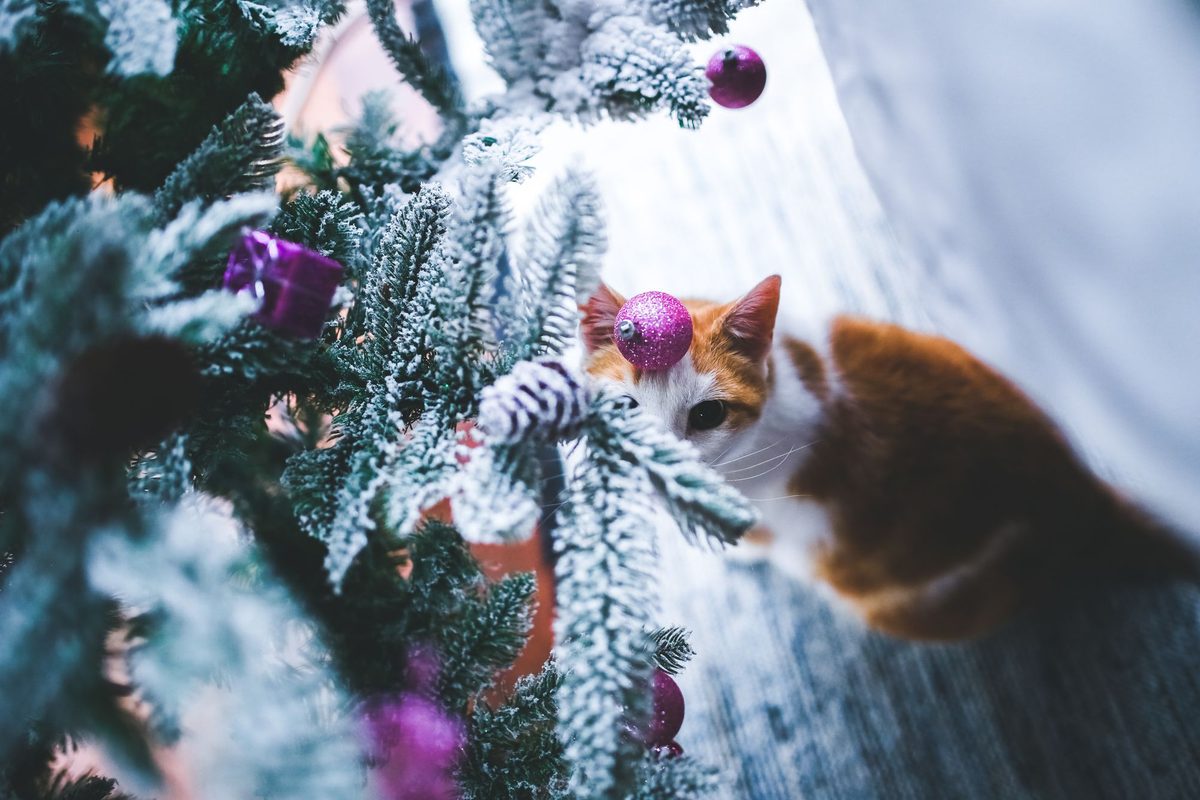
Cats like Christmas trees because a tree offers three things many cats seek out: height, movement and novelty. It is a tall perch in the middle of the room, hung with ornaments and tinsel that swing and catch the light, and motion grabs a cat's attention more than color does. It is also a new object, so it gets climbed, batted and sniffed.
A tree is a tall perch
Many cats seek high resting places, where they can relax and still keep an eye out for possible threats.1 A cat may also feel safer sleeping up high, where no other animal or person can sneak up on it.2
A Christmas tree is shaped much like a homemade cat tree: wood covered in carpet, fabric or sisal, with climbing perches.3 It has a trunk, branches at several heights and space underneath, and cats love to climb and hide.4
Ornaments and tinsel move like prey
To a cat, hanging ornaments may look like something to hunt. Even well-fed cats stalk potential prey, and almost anything that moves rapidly or squeaks in a high pitch can set off the response.1 Toys that swing, jitter or vibrate remind cats of moving meals,5 and an ornament on a springy branch keeps swinging after a swat.
A decorated tree is covered in objects suspended in air, which count as bird-type toys when cat toys are sorted by the prey they imitate.6 Outdoors, cats without access to prey will often play with fallen leaves or grass blowing in the wind.4
Tinsel gets extra attention because it is sparkly, catches the light, and is easy to bat around and carry in the mouth.7
Play that imitates a hunt can even cut the prey a cat brings home. In a 12-week University of Exeter trial with 355 cats in 219 households, owners moved a feather toy on a wand for their cats to stalk, chase and pounce on, then gave them a toy mouse to mimic a kill. Five to ten minutes of this a day led to a 25% drop in the animals the cats captured and brought home.89 More from that trial is in why cats bring home dead animals.
Lights: motion counts more than color
The red and green of a traditional tree may be lost on a cat. Cats have two types of cones and identify yellows and blues, and veterinary ophthalmologist Paul Miller told PetMD that they have a difficult time telling red from green.10 Red and green toys may look like similar shades of gray. Color matters less to cats anyway, Miller says, because motion is what grabs their attention.10
In dim light, cats see about six times better than people.11 In daylight, Miller says, people are 10 to 12 times better at detecting motion, but after sundown cats have the upper hand.10 A tree lit up in a dim room plays to a cat's strengths. Can cats see in the dark? explains how.
Quick quiz: how well do you know cat behavior?
A cat's coat that becomes matted or tangled due to lack of grooming can develop which condition?
Answer: Skin infections from trapped moisture and reduced air circulation. Matted fur traps moisture against the skin and prevents air circulation, creating ideal conditions for bacterial and fungal growth. This is why regular grooming is essential for skin health. It prevents mats that can lead to skin infections, dermatitis, and other complications. When cats neglect grooming due to illness or pain, their skin health can deteriorate quickly. Source
A hiss is best described as which kind of cat sound?
Answer: A defensive warning made when a cat feels cornered or scared. Hissing is a defensive reaction, produced by rapidly expelling air through the mouth, that signals a cat feels threatened or cornered. Source
A trainer working with a cat on multiple training goals during a single session should use which approach for delivering rewards to best maintain the cat's engagement?
Answer: Vary the reward type by alternating treats, play, and praise throughout. Behavioral research on habituation shows that cats' responsiveness to a single reward type diminishes with repetition within a session. Alternating between different reward types (high-value treats, interactive play, verbal praise, or affection) prevents habituation and maintains the reinforcing power of each reward, keeping motivation stable across training. Source
Something new to sniff and investigate
A tree is also new, and novelty holds a cat's interest: rotating toys often keeps them novel1 and makes old ones seem new and exciting.5 A Christmas tree brings a whole set of objects the cat has not seen for a year, or ever.
Smell is part of the inspection, and a cat's sense of smell is much stronger than a person's.11 A real tree is also a plant, and cats may chew on plants as part of normal investigation and play.3
Novelty does not suit every cat. New "furniture" such as holiday decorations and a Christmas tree may be a source of stress.12
What draws a cat to each part of the tree
| Part of the tree | What a cat may do | The instinct behind it |
|---|---|---|
| Height and branches | Climb, perch near the top | High resting places let a cat watch for threats1 |
| Hanging ornaments | Bat, swat, knock them off | Toys that swing remind cats of moving meals5 |
| Tinsel | Bat it, carry it in the mouth | Sparkly, light-catching and easy to bat around7 |
| Blinking lights | Watch, sometimes paw | Motion grabs a cat's attention more than color10 |
| Red and green | Probably little on their own | Cats have trouble telling red from green10 |
| Needles of a real tree | Sniff, chew | Chewing plants can be normal investigation and play3 |
| Space under the branches | Hide, nap | Cats love to climb and hide4 |
| The whole tree, new overnight | Investigate, or keep away | Novelty holds interest, but a new tree can also cause stress112 |
True or false: cats and Christmas trees
Make a guess, then tap a claim for the verdict and its source.
A well-fed cat will leave the ornaments alone.
FalseA cat's desire to hunt is not connected to hunger. Even well-fed cats stalk when they see or hear potential prey.1
Red and green ornaments look as different to a cat as they do to you.
FalseCats are red-green color blind: the two are difficult for them to tell apart.10
Cats notice movement better than people do.
Not that simpleIn daylight, people are 10 to 12 times better at detecting motion. After sundown, cats have the upper hand.10
A cat that knocks ornaments off the tree is getting back at you.
FalseThe idea that cats are "out for revenge" is a common misconception, according to Cornell's Feline Health Center. Destroying household items is usually part of normal investigation and play.3
Cats chew on plants only when they feel sick.
FalsePlant chewing can be part of normal investigation and play, or a craving for vegetable matter. Houseplant chewers are usually indoor cats with little access to grass or other greens.3
Cats are drawn to the smell of pine.
Not that simpleTheir sense of smell is much stronger than ours,11 but I could not find a study that tested how cats respond to the scent of pine or fir. Treat this one as unproven.
For tree, tinsel and ornament hazards, see the ASPCA's holiday safety tips. Cats up the Christmas tree are also the theme of the December 23 door in the cat trivia advent calendar.
Frequently asked questions
Are young cats more drawn to the tree than older ones?
I could not find a study of cats and trees by age. Play drive does change: older cats enjoy playing three or four times a day, while younger cats are happy with 10 times a day or more.4
Would my cat rather play with the ornaments or with me?
Possibly you. Offered human social interaction, food, toys and scent in a 2017 Oregon State University study, most of the pet and shelter cats preferred social interaction, followed by food, though individual cats varied.13
Up next
Christopher writes and runs Cat Trivia Games. The sources for this article are listed below, and how the site is made and corrected is on the editorial policy page. More about the author.
References
- VCA Animal Hospitals, Ellen Lindell, Monique Feyrecilde, Debra Horwitz and Gary Landsberg. Cat behavior and training: enrichment for indoor cats. back
- The Ohio State University, Indoor Pet Initiative. Perches. back
- Cornell Feline Health Center. Feline behavior problems: destructive behavior. back
- Cats Protection. Cats and play. back
- The Ohio State University, Indoor Pet Initiative. Toys. back
- The Ohio State University, Indoor Pet Initiative. Identifying prey preference. back
- ASPCA. Holiday safety tips. back
- University of Exeter (2021). Play and meaty food reduce hunting by cats. back
- Cecchetti, M., Crowley, S. L., Goodwin, C. E. D. and McDonald, R. A. (2021). Provision of high meat content food and object play reduce predation of wild animals by domestic cats Felis catus. Current Biology 31, 1107-1111. back
- PetMD, with veterinary ophthalmologist Paul Miller. How do cats see the world? What to know about cat vision. back
- Merck Veterinary Manual. Physical description of cats. back
- The Ohio State University, Indoor Pet Initiative. Events in and around the house. back
- Vitale Shreve, K. R., Mehrkam, L. R. and Udell, M. A. R. (2017). Social interaction, food, scent or toys? A formal assessment of domestic pet and shelter cat (Felis silvestris catus) preferences. Behavioural Processes 141, 322-328. back
Written by Christopher Fox under our editorial policy.