 Cat Trivia Games
iOS App
Are Cats Adopted at Christmas Returned More Often?
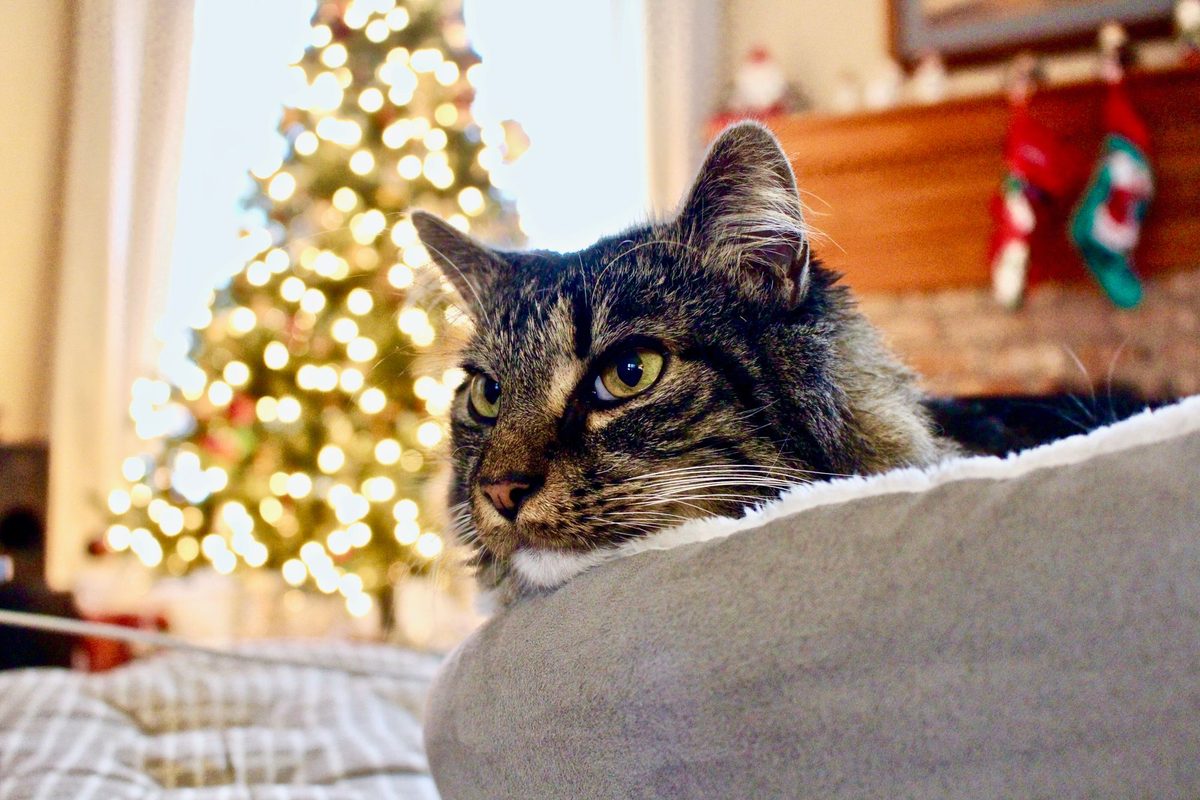
No. Cats adopted in December were not brought back more often than cats adopted in other months. I followed 152,477 cat adoptions at 10 US animal shelters. Of the 14,098 cats adopted in December, 3.77% came back to the same shelter within 90 days. Of the 138,379 adopted in the other 11 months, 3.84% did.
Key findings
- Within 90 days, 3.77% of December cat adoptions came back, against 3.84% in other months. With each shelter's own rate held equal, the odds ratio is 0.99, where 1.00 would mean no difference at all (95% confidence interval 0.90 to 1.08).
- The answer is the same at 30 days (2.95% against 3.06%) and at 180 days (4.33% against 4.44%).
- December's return rate ranks 7th of the 12 months. March is highest, at 5.57%. Fewer kittens are adopted in March, and adult cats come back more often than kittens.
- December is a little busier than an average month. At 12 shelters it holds 9.55% of a year's cat adoptions, a little above the 8.5% an even spread would give. July (11.96%) and August (11.81%) are bigger.
- Only one of 11 datasets, Dallas, shows a December gap bigger than chance usually makes (5.22% against 4.33%). Among 11 datasets, one result like that is expected now and then.
Jump to: By month, Every shelter, What counts, December adoptions, Research, Shelter policies, Method, Use this data
December next to the other months
December lands in the middle. Its 90-day return rate is 7th highest of the 12 months. The likely range for December, with 95% confidence, is 3.47% to 4.10%, and for all other months together it is 3.74% to 3.94%. The two ranges overlap, and a standard test finds no real difference (p = 0.69).
Every shelter's numbers
Each of these shelters publishes its records as open data, and an animal keeps its ID when it comes back, so a return shows up in the file.1234567891011 Austin changed record systems in May 2025, and its new IDs do not match the old ones, so Austin has two rows.
| Shelter | December | Other months | December adoptions | December returns | Other-month adoptions | Other-month returns |
|---|---|---|---|---|---|---|
| Austin, TX (to May 2025) | 2.98% | 3.60% | 3,561 | 106 | 31,185 | 1,123 |
| Austin, TX (from May 2025) | 4.51% | 3.12% | 355 | 16 | 4,652 | 145 |
| Broward County, FL | 2.79% | 3.38% | 1,183 | 33 | 11,868 | 401 |
| Dallas, TX | 5.22% | 4.33% | 3,142 | 164 | 33,126 | 1,434 |
| Long Beach, CA | 0.97% | 1.99% | 719 | 7 | 6,130 | 122 |
| Los Angeles County, CA | 4.15% | 3.95% | 1,470 | 61 | 17,186 | 679 |
| Louisville, KY | 3.33% | 3.79% | 480 | 16 | 5,284 | 200 |
| Montgomery County, MD | 4.78% | 5.26% | 984 | 47 | 9,108 | 479 |
| Norfolk, VA | 3.69% | 3.57% | 1,110 | 41 | 10,510 | 375 |
| Sacramento, CA | 4.02% | 3.72% | 647 | 26 | 5,105 | 190 |
| Sonoma County, CA | 3.36% | 3.98% | 447 | 15 | 4,225 | 168 |
| All 10 shelters | 3.77% | 3.84% | 14,098 | 532 | 138,379 | 5,316 |
Six of the 11 rows show a lower December rate and five show a higher one. Only the Dallas gap passes the usual test for chance (p = 0.02). When you test 11 datasets, one result like that can turn up by luck alone, so I do not read it as a December effect. The biggest gaps sit on small numbers: the new Austin system has had only one December, with 16 returns, and Long Beach's December figure rests on 7 returns.
The same pattern holds over a shorter and a longer window.
| Shelter | 30 days, December | 30 days, other months | 180 days, December | 180 days, other months |
|---|---|---|---|---|
| Austin, TX (to May 2025) | 2.22% | 3.00% | 3.38% | 4.19% |
| Austin, TX (from May 2025) | 4.51% | 2.88% | 4.51% | 3.30% |
| Broward County, FL | 2.37% | 2.85% | 3.21% | 3.67% |
| Dallas, TX | 3.76% | 3.10% | 5.98% | 5.29% |
| Long Beach, CA | 0.83% | 1.67% | 0.97% | 2.24% |
| Los Angeles County, CA | 3.67% | 3.40% | 4.76% | 4.26% |
| Louisville, KY | 2.71% | 3.62% | 3.54% | 3.91% |
| Montgomery County, MD | 3.86% | 4.03% | 5.49% | 6.07% |
| Norfolk, VA | 2.79% | 2.30% | 4.87% | 4.48% |
| Sacramento, CA | 2.94% | 3.25% | 4.02% | 3.75% |
| Sonoma County, CA | 3.13% | 3.22% | 3.80% | 4.36% |
| All 10 shelters | 2.95% | 3.06% | 4.33% | 4.44% |
What counts as a return
A return here is the same cat, under the same animal ID, taken back in at the same shelter as an owner surrender or as a returned adoption, 0 to 90 days after the adoption date (or 0 to 30, or 0 to 180). If an adopted cat was picked up as a stray instead, it is left out of the main numbers. Counting every kind of re-entry gives the same picture: 4.12% for December and 4.18% for other months at 90 days.
Returns somewhere else are invisible. A cat passed on to a friend, taken to a different shelter, or brought back under a new ID does not show up. So every rate on this page is a floor, the lowest the true number could be. That gap affects every month alike, so the December comparison stays fair.
This page is about cats. I did not count dogs or puppies, so it says nothing about them.
Do shelters adopt out more cats in December?
A little. At 12 shelters with full calendar years of adoptions, December holds 9.55% of the year's cat adoptions. If adoptions were spread evenly, a 31-day month would hold about 8.5%. November is almost the same, at 9.56%. The real peak is kitten season: July holds 11.96% and August 11.81%. Riverside County and Corona join this table. Their files show adoptions, but Corona's lists adoptions only and Riverside County's covers just one year, too short to follow returns.1213
| Shelter | December share | Years | Adoptions | Lowest year | Highest year |
|---|---|---|---|---|---|
| Austin, TX | 9.8% | 2014 to 2024 | 33,975 | 8.5% | 13.8% |
| Broward County, FL | 8.5% | 2022 to 2025 | 11,148 | 6.6% | 9.9% |
| Corona, CA | 8.9% | 2017 to 2024 | 3,919 | 4.7% | 14.2% |
| Dallas, TX | 9.1% | 2006 to 2025 | 34,398 | 6.4% | 13.5% |
| Long Beach, CA | 11.4% | 2017 to 2025 | 6,309 | 8.0% | 17.9% |
| Los Angeles County, CA | 8.8% | 2020 to 2025 | 16,640 | 6.6% | 12.3% |
| Louisville, KY | 9.5% | 2022 to 2025 | 5,066 | 8.3% | 11.2% |
| Montgomery County, MD | 11.0% | 2017 to 2025 | 8,938 | 9.1% | 11.9% |
| Norfolk, VA | 9.6% | 2015 to 2025 | 11,620 | 5.8% | 14.2% |
| Riverside County, CA | 8.1% | 2024 | 3,117 | 8.1% | 8.1% |
| Sacramento, CA | 11.9% | 2023 to 2025 | 5,435 | 7.5% | 15.8% |
| Sonoma County, CA | 9.8% | 2014 to 2025 | 4,544 | 3.5% | 25.5% |
| All 12 shelters | 9.55% | 145,109 |
The share swings from year to year. One small Sonoma County year reached 25.5%, and Riverside County has only one full year in its file.
December adopters also take home about the same mix of cats. At the 6 shelters that record age, 71.4% of cats adopted in December were kittens under 1 year old, against 70.5% from February to October and 69.2% in November and January. That December gap passes a test for chance (p = 0.03), but it is about one point. Norfolk goes the other way, with 59.7% kittens in December against 66.4% from February to October. Shelters even name cats for the season, as my count of Christmas cat names shows.
Kittens, adults and the month that stands out
Who is adopted matters more than when. In the months other than December, adult cats came back within 90 days at 5.96% and kittens at 2.65%, so adults came back more than twice as often. March has the highest return rate of any month, and it is also the month with the fewest kittens: 46.1% of March adoptions at the shelters that record age were kittens, against 80.2% in July.
Split by age, December still looks no worse. Kittens adopted in December came back at 2.26%, against 2.65% in other months, and adults at 5.47%, against 5.96%. When I hold both the shelter and kitten-or-adult equal, the odds ratio is 0.880 (95% confidence interval 0.773 to 1.001, p = 0.06). That leans slightly toward fewer December returns, but it is too small to call.
What earlier research found
A study of pet gifts asked a different question and reached the same answer. In 2013, researchers at the ASPCA studied a national phone survey of 1,006 US adults, taken July 18 to 21. Of them, 222 had received a dog or cat as a gift in about the past 10 years. Of 218 who answered, 126 (57.8%) said the gift made them love the pet more, and 6 said less. Of 215, 169 (78.6%) still had the pet; 25 pets had died and 21 had been rehomed. Whether the gift was a surprise made no difference (p = 0.59). The authors wrote that this supports "the notion that pets given as gifts are not at higher risk for abandonment."15 They also point to a 1999 shelter study in which "unwanted gift" was the reason given for only 0.4% of cats taken to the shelters surveyed.15
The survey covered gifts of dogs and cats at any time of year, and it relied on what people remembered. My records cover cats only and show real returns by month, but they cannot tell which December adoptions were gifts. Both point the same way.
The question comes back every December. In a 2019 FOX story on holiday returns, Amy Nichols of the Humane Society of the United States said: "We are unaware of any data to support the assertion that pets adopted during the holiday season are returned to shelters at a higher rate." She added that people should think carefully about caring for a pet, wherever it comes from. The same story reported that some local shelters see more surrenders after the holidays, and that Los Angeles County's care centers had not seen a holiday trend.16 The Los Angeles County records here agree: 4.15% of December adoptions came back within 90 days, against 3.95% in other months, a gap that chance explains easily (p = 0.71).6
Holiday adoptions and Christmas pauses
Animal groups still disagree. The ASPCA supports pets as gifts, but only for people who have shown "a sustained interest in owning one, and the ability to care for it responsibly." It adds that the new owner needs time for the pet to settle in, which "is especially important during the holidays and other busy times."17 Its page for shelter staff says worries about a high rate of return are unfounded.18
Some shelters still stop for Christmas. In December 2025, the Tierschutzverein für Berlin, which runs Tierheim Berlin in Germany, said December 20 was the shelter's last advice day before the holidays. Only adoptions that were already settled would go ahead, there would be no new or spontaneous adoptions, and adoptions would start again on January 6. Its appeal named cats along with dogs and other pets. Its stated aim was to keep animals from being given away on a Christmas whim.19
My data cannot judge either policy. Holiday events, gift programs and adoption screening may all change who adopts in December. What the records show is the result at 10 US shelters, most with many Decembers on file: no extra returns. For a family thinking about a cat this Christmas, the ASPCA's advice above is the practical part. The person who will care for the cat should want one, and the first weeks at home should be calm enough for the cat to settle.17
What this data cannot show
- Gifts. The records show the adoption month, not why someone adopted. I cannot tell which December cats were gifts.
- Returns elsewhere. Cats rehomed privately, taken to another shelter or brought back under a new ID are missing, so all rates are floors.
- Cats from other places. A kitten bought from a breeder or a pet store, or given by a friend, is not in these files. Surrenders after the holidays can include those cats, and this test does not.
- Small Decembers. The new Austin system has one December (355 adoptions), and Long Beach's December result rests on 7 returns.
- Record errors. 49 adoptions were followed by a later record dated before the adoption. I did not count those as returns.
- Which shelters. These are 10 US shelters that publish open data. They are not a sample of every shelter in the country.
Use this data
Reporters, bloggers and teachers may quote these numbers and chart them, with a link to this page. That is the only condition. Every shelter's return rates at 30, 90 and 180 days, with adoption counts, dates and source links, are in one file: cats-as-christmas-gifts-2026.csv.
Cats adopted in December were returned no more often than cats adopted in other months: 3.77% against 3.84% within 90 days, in a count of 152,477 adoptions at 10 US shelters by Cat Trivia Games.
Source: Are Cats Adopted at Christmas Returned More Often?, cattriviagames.com
How I counted
- The records. On November 19, 2026, I combined public shelter records from 16 open datasets into one table of 539,395 cat stays. This page uses the 11 datasets, from 10 shelters, where an animal's ID repeats from one stay to the next, so a return can be seen. Los Angeles County's file covers its seven care centers and counts as one shelter. The same kind of open records is behind my count of the most popular cat names.
- Adoption. Any outcome the shelter records as an adoption, including offsite adoptions, foster-to-adopt in Long Beach and adoption events in Riverside County. Austin's "Rto-Adopt" counts as a return to owner, not an adoption.
- Return. The cat's next stay at the same shelter, under the same ID, starts 0 to 30, 90 or 180 calendar days after the adoption and is recorded as an owner surrender or a returned adoption.
- Follow-up. An adoption counts toward a window only if that shelter's records run at least that many days past the adoption date. The 90-day counts cover adoptions from March 29, 2005 to August 20, 2026.
- Kitten or adult. Age at intake plus days in the shelter, under 365 days for a kitten. Dallas, Louisville, Sacramento and Los Angeles County give no usable age, so the age figures come from the other 6 shelters. The monthly kitten shares for March (46.1%) and July (80.2%) are my own count from the combined table with the same rule.
- The test. The odds ratio compares December with the other months inside each shelter and then combines the shelters (a Mantel-Haenszel odds ratio), so one large shelter cannot tilt the result. The p values for single shelters come from a two-proportion test.
- December share. Adoptions in complete calendar years only, at the 10 shelters above plus Riverside County and Corona.1213
- Credit. Long Beach data: City of Long Beach Animal Care Services, Animal Shelter Data, licensed under CC BY 4.0, changed here by counting adoptions and returns.14 Austin data: City of Austin, Texas. Other data: the cities and counties named in the references. None of them reviewed or endorsed this page.
Think you can guess numbers like these? Play Cat Higher or Lower, a ten question game built from this site's own counts. Every data file is on the open data page.
Frequently asked questions
How soon do returned cats come back?
Fast. Among cats brought back within 180 days, the median return came 12 days after adoption, for December adoptions and for the rest alike.
Does this apply to puppies and dogs?
This page cannot answer that. I counted cats only. The 2013 survey covered dogs and cats together, but my return counts say nothing about dogs adopted at Christmas.15
Why are the return rates so low?
Partly because they are floors: a cat that went to a friend or to another shelter does not show up. Shelters also differ. For adoptions outside December, the 90-day rate runs from 1.99% at one shelter to 5.26% at another.
Test your cat knowledge
You have seen the shelter numbers. Now see how much you know about the cats. Cat Trivia is free to play, with no account.
Play Cat TriviaUp next
 Cat FactsMost Popular Cat Names 2026: Data From 4 Cities and a CountyLuna leads in every city, counted from license and shelter records.
 Cat FactsChristmas Cat Names, Counted: What Real Cats Are CalledThe holiday names real cats have, and the sets shelters give in December.
 Cat FactsKitten Age Chart: How to Tell a Kitten's Age Week by WeekHow to tell a kitten's age, week by week.
 Cat FactsChristmas Cat Trivia: Questions and Answers28 holiday questions and answers to print or play.

Christopher writes and runs Cat Trivia Games. The datasets and studies behind this page are listed below, and how the site is made and corrected is on the editorial policy page. More about the author.
References
- City of Austin, Texas, data.austintexas.gov, public domain, read November 19, 2026. Austin Animal Center Intakes (10/01/2013 to 05/05/2025) and Austin Animal Center Outcomes (10/01/2013 to 05/05/2025). back
- City of Austin, Texas, data.austintexas.gov, no license stated on the dataset, read November 19, 2026. Austin Animal Center Intakes and Austin Animal Center Outcomes. back
- Broward County, Florida, Animal Care and Adoption, ArcGIS Online, Broward County Terms of Use, read November 19, 2026. Animal_Care_Intake_and_Outcome_Data. back
- City of Dallas, Dallas Animal Services, www.dallasopendata.com, no license stated on the dataset, read November 19, 2026. Dallas Animal Shelter Data Fiscal Year 2000 - Present and Dallas Animal Shelter Data FY 2023 - 2026. back
- City of Long Beach Animal Care Services, data.longbeach.gov, CC BY 4.0, read November 19, 2026. Animal Shelter Data. back
- County of Los Angeles, Department of Animal Care and Control, ArcGIS Online, no license stated, read November 19, 2026. Animal Care PawStats Data. back
- Louisville Metro Animal Services, LOJIC open data, Open Data Platform Terms and Use, read November 19, 2026. Louisville Metro KY - Animal Service Intake and Outcome. back
- Montgomery County, MD, Office of Animal Services, dataMontgomery, public domain, read November 19, 2026. OAS - Animal Shelter Pathway. back
- City of Norfolk, Virginia, data.norfolk.gov, no license stated on the dataset, read November 19, 2026. Norfolk Animal Care and Adoption Center (NACC). back
- City of Sacramento, ArcGIS Hub, no license stated, read November 19, 2026. Animal Intakes and Outcomes for the Last 3 Years. back
- County of Sonoma, Department of Health Services, data.sonomacounty.ca.gov, no license stated on the dataset, read November 19, 2026. Animal Shelter Intake and Outcome. back
- County of Riverside, Department of Animal Services, data.countyofriverside.us, no license stated on the dataset, read November 19, 2026. Animal Services, Animal Impound Report. back
- City of Corona, Corona Animal Services, CorStat, no license stated on the dataset, read November 19, 2026. CorStat - Animal Adoptions. back
- Creative Commons. Attribution 4.0 International (CC BY 4.0). back
- Weiss, E., Dolan, E. D., Garrison, L., Hong, J., and Slater, M. (2013). Should Dogs and Cats be Given as Gifts? Animals, 3(4), 995 to 1001. doi:10.3390/ani3040995. Read on PubMed Central, November 19, 2026. Full text (PMC4494363). back
- Gabrielle Moreira, FOX TV Digital Team, published on FOX 5 DC, December 30, 2019, updated January 2, 2020, read November 19, 2026. Some shelters report uptick in surrendered animals after the holidays but national orgs say that's not a trend. back
- ASPCA, read November 19, 2026. Position Statement on Pets as Gifts. back
- ASPCApro, read November 19, 2026. Pets as Gifts Can Safely Increase Holiday Adoptions. back
- Tierschutzverein für Berlin, press release (in German), December 11, 2025, read November 19, 2026. Tiere sind kein Weihnachtsgeschenk. back
Written by Christopher Fox under our editorial policy.