 Cat Trivia Games
iOS App
How Many Teeth Do Cats Have?
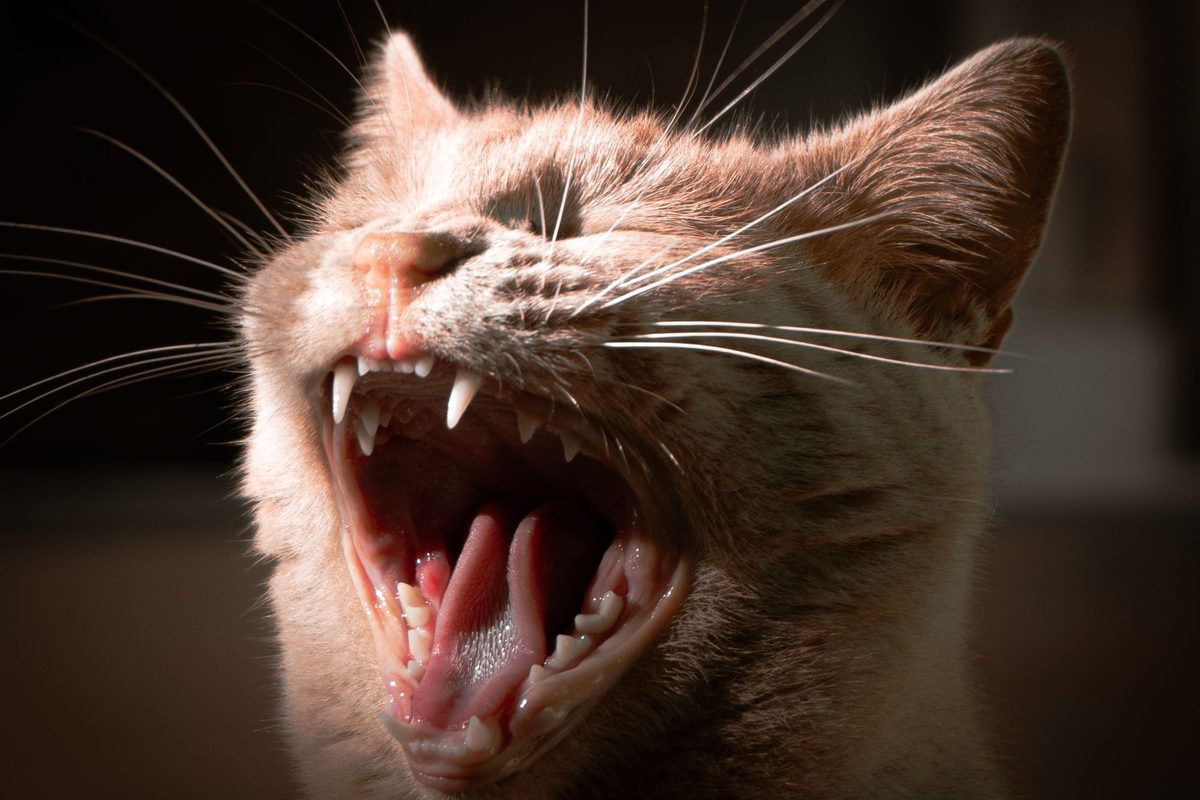
Adult cats have 30 teeth: 12 incisors, 4 canines, 10 premolars and 4 molars. Kittens have 26 baby teeth, the same set without the molars. The first baby teeth come in at about 2 to 4 weeks old, and adult teeth replace them between roughly 3 and 7 months, depending on the source.
The dental formula: 30 adult teeth, 26 baby teeth
A dental formula counts each type of tooth in one upper and one lower quadrant, then doubles it for both sides. A cat's is 2 × (I 3/3, C 1/1, P 3/2, M 1/1) = 30 as an adult and 2 × (i 3/3, c 1/1, p 3/2) = 26 as a kitten.1
| Tooth type | Upper jaw, each side (adult) | Lower jaw, each side (adult) | Adult cat | Kitten |
|---|---|---|---|---|
| Incisors | 3 | 3 | 12 | 12 |
| Canines | 1 | 1 | 4 | 4 |
| Premolars | 3 | 2 | 10 | 10 |
| Molars | 1 | 1 | 4 | None |
| Total | 8 | 7 | 30 | 26 |
Kittens have no molars because molars have no baby versions.2 Each of the 26 baby teeth is replaced by an adult tooth, and the four molars come in as additions.2 Some cats have fewer than 30: the upper second premolar and upper first molar can be absent.1
How vets number cat teeth
Vets commonly number teeth with the modified Triadan system. The hundreds digit is the quadrant, from 100 for the upper right around to 400 for the lower right (500 to 800 for baby teeth), and the last two digits are the position, so a canine is always 04 and a first molar 09.1 Missing teeth are skipped. Cats lost the first premolar during evolutionary history, so there is no 105 or 205, and the tooth behind the upper canine is the second premolar, 106 or 206.1 The lower right premolars are 407 and 408, not 405 and 406.3 Each quadrant has one molar: 109, 209, 309 or 409.1
When kittens get and lose their teeth
Baby teeth come in from front to back over about a month, and adult teeth follow a few months later. Merck's averages, which it says vary considerably:4
| Teeth | Baby tooth comes in | Adult tooth comes in |
|---|---|---|
| Central incisors | 2 to 3 weeks | 4 to 7 months |
| Second and third incisors | 3 to 4 weeks | 4 to 7 months |
| Canines | 3 to 4 weeks | 4 to 7 months |
| Premolars | 5 to 6 weeks | 4 to 7 months |
| First molars | No baby tooth | 4 to 7 months |
Across three veterinary sources, adult teeth replace baby teeth at about 3 to 7 months. The Cornell Feline Health Center says milk teeth start to appear at about four weeks, are all in by about six weeks, and are replaced by permanent teeth by about six months.5 Reiter and Soltero-Rivera of the University of Pennsylvania give 2 to 6 weeks for baby teeth and 3 to 6 months for adult teeth.6
Around five months, kittens quite commonly develop juvenile gingivitis and smelly breath, usually because adult teeth are breaking through and baby teeth are coming out. It usually takes 4 to 6 weeks to settle, and a lost tooth may turn up on the floor.7 Sometimes a baby tooth stays in after its adult replacement has come through, and the adult tooth may then grow at an abnormal angle.7 If you see that, or anything else abnormal, check with your veterinary team.7
Quick quiz: how well do you know cat biology?
Studies showing that even visually deprived kittens can still right themselves point to what as the main trigger for the reflex?
Answer: Signals from the inner ear's vestibular system. Because kittens with no vision can still right themselves, researchers concluded the reflex is driven mainly by the vestibular system detecting head orientation, not by sight. Source
The Bengal cat breed derives from Prionailurus bengalensis, a species known by which common name?
Answer: Asian leopard cat. Prionailurus bengalensis is the scientific name for the Asian leopard cat, the small wild felid whose genetics were combined with domestic cats to create the modern Bengal breed. This species is native to forests and grasslands across southern and eastern Asia. Source
The MC1R gene encodes the melanocortin-1 receptor. When this receptor is activated by alpha-melanocyte-stimulating hormone (alpha-MSH), what is the primary biochemical consequence in the melanin synthesis pathway?
Answer: The cell increases production of eumelanin and decreases pheomelanin synthesis. MC1R activation by alpha-MSH signals melanocytes to shift toward eumelanin (dark pigment) production and away from pheomelanin. Mutations in MC1R can cause a loss of this signaling, resulting in predominantly red coats because pheomelanin becomes the default pigment produced. Source
What each type of tooth does
- Incisors: cutting, picking up food and grooming.6 With the mouth closed, the upper incisors sit in front of the lower ones.3
- Canines: penetrating, grasping and defense.6 Cat canines tend to be long and conical, suited to puncturing with minimal force. Small prey, the kind some cats bring home, are killed with a bite to the base of the skull that severs the spinal cord.8 Each lower canine sits in the gap between the upper third incisor and the upper canine, touching neither. Together with the incisor bite, this forms the dental interlock.3
- Premolars and molars: holding, carrying, breaking and tearing food.6 In the cat family these cheek teeth are specialized for shearing.8
- Carnassials: the upper fourth premolar and the lower first molar.6 In carnivores this pair is an efficient shear for cutting meat and tendon.9 When the mouth closes, the lower molar's outer face meets the upper premolar's inner face.3
Below the gum line, incisors and canines have one root each, the lower third and fourth premolars and the lower first molar have two, and the upper fourth premolar has three.6 Cat teeth are short-crowned (brachydont), while horses and cattle have long-crowned teeth that keep erupting.1
Can cats chew side to side?
A little. In a 1980 study, Gorniak and Gans filmed cats eating raw beef, cooked beef and cooked chicken while recording their jaw muscles' electrical activity. The cats chewed on one side at a time, with sideways as well as front-to-back jaw movement, and closing began with the lower canines shifting horizontally toward the chewing side.10 They shifted food across the mouth with sideways head jerks and tongue movements.10
As in most carnivores, a cat's jaw joint sits in a well-defined, crosswise socket, and its main motion is up and down.9 Cats have a shorter muzzle and tooth row than the dog family, and the shorter build increases bite force.8 The masseter, temporal and pterygoid muscles close a cat's mouth, and the digastric muscles open it.6
Frequently asked questions
Do cats have more teeth than people or dogs?
Fewer adult teeth than either. People usually have 20 baby teeth and 32 permanent teeth.11 Dogs have 28 baby teeth and 42 adult teeth.1 Cats have 26 baby teeth, between the two, and 30 adult teeth. The true or false cat facts page checks the claim that adult cats have 32.
Can a vet tell how old a cat is from its teeth?
Roughly. For cats and dogs, age estimates from teeth are less accurate and rest mostly on eruption times, plus a subjective look at root canal width on dental imaging.4 A living tooth keeps adding dentin on the inside throughout life, so a young cat's permanent teeth have much wider pulp cavities and thinner walls than an old cat's.6 If you know the age, the cat age calculator converts it to human years.
Do wild cats have the same teeth?
Mostly. The typical dental formula for the cat family is 3/3, 1/1, 3/2, 1/1, for 30 teeth. In most species an upper premolar is much reduced, and lynxes have lost it completely.8
Up next

Christopher writes and runs Cat Trivia Games. The sources for this article are listed below, and how the site is made and corrected is on the editorial policy page. More about the author.
References
- Merck Veterinary Manual, by Alexandra Wright, Cornell University (reviewed July 2026). Dentition and dental nomenclature of animals. back
- Merck Veterinary Manual, by Alexandra Wright, Cornell University (reviewed July 2026). Dental development in animals. back
- American Veterinary Dental College. AVDC nomenclature (tooth numbering and normal occlusion in the cat). back
- Merck Veterinary Manual, by Alexandra Wright, Cornell University (reviewed July 2026). Estimation of age by examination of the teeth in animals (table: eruption of the teeth). back
- Cornell Feline Health Center, Cornell University College of Veterinary Medicine. When kitty needs a dentist. back
- Reiter AM, Soltero-Rivera MM. Journal of Feline Medicine and Surgery, 2014. Applied feline oral anatomy and tooth extraction techniques: an illustrated guide. back
- International Cat Care. Dental disease in cats. back
- Animal Diversity Web, University of Michigan Museum of Zoology. Etnyre E, Lande J, Mckenna A (2011). Felidae: cats. back
- Animal Diversity Web, University of Michigan Museum of Zoology. Poor A, Myers P. Carnivora: carnivores. back
- Gorniak GC, Gans C. Journal of Morphology, 1980;163(3):253-281, doi:10.1002/jmor.1051630304. Quantitative assay of electromyograms during mastication in domestic cats (Felis catus). back
- American Dental Association, MouthHealthy. Eruption charts. back
Written by Christopher Fox under our editorial policy.