 Cat Trivia Games
iOS App
Cat Facts: 101 Facts About Cats, Each With a Source
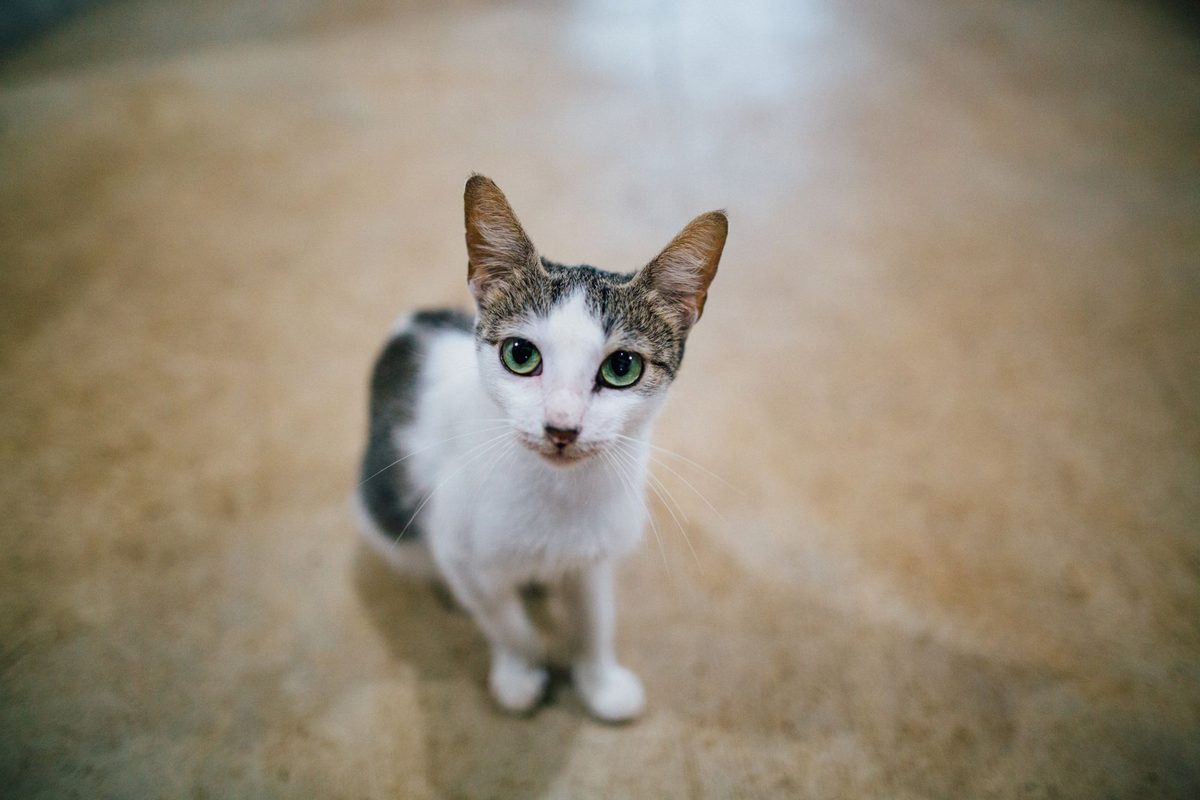
Cat facts first: a cat cannot taste sweetness,1 can hear sounds as high as 85 kilohertz,2 sleeps 12 to 16 hours a day3 and has 30 adult teeth.4 This page lists 101 facts about cats, each with a numbered source you can open. The fun and amazing cat facts come first, then bodies, senses, behavior, history, records, breeds and kittens. The last ten are popular claims that turn out to be wrong.
- Fun facts about cats (facts 1 to 14)
- Cat body facts (facts 15 to 26)
- Cat senses (facts 27 to 38)
- Cat behavior facts (facts 39 to 51)
- Cat history facts (facts 52 to 63)
- Cat records (facts 64 to 73)
- Cat breed and coat facts (facts 74 to 83)
- Kitten facts (facts 84 to 91)
- Popular cat facts that are wrong (facts 92 to 101)
- How these facts were checked
- Cat facts quiz
- Frequently asked questions
Fun facts about cats
- Cats lack a working version of Tas1r2, one of the two genes needed for the sweet taste receptor, so they do not taste sweetness the way we do.1 One of the scientists behind the finding has said some cats may detect very high sugar levels another way.5
- Cats can taste ATP, a compound found in every living cell that we cannot taste. One researcher described it as a signal for meat.5
- A cat drinks with the top of its tongue. It curls the tip backward so the top touches the water, then pulls back fast. A column of water rises with the tongue, and the cat closes its mouth on it, about four times a second.67
- A house cat's slit pupil changes its area about 135-fold between narrow and wide. A human pupil changes about 15-fold.8 Lions and tigers have round pupils.9
- Some cats will sit inside a square that is only an optical illusion. In a 2021 study run in owners' homes, cats chose an illusory square 7 times and a real taped outline 8 times.10
- About one cat in three does not react to catnip.11 A cat that does usually sniffs, rubs and rolls for 5 to 15 minutes.12
- That rubbing may do a job. In a 2021 study, cat heads treated with a similar compound from silver vine drew about half as many mosquito landings as untreated ones.12
- A cat video has crossed deep space. On December 11, 2023, a laser experiment on NASA's Psyche spacecraft beamed a 15-second video of Taters, an orange tabby, 19 million miles to Earth in 101 seconds.13
- A cat ran a railway station in Japan. Tama became stationmaster of Kishi station on January 5, 2007,14 and passenger numbers rose 10% in her first year.15
- The first cloned cat, CC, was born in Texas on December 22, 2001.16 She had the same DNA as Rainbow, a calico, but a visibly different coat.17
- A group of cats can be called a clowder. Dictionary.com dates the word to 1795 to 1805.18
- Luna is the most common name among licensed cats in both Seattle and Toronto.1920
- Maryland has a state cat: the calico, since October 1, 2001.21
- When the journal Nature printed photographs of a falling cat turning over in 1894, it noted the cat's "expression of offended dignity" and its "want of interest in scientific investigation."22
Cat body facts
- A 1901 anatomy textbook counts 230 to 247 bones in a cat. Old cats have fewer than young ones, because some bones fuse with age.4
- A cat's spine has 52 or 53 vertebrae, and 22 or 23 of them are in the tail.4
- Cats have a collarbone, but it is small: a slender curved rod of bone set in the shoulder muscles.4
- Cats walk on their toes.23 Animals that walk this way are called digitigrade.24
- Most cats have 18 toes: five on each front paw, usually counting a dewclaw, and four on each back paw. A cat with more is called polydactyl.25
- Adult cats have 30 teeth: 12 incisors, 4 canines, 10 premolars and 4 molars.4
- A resting cat's heart beats 120 to 140 times a minute.26 In one study, healthy cats averaged 132 beats a minute at home and 187 while held still for a heart scan.27
- A cat's normal rectal temperature is 100.5 to 102.5°F, or 38.1 to 39.2°C.28
- A cat's tongue is covered in sharp, backward-facing spines called papillae. Each has a hollow tip that soaks up saliva and releases it into the fur during grooming.29
- Cats have sweat glands only on their paws, and grooming helps cool them as saliva evaporates from the fur. House cats can spend up to 24% of their waking time grooming.29
- Every member of the cat family can retract its claws, though retraction is less developed in the cheetah.23
- A 2008 study found that walking cats recover less mechanical energy than mammals built for distance. Its authors suggest a possible tradeoff between stealth and saving energy.30
Cat senses
- In a 1985 study of two cats, hearing extended from 48 hertz to 85 kilohertz at 70 decibels, one of the broadest hearing ranges known in mammals.2 People typically hear up to about 20,000 hertz.31
- Each ear flap moves on its own, which helps a cat locate a sound.32
- A cat's nose holds up to 200 million scent-detecting cells, compared with about 5 million in ours.33
- Cats have a second scent organ, the vomeronasal or Jacobson's organ, in the roof of the mouth, used to detect pheromones.34 The open-mouthed, lip-curled face a cat sometimes makes while investigating a smell is called the flehmen response.35
- Most cats have 24 whiskers on the muzzle, 12 on each cheek in four rows of three. Many also have whiskers above the eyes, along the jaw and on the back of the front legs.36
- A whisker senses at its root. Its follicle is five to six times the size of an ordinary hair follicle.37 The hair itself has no nerve endings, and nerves in the follicle respond when the whisker bends.38
- Whiskers are as sensitive as your fingertips. As a cat approaches a narrow gap, they help it judge whether it can fit through. They do not guarantee a fit.39
- In a 1992 study, cats without vision from birth grew larger whiskers than usual.40
- Cats have a third eyelid, the nictitating membrane, in the inner corner of each eye. It can extend to protect the eye, and it also comes up when the eye is inflamed, so one that stays visible is worth showing your vet.41
- Cats see about six times better than people in dim light.41 A reflective layer behind the retina, the tapetum lucidum, gives some light a second chance, and it is why cat eyes shine in photos.42
- Cats focus clearly on things about 10 inches or more away. Closer than that, things look blurry, which is one reason a treat right under the nose can be hard to find.42
- A cat's field of view covers about 200 degrees, compared with about 180 for people, according to veterinary ophthalmologist Paul Miller.42
Cat behavior facts
- Kittens meow to their mothers, but adult cats rarely meow at each other. International Cat Care says most meows are aimed at people.34 Talk to my cat Moe from above and he meows a reply every time.
- A study found that cats were more likely to approach a person after a slow-blink interaction. That is evidence of a positive social response, not a translation of every blink.43
- Purrs fall roughly between 25 and 150 hertz.44 How cats make them is still being worked out: in a 2023 lab study, cat larynges produced purring frequencies without any rhythmic nerve signal.45
- Some cats mix a higher-pitched cry into the purr when asking for food. In a 2009 study, people who listened to recordings rated those purrs as more urgent and less pleasant.46
- Cats commonly sleep 12 to 16 hours a day, and kittens may sleep up to 20.3 About a quarter of that is very deep sleep.47
- Sleep science borrowed a term from cats. REM sleep is also called paradoxical sleep, a name that came out of Michel Jouvet's 1959 work on sleeping cats.48
- Kneading starts with nursing kittens, and many cats keep doing it as adults, often while settling down. One knead does not reveal a purpose or a feeling.49
- Some cats scrape around their food bowl with the same movement they use in the litter box. International Cat Care lists several theories, from saving leftovers to reacting to a smell the cat does not like.50
- Cats have scent glands under the chin, at the sides of the mouth and on the forehead. When a cat rubs its head on something, which is called bunting, it leaves scent behind.34
- Hunting is not driven by hunger, so well-fed cats still do it.51 In a 2021 trial with 355 cats,52 a switch to meat-rich food cut the prey cats brought home by 36%, and daily play cut it by 25%.53
- In a Dutch shelter trial, newly arrived cats given a cardboard hiding box reached a steady, lower stress score on day 2. Cats without a box took until day 9.54
- In a 2019 test adapted from research on human infants, about 64% of 70 kittens were classed as securely attached to their caregivers, close to the 65% seen in infants.55
- A 2019 study found that cats can tell their own names from other words.56
Interesting facts about cats in history
- A cat buried near a person at Shillourokambos, on Cyprus, about 9,500 years ago is one of the oldest known signs of cats living with people.57
- House cats descend from the African wildcat.58 In a 2007 study of 979 cats, every domestic cat tested fell into one genetic group with wildcats from the Near East.59
- Domestic cats spread late. Ancient DNA puts them in Europe about 2,000 years ago58 and in China about 1,400 years ago.60
- Ancient Egyptians associated cats with the goddess Bastet, and a cat cemetery at Beni Hasan held some 300,000 cat mummies.61
- In February 1890, about 180,000 cat mummies from Beni Hasan, weighing about 19.5 tons, were shipped to Liverpool and auctioned as farm fertilizer.62
- The Greek historian Diodorus Siculus wrote that killing a cat in ancient Egypt meant death, even by accident, and says he saw it happen to a visiting Roman.63
- Herodotus wrote that when a cat died a natural death in an Egyptian household, everyone living there shaved off their eyebrows.64
- The Hermitage Museum in St Petersburg has kept cats since 1745, when Empress Elizabeth ordered thirty of the best and biggest neutered tomcats from Kazan sent to her court to catch mice.65
- Samuel Johnson bought oysters for his cat Hodge himself, "lest the servants having that trouble should take a dislike to the poor creature," his biographer James Boswell wrote.66
- Simon, ship's cat of HMS Amethyst, received the PDSA Dickin Medal in 1949 for "disposing of many rats though wounded by shell blast."67 Of 75 Dickin Medals since 1943, his is the only one given to a cat.68
- In October 1963, France sent a cat named Félicette on a short rocket flight. She reached about 154 km and came back alive, the first cat in space.69 A statue of her stands at the International Space University.70
- Larry has lived at 10 Downing Street since February 15, 2011. He is the first cat there with the official title Chief Mouser.71
Cat records
These ten cool facts about cats all come from Guinness World Records. Dates and places are in the cat world records table.
- The oldest cat ever recorded by Guinness World Records is Creme Puff of Austin, Texas, who lived from August 3, 1967 to August 6, 2005: 38 years and 3 days.72 The cat age calculator shows what your own cat's age works out to.
- The longest domestic cat ever measured was Stewie, a Maine Coon, at 123 cm (48.5 inches).73
- The tallest domestic cat ever measured was Arcturus, a Savannah, at 48.4 cm (19.05 inches).74
- The loudest purr by a domestic cat on record is 67.8 decibels. Smokey reached it in Northampton, UK, in 2011, and Merlin equaled it in Torquay, UK, in 2015.75
- The record for the most toes on a cat is 29, set by Erebus of Kaukauna, Wisconsin, on May 13, 2026. The previous record of 28 had stood since 2002.76
- The largest litter on record is 19 kittens, four of them stillborn, born in Oxfordshire, UK, on August 7, 1970.77
- Dusty, a tabby from Bonham, Texas, had 420 kittens. Her last litter, in 1952, was a single kitten.78
- Towser, a tortoiseshell at the Glenturret distillery in Scotland, is the greatest mouser on record, with an estimated 28,899 mice.79
- The smallest cat ever, Tinker Toy, stood 7 cm tall and measured 19 cm long when fully grown.80
- Guinness stopped tracking the heaviest cat in 1998, to deter people from overfeeding their pets.81
Cat breed and coat facts
- How many cat breeds there are depends on who is counting. As of October 2026, the Cat Fanciers' Association recognizes 4582 and The International Cat Association 73.83
- Tabby is a coat pattern, not a breed. Registries describe four main patterns: mackerel, classic, spotted and ticked.84
- Tuxedo is a pattern too. The white comes from white spotting, a version of the KIT gene.85
- Calico cats are almost always female. The orange gene sits on the X chromosome, and a cat needs two X chromosomes, one with orange and one without, to grow orange and black patches.86
- Male tortoiseshells do turn up. In a 1999 UK survey, 20 of 4,598 male cats were tortoiseshell, about 1 in 230.87
- Most orange cats are male for the same reason: one copy of the orange gene makes a male orange, and a female needs two.86 In May 2025, two research teams traced it to a small deletion in a gene called ARHGAP36.88
- A black house cat and a black jaguar are black for different reasons. House cats carry a small deletion in a gene called ASIP, and black jaguars got there through another gene, MC1R.89
- A Siamese cat's dark ears, paws and tail come from a temperature-sensitive form of albinism. Dark pigment develops only in the cooler parts of the body.90
- Amber was the rarest coat color variant found in a 2022 DNA study of 11,036 mostly pedigreed cats, at 0.03% of gene copies.91 It is known from Norwegian Forest Cat lines.92
- Blue eyes and deafness go together in white cats. In a 1973 study of mixed-breed white cats, 17% with no blue eyes were deaf in one or both ears, against 40% with one blue eye and 85% with two.93
Kitten facts
- Kittens are born with their eyes closed and open them at about 8 to 12 days old.42
- Kittens are born without teeth.4 They grow 26 baby teeth, all in by about six weeks.94
- Kittens can purr when they are about two days old, usually while nursing.95
- The midair twist that turns a falling cat upright develops by the fifth week of life, a 1984 study found.96 Most kittens have the righting reflex by about seven weeks old.97
- Kittens in one litter can have different fathers, because a queen in season may be mated by more than one tom.98
- A kitten's socialization period runs from two to seven weeks of age. What it meets in those weeks, it is more likely to accept later in life.98
- Play-fighting teaches limits. By playfully biting their littermates, kittens learn when they are biting too hard.99
- Hunting is innate: even a kitten hand-reared alone will still be able to hunt. Mother cats set up chances to practice, usually with half-dead prey.98
Popular cat facts that are wrong
Each line gives the claim, then what a source says. Longer versions are in 9 Cat Myths Explained and 100 cat claims checked.
- "Cats have nine lives." A cat has one. The saying is old: John Heywood's book of proverbs had it in print by 1546.100
- "Milk is good for cats." Many cats are lactose intolerant and can develop digestive problems if fed dairy products, so milk is not generally recommended as a treat.101
- "Cats always land on their feet." The righting reflex does not work every time, and it does not make a fall safe.97 In a 1987 New York study of 132 cats that fell from buildings, 90% had chest injuries.102
- "Cats are color blind." Cats have cone cells, which handle color. The Merck Veterinary Manual says it is uncertain how much color cats see,41 and veterinary ophthalmologist Paul Miller describes them as seeing mainly blues and yellows.42
- "Cats can see in total darkness." They see far better than we do in dim light, but they still need some light.41
- "A purring cat is a happy cat." Cats purr when content, but also when anxious, at the vet, and when sick or in pain.95
- "All cats hate water." Plenty of cats dislike getting wet, but the Cat Fanciers' Association says the Turkish Van is well known for its affinity to water.103
- "One cat year equals seven human years." International Cat Care's age chart counts a one-year-old cat as about 15 in human years and a two-year-old as 24, then adds four a year.104
- "A cat brings prey home as a present for you." Cats Protection calls the present idea a myth and says home is where a cat feels safe to eat its catch or keep it for later.51
- "Ancient Egyptians never harmed a cat." X-rays of 53 Egyptian cat mummies showed that most died young, and seven had badly dislocated necks, which the researchers read as deliberate killing.105
How these facts were checked
Every fact has a number that leads to its source in the list below. I checked each one against that source, for this page or for the longer article it links to. Where sources gave different numbers, I used the one that shows how it was measured, which is why the resting heart rate here is the Merck Veterinary Manual's 120 to 140 beats a minute.26 Some popular facts are missing on purpose. I found no published measurement behind a 30 mph top speed and no study showing that every cat's nose print is unique. Pet sites often say each ear has 32 muscles, but the 1901 textbook describes the outer ear's muscles one by one without giving a total.4
Cat facts quiz: 5 questions
Which taste can cats not detect the way we do?
Answer
Sweetness.1
How many teeth does an adult cat have?
Answer
30.4
What can a group of cats be called?
Answer
A clowder.18
What was the name of the first cat in space?
Answer
Félicette, who flew in October 1963.69
How long did Creme Puff, the oldest cat on record, live?
Answer
38 years and 3 days.72
More questions like these are in the Cat Trivia game, free to play with no account.
Frequently asked questions
What are 5 interesting facts about cats?
Cats cannot taste sweetness.1 In one study they heard sounds as high as 85 kilohertz.2 Adults have 30 teeth.4 They commonly sleep 12 to 16 hours a day.3 And grown cats aim most of their meows at people, not at other cats.34
What is a surprising fun fact about cats?
My pick is how a cat drinks: it pulls a column of water up with the top of its tongue and closes its mouth on it about four times a second.6 A close second is that a video of an orange tabby named Taters was beamed 19 million miles to Earth from deep space.13
What are some cat facts for kids?
Short ones work best: most cats have 18 toes,25 kittens are born with their eyes closed42 and a group of cats can be called a clowder.18 50 Cat Facts for Kids has more fun cat facts in simple words, with a mini quiz.
Up next

Christopher writes and runs Cat Trivia Games. Each fact here links to its source, and how the site is made and corrected is on the editorial policy page. More about the author.
References
- Li, X. et al., PLOS Genetics (2005). Pseudogenization of a sweet-receptor gene accounts for cats' indifference toward sugar. back
- Heffner, R. S. and Heffner, H. E., Hearing Research (1985). Hearing range of the domestic cat. back
- PetMD. Why do cats sleep so much? back
- Jacob Reighard and H. S. Jennings, 1901. Anatomy of the Cat (Project Gutenberg edition): skeleton, vertebral column, clavicle, teeth and muscles of the external ear. back
- Scientific American. Strange but true: cats cannot taste sweets. back
- Reis PM, Jung S, Aristoff JM, Stocker R. Science, 2010. How cats lap: water uptake by Felis catus. back
- MIT News, Denise Brehm (November 12, 2010). The surprising physics of cats' drinking. back
- Banks MS, Sprague WW, Schmoll J, Parnell JAQ, Love GD. Science Advances, 2015. Why do animal eyes have pupils of different shapes? back
- UC Berkeley News, Sarah Yang (August 7, 2015). Pupil shape linked to animals' place in ecological web. back
- Gabriella E. Smith, Philippe A. Chouinard and Sarah-Elizabeth Byosiere, Applied Animal Behaviour Science 240 (2021). If I fits I sits: a citizen science investigation into illusory contour susceptibility in domestic cats. back
- Sebastiaan Bol, Jana Caspers, Lauren Buckingham and others, BMC Veterinary Research 13 (2017). Responsiveness of cats (Felidae) to silver vine (Actinidia polygama), Tatarian honeysuckle (Lonicera tatarica), valerian (Valeriana officinalis) and catnip (Nepeta cataria). back
- Reiko Uenoyama, Tamako Miyazaki, Jane L. Hurst and others, Science Advances 7 (2021). The characteristic response of domestic cats to plant iridoids allows them to gain chemical defense against mosquitoes. back
- NASA Jet Propulsion Laboratory, December 18, 2023. NASA's tech demo streams first video from deep space via laser. back
- Wakayama Electric Railway (in Japanese). About the cat stationmasters, with Tama's history. back
- The Guardian (June 29, 2015). Tama the cat: 3,000 attend elaborate funeral for Japan's feline stationmaster. back
- Texas A&M College of Veterinary Medicine and Biomedical Sciences, March 4, 2020. Texas A&M says goodbye to CC, world's first cloned cat. back
- Texas A&M Foundation, Maroon magazine, spring 2024. Curiosity cloned the cat. back
- Dictionary.com. Clowder (definition and word origin). back
- City of Seattle, data.seattle.gov, public domain, read October 31, 2026. Seattle Pet Licenses. back
- City of Toronto, Toronto Open Data, read October 31, 2026. Licensed Dog and Cat Names Since 2020 (CSV file). back
- Maryland State Archives, Maryland Manual On-Line. Maryland State Cat: Calico Cat. back
- Nature, vol. 51, pp. 80 to 81 (November 22, 1894). Photographs of a tumbling cat. back
- Lamberski N. In Miller RE and Fowler ME (editors), Fowler's Zoo and Wild Animal Medicine, Volume 8, 2015 (PubMed Central). Felidae. back
- Dictionary.com. Digitigrade (definition). back
- PetMD, Janelle Leeson. Polydactyl cats: what to know about cats with "thumbs". back
- Merck Veterinary Manual, Susan E. Fielder. Resting heart rates. back
- Jonathan A. Abbott, Journal of Feline Medicine and Surgery, 2005. Heart rate and heart rate variability of healthy cats in home and hospital environments. back
- Merck Veterinary Manual, Susan E. Fielder. Normal rectal temperature ranges. back
- Noel, A. C. and Hu, D. L., PNAS (2018). Cats use hollow papillae to wick saliva into fur. back
- Bishop KL, Pai AK, Schmitt D. PLoS ONE, 2008 (PubMed Central). Whole body mechanics of stealthy walking in cats. back
- VCA Animal Hospitals. Why do cats stare at nothing? (human and cat hearing ranges). back
- Merck Veterinary Manual, pet owner version. Ear structure and function in cats. back
- National Geographic. Here's how your cat experiences the world. back
- International Cat Care. Cat communication. back
- PetMD. What is the flehmen response in cats? back
- Cats Protection. Why do cats have whiskers? back
- Ahl AS. Veterinary Research Communications, 1986. The role of vibrissae in behavior: a status review. back
- CatWatch newsletter, with the Cornell Feline Health Center (June 17, 2023). 5 things to know about whiskers. back
- VCA Animal Hospitals. Why do cats have whiskers? back
- Rauschecker JP, Tian B, Korte M, Egert U. Proceedings of the National Academy of Sciences, 1992. Crossmodal changes in the somatosensory vibrissa/barrel system of visually deprived animals. back
- Merck Veterinary Manual. Eye structure and function in cats. back
- PetMD, with veterinary ophthalmologist Paul Miller. How do cats see the world? What to know about cat vision. back
- Humphrey, T. et al., Scientific Reports (2020). The role of cat eye narrowing movements in cat-human communication. back
- Scientific American. Why do cats purr? back
- University of Vienna, via ScienceDaily (2023). Cats purr differently than previously thought. back
- McComb, K. et al., Current Biology (2009). The cry embedded within the purr. back
- PDSA. Why do cats sleep so much? back
- Gabriel Natan Pires, Sergio Tufik and Monica Andersen, Sleep Science 10 (2017). Michel Jouvet and his importance for Brazilian preclinical sleep research. back
- Hart, H., DVM, PetMD. Why do cats knead? back
- International Cat Care. Why do cats..? (covering food). back
- Cats Protection. Why do cats bring you dead animals? back
- University of Exeter (2021). Play and meaty food reduce hunting by cats. back
- Cecchetti, M. et al., Current Biology (2021). Provision of high meat content food and object play reduce predation of wild animals by domestic cats. back
- W. J. R. van der Leij, L. D. A. M. Selman, J. C. M. Vernooij and C. M. Vinke, PLOS ONE (2019). The effect of a hiding box on stress levels and body weight in Dutch shelter cats; a randomized controlled trial. back
- Oregon State University (2019), on Vitale, K. R. et al., Current Biology. Cats, like children and dogs, develop attachments to their caregivers, study shows. back
- Saito A, Shinozuka K, Ito Y, Hasegawa T. Domestic cats (Felis catus) discriminate their names from other words. Scientific Reports, 2019. back
- Pickrell, John (2004), National Geographic. Oldest known pet cat? 9,500-year-old burial found on Cyprus. back
- De Martino, M. and others (2025), Science. The dispersal of domestic cats from North Africa to Europe around 2,000 years ago (author manuscript, PubMed Central). back
- Driscoll, C. A. and others (2007), Science. The Near Eastern origin of cat domestication (author manuscript, PubMed Central). back
- Han, Y., Luo, S.-J. and others (2025), Cell Genomics. The late arrival of domestic cats in China via the Silk Road after 3,500 years of human-leopard cat commensalism. back
- Smithsonian Magazine. A brief history of house cats. back
- Elliott, Chris (2023), The Journal of Egyptian Archaeology. Cats, commerce, and cemeteries: the mummified felines of Beni Hasan. back
- Diodorus Siculus, Library of History, Loeb Classical Library edition (1933), on LacusCurtius. Book 1, chapters 83 and following. back
- Herodotus, translated by G. C. Macaulay. Project Gutenberg. The History of Herodotus, Volume 1 (Book 2, chapters 59 to 67 and 137). back
- Irina Chirskova, Verkhnevolzhsky Philological Bulletin, no. 4 (2021), pp. 231 to 237 (in Russian, English abstract). Cats' state service in the 18th century Russia. back
- James Boswell, Life of Johnson, edited by Charles Grosvenor Osgood. Project Gutenberg eBook 1564. Boswell's Life of Johnson (the Hodge passage, in the 1783 chapter). back
- PDSA. Simon, PDSA Dickin Medal 54: citation and story (PDF). back
- PDSA. The PDSA Dickin Medal. back
- Guinness World Records. First cat in space. back
- Katherine J. Wu, Smithsonian Magazine, January 28, 2020. Félicette, the first cat in space, finally gets a memorial. back
- GOV.UK. History of 10 Downing Street: Larry, Chief Mouser to the Cabinet Office. back
- Guinness World Records. Oldest cat ever. back
- Guinness World Records. Longest domestic cat ever. back
- Guinness World Records. Tallest domestic cat ever. back
- Guinness World Records. Loudest purr by a domestic cat. back
- Guinness World Records. Most toes on a cat. back
- Guinness World Records. Largest litter of domestic cats. back
- Guinness World Records. Most prolific cat. back
- Guinness World Records. Greatest mouser. back
- Guinness World Records. Smallest cat ever. back
- Craig Glenday, Guinness World Records, 26 August 2015. 60 years on, the categories that Guinness World Records no longer monitors. back
- The Cat Fanciers' Association. Show Rules 2026-2027 (Articles XXX to XXXIII: championship, provisional and miscellaneous breeds). back
- The International Cat Association. Browse All Breeds (read in the Internet Archive copy of October 19, 2026). back
- Fédération Internationale Féline (FIFe). Breed standards, General Part: tabby patterns, dated January 1, 2026. back
- David and colleagues, G3: Genes, Genomes, Genetics, 2014 (PubMed Central). Endogenous retrovirus insertion in the KIT oncogene determines White and White spotting in domestic cats. back
- Stanford Medicine News Center, Nina Bai, May 15, 2025. Scientists track down mutation that makes orange cats orange. back
- Leaman, Rowland and Long, University of Bristol, Veterinary Record, 1999 (PubMed). Male tortoiseshell cats in the United Kingdom. back
- Kyushu University, May 16, 2025. Scientists find the 'meow-tation' that gives cats their orange fur. back
- PubMed, National Library of Medicine. Eizirik and colleagues, Current Biology, 2003. Molecular genetics and evolution of melanism in the cat family. back
- Memorial University of Newfoundland. Albinism in cats. back
- Anderson H, Davison S, Lytle KM, et al. PLOS Genetics, 2022. Genetic epidemiology of blood type, disease and trait variants, and genome-wide genetic diversity in over 11,000 domestic cats. back
- Peterschmitt M, Grain F, Arnaud B, Deléage G, Lambert V. Animal Genetics, 2009. Mutation in the melanocortin 1 receptor is associated with amber colour in the Norwegian Forest Cat. back
- George M. Strain, Louisiana State University School of Veterinary Medicine (from Veterinary Clinics of North America: Small Animal Practice, 1999). Congenital deafness and its recognition. back
- Cornell Feline Health Center. When kitty needs a dentist. back
- Sung, W., DVM, DACVB, PetMD. Why do cats purr? 5 meanings behind a purring cat. back
- Sechzer JA, Folstein SE, Geiger EH, Mervis RF, Meehan SM. Experimental Neurology, 1984. Development and maturation of postural reflexes in normal kittens. back
- VCA Animal Hospitals. True or false: cats always land on their feet. back
- Cats Protection. The Behaviour Guide (PDF). back
- Cats Protection. Kitten Academy: learning through play. back
- John Heywood, A dialogue conteinyng the nomber in effect of all the prouerbes in the englishe tongue, Thomas Berthelet, London, 1546, transcribed in the Textbase of Early Tudor English, University of Otago. A Dialogue of Proverbs. back
- Cornell Feline Health Center. Feeding your cat. back
- Whitney WO, Mehlhaff CJ. Journal of the American Veterinary Medical Association, 1987. High-rise syndrome in cats. back
- The Cat Fanciers' Association. Turkish Van. back
- International Cat Care. How old is your cat? (printable age chart, PDF). back
- Armitage, P. L. and Clutton-Brock, J. (1981), Journal of Archaeological Science. A radiological and histological investigation into the mummification of cats from Ancient Egypt. back
- Folger Shakespeare Library. Romeo and Juliet, Act 3, scene 1. back
This is general information, not veterinary advice. Written by Christopher Fox under our editorial policy.