 Cat Trivia Games
iOS App
Maneki-neko Meaning: Left or Right Paw, Colors and Legends
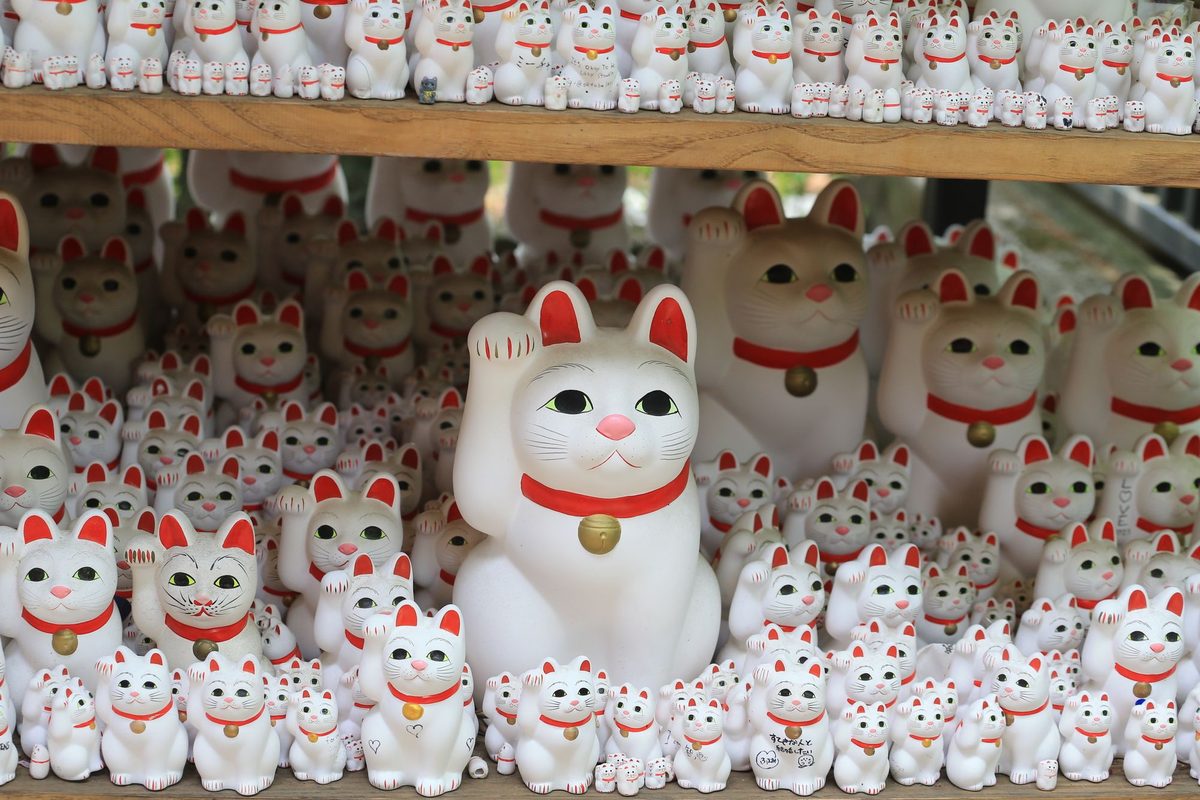
Maneki-neko (招き猫) means "beckoning cat," from the Japanese maneku, "to invite," and neko, "cat."1 The raised paw is a Japanese beckon, palm forward and fingers down, not a wave.2 By the usual rule, a raised right paw invites money and a raised left paw invites people and customers; colors add meanings, such as red for health.3 The figure is Japanese, and National Geographic calls an 1852 Hiroshige print the oldest known image of one.24
What the raised paw means
Right for money, left for people and customers is the general rule.3 Gōtokuji's cats in Tokyo raise the right paw yet hold no coin.6
| Feature | What it is said to mean |
|---|---|
| Right paw raised | Money,3 or good fortune and wealth1 |
| Left paw raised | People and customers3 |
| Both paws raised | A recent design. Some avoid it because it can read as o-teage, throwing up your hands in defeat.7 Richard Medhurst of nippon.com says it is "generally considered cheating."8 |
| Paw above the ear (tenaga, "long arm") | Fortune from far away, or a big fortune3 |
| Paw below the ear | Fortune close by, everyday happiness3 |
| Koban coin | Wealth. A koban is an oval gold coin of the Edo period (1603 to 1868).8 The sums written on it have grown from ten million ryō to oku-man ryō, hundreds of millions.9 |
| No coin (Gōtokuji) | The temple says the cat brings chances to connect with people, not happiness itself: "it is up to you whether you can make it work."10 Others suggest a coin seemed wrong for a temple8 or for a samurai family that looked down on money.6 |
| Back of the paw facing out | Versions sold in the United States and Europe, where a raised palm facing someone means "go away." American ones may hold a dollar koban.76 |
What the colors mean
Calico, with white, black and orange markings, is the usual color and still the most popular, says the Japan Tourism Agency.1 Some white and black figures copy cats from legends: Gōtokuji's white cat and Jishōin's black one.7 Many other colors are more recent, with meanings drawn from feng shui, says Japan Airlines' travel site SKYWARD+.7 Beyond the traditional colors, Medhurst writes, "it partly depends on who's marketing the cats."8
The lists below mostly agree. Blue is the exception: study for SKYWARD+ in 2021, traffic safety for National Geographic.
| Color | Japan Maneki Neko Club3 | SKYWARD+ (JAL), 2021 and 202297 | English-language press82 |
|---|---|---|---|
| White | General good fortune, family safety | Better luck, business prosperity (2022) | "Fairly generic" (nippon.com) |
| Calico | Not listed | Calls in luck (2022) | Not listed |
| Black | Wards off bad luck | Wards off misfortune (2021); also evil, family safety (2022) | Wards off evil spirits (nippon.com) |
| Red | Health, long life | Health and long life (2021); keeps illness away (2022) | Drives away illness (nippon.com) |
| Gold | Money | Money | Money (nippon.com); prosperity (National Geographic) |
| Pink | Love | Love | Love (both) |
| Blue | Not listed | Study (2021); also job hunting, traffic safety (2022) | Traffic safety (National Geographic) |
| Green | Not listed | Family safety (2021); also school results (2022) | Not listed |
| Purple | Not listed | Health and long life (2022) | Not listed |
Quick quiz: how well do you know cat history?
What distinctive coat color pattern did Palmerston, the UK's Foreign Office Chief Mouser, display?
Answer: Black and white tuxedo. Palmerston was a black-and-white tuxedo cat, adopted from Battersea Dogs & Cats Home. The formal attire of his coloring was fitting for a diplomatic feline. Source
What finishing product is applied to show cat coats immediately after bathing and drying to enhance coat separation?
Answer: Light powder for coat. Light powdering after bathing helps separate coat fibers and enhances the overall grooming effect before final brushing. This technique is particularly valuable for long-haired breeds that require maximum volume and definition for show presentation. Source
What is the name of Chris Torres's pet cat that inspired Nyan Cat?
Answer: Marty. Nyan Cat was based on Chris Torres's own Russian Blue cat named Marty. The cat passed away on November 1, 2012. Source
Four origin legends
The first figures are thought to date from the mid-19th century,1 and a 2021 nippon.com interview with Iwazaki Eiji, a doctor of veterinary science who studies cat folklore, says there is "no one definite explanation" for them.11 Four places claim the cat:
- Gōtokuji, Setagaya. In the temple's telling, a cat at the gate beckoned in Ii Naotaka, lord of the Hikone domain, as he returned from falconry, and thunder and rain broke while he was inside. The temple, founded in 1480 as Kōtoku-in, was rebuilt with his support in 163310 and renamed Gōtoku-ji in 1659 after his posthumous Buddhist name.12 National Geographic's version, from temple historians, names the cat Tama and has lightning instead of rain.2 In 2014 about a thousand figures crowded the small offering area,8 and in early 2021 the temple gave out about 5,000 a month in nine sizes.9
- Imado Shrine, Asakusa. In National Geographic's version, dated 1852, a woman too poor to feed her cat let it go, then dreamed it told her to make figures in its image. She made them in local Imado ware, sold them at the shrine gates and escaped poverty.2 The nippon.com interview says the shrine "is not the origin of the figures," though Imado-ware marushime-neko, popular in the late Edo period, are considered a kind of prototype.11 These sit sideways, only the face turned forward, usually beckon with the right paw and carry a circled 〆 on the lower back, said to mean keeping all the money and luck for yourself. They also appear in the Bukō nenpyō, a chronicle of Edo.9
- Jishōin, Shinjuku. The earliest-dated story. Shinjuku City's cultural-property guide says that in 1477, in a battle at Ekoda-ga-hara between the Toshima clan and Ōta Dōkan, a black cat led the lost Dōkan to the temple. A Jizō statue offered to the temple after the cat died, the "cat Jizō," is kept hidden except on Setsubun each February.13 On a gatepost at the approach, a stone maneki-neko about a meter in size raises its left paw and grips a koban in its right.6
- Saihōji and the courtesan Usugumo. Usugumo, a Yoshiwara courtesan, kept a cat that protected her from a giant snake.11 In SKYWARD+'s version the cat, a calico named Tama, tugged at her hem on the way to the privy; the brothel's master cut off its head, which flew into the privy and killed the snake hiding there. She built a cat mound at Saihōji, and figures made in its memory later sold at Asakusa's year-end market.7
Maneki-neko history in dates
- 1603 to 1868. Silk-farming regions trade cats to guard silkworms from rats, and records show a cat sometimes fetching five ryō when a horse was worth one.11
- 1852. Hiroshige's Jōrurimachi hanka no zu ("Flourishing Business in Balladtown") shows a seller of small cat figures in Edo, today's Tokyo, at the top left of one sheet.4 The cats wear bells and hold no koban.14
- 1868 to 1912. Meiji-era plaster molds allow mass production, and coins typically replace the cats' neck bells.14
- 1872. The Public Morals Ordinance bans phallic charms. A University of California, Irvine undergraduate project led by anthropologist Bill Maurer says maneki-neko replaced them as ornaments, and the custom spread to other Asian countries.2
- Early 1900s. Seto, in Aichi, makes its "Ko-Seto" cats in plaster molds, a technique used for export dolls.7
- Late 1930s. Tokoname, also in Aichi, starts making maneki-neko. By 1950 it is Japan's top producer.1
- 1941. Gōtokuji builds the Shōfukuden, a hall to enshrine the beckoning cat.1012
- 1950s. Aichi makers borrow the look of local Okkawa dolls: a head as big as the body and wide-open eyes.14
- 2005. The Manekineko Museum moves to Seto from Gunma.5 It shows about 5,000 cats and calls itself Japan's largest maneki-neko museum.15
- 2007. Hikone creates the mascot Hikonyan, modeled on the Gōtokuji cat, for its castle's 400th anniversary.14
Why it is often called a Chinese lucky cat
The "Chinese waving cat" of Chinatowns and Asian shops is Japanese, and exactly how it spread abroad is unclear.2 Tets Kimura, writing in The Conversation, traces one route: later in the 20th century the cat caught on in the Chinese-speaking world through Hong Kong and Taiwan, and in Hong Kong tea houses it now sits on altars traditionally dedicated to figures such as the third-century general Guan Yu. Asian migrants then carried it around the world.14
Some overseas figures began as souvenirs made for Japanese tourists abroad and took root locally.3 The "Cool Japan" boom of the 1980s and 1990s, which coincided with the second wave of Chinese immigration to the United States, further embedded the cat in mainstream culture.2 The Chinatown link is now so strong that many people assume the cats were Chinese to begin with.8
A Chinese book from around the ninth century is said to be one source of the idea: it says a guest will arrive when a cat washing its face raises its paw above its ears.7
Frequently asked questions
When is Maneki Neko Day?
September 29. The Japan Maneki Neko Club, an enthusiasts' group founded in 1993, set it in 1995 as a pun: 9 for kuru, "comes," and 29 for fuku, "good fortune." SKYWARD+ says the Seto City Tourism Association set it with the club. The first Kuru Fuku Maneki Neko Festival was held that year in Ise, Mie Prefecture, and came to Seto in 1996.57
Is the maneki-neko a particular breed of cat?
The figures vary by maker. Gōtokuji's white cats are commonly shaped like a Japanese Bobtail, a short-tailed breed from Japan,2 while Seto-style cats are slim, with a small head and glossy white body.9
Where can I see a giant maneki-neko?
Tokonyan in Tokoname is one of Japan's largest: a head and raised left paw 3.8 meters high and 6.3 meters wide, peeking over an embankment on Maneki Neko-dori, a street lined with 39 cats by artists linked to Tokoname.16
Up next
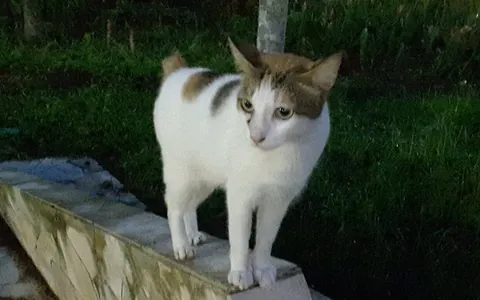 Cat BreedsJapanese BobtailThe short-tailed breed Gōtokuji's white cats are often shaped like.
 Cat FactsBlack Cat Facts, Trivia Questions and AnswersWhere black cats count as lucky, and where they do not.
Breed photos: mostly Wikimedia Commons contributors under free licenses, cropped. Every photographer and license is on the photo credits page.
Christopher writes and runs Cat Trivia Games. The sources for this article are listed below, and how the site is made and corrected is on the editorial policy page. More about the author.
References
- Japan Tourism Agency, multilingual explanation database. Tokoname maneki neko (lucky cats). back
- Rebecca Saunders, National Geographic, May 3, 2021. The fascinating history behind the popular "waving lucky cat." back
- Japan Maneki Neko Club (日本招猫倶楽部). 招き猫Q&A (maneki-neko questions and answers, in Japanese). back
- National Diet Library Digital Collections. Utagawa Hiroshige, 浄瑠理町繁花の圖 (Jōrurimachi hanka no zu), 1852, sheet 4. back
- Japan Maneki Neko Club. 日本招猫倶楽部とは (about the club, with its dated history, in Japanese). back
- OFFICE-SANGA, Mynavi News, July 22, 2014. 東京都の"招き猫発祥の地"である豪徳寺・自性院・今戸神社、猫はどう違う? (Gōtokuji, Jishōin and Imado Shrine compared, in Japanese). back
- SKYWARD+ (Japan Airlines), June 27, 2022. 招き猫とは?由来や種類、ポーズ&色別でご利益を解説 (origins, poses and colors, in Japanese). back
- Richard Medhurst, nippon.com, August 1, 2014. Fortune beckons: Japan's lucky cat figurines. back
- Toru Yoshihara, SKYWARD+ (Japan Airlines), February 12, 2021. めでたい日本 招福猫紀行: 招き猫の豆知識&東京の猫寺 (maneki-neko basics and Tokyo's cat temples, in Japanese). back
- Gōtokuji temple (official website). Gotokuji and manekineko. back
- Iwazaki Eiji, interviewed by Itakura Kimie, nippon.com, April 23, 2021. "Waneko" studies: a journey into Japan's cat lore. back
- Gōtokuji temple (official website). 豪徳寺について (history and grounds, in Japanese). back
- Neko no Ashiato temple guide, quoting Shinjuku City's guide to its cultural properties. 自性院 (Jishōin, in Japanese). back
- Tets Kimura (Flinders University), The Conversation, July 3, 2023. What is the story of maneki-neko, the Japanese beckoning cat? back
- Manekineko Museum, Seto. Japan's largest maneki-neko ("beckoning cat") museum (English page). back
- Japan Tourism Agency, multilingual explanation database. Tokonyan, the guardian cat of Tokoname. back
Written by Christopher Fox under our editorial policy.