 Cat Trivia Games
iOS App
HOME / BREEDS / JAPANESE BOBTAIL
Japanese Bobtail Cat Breed
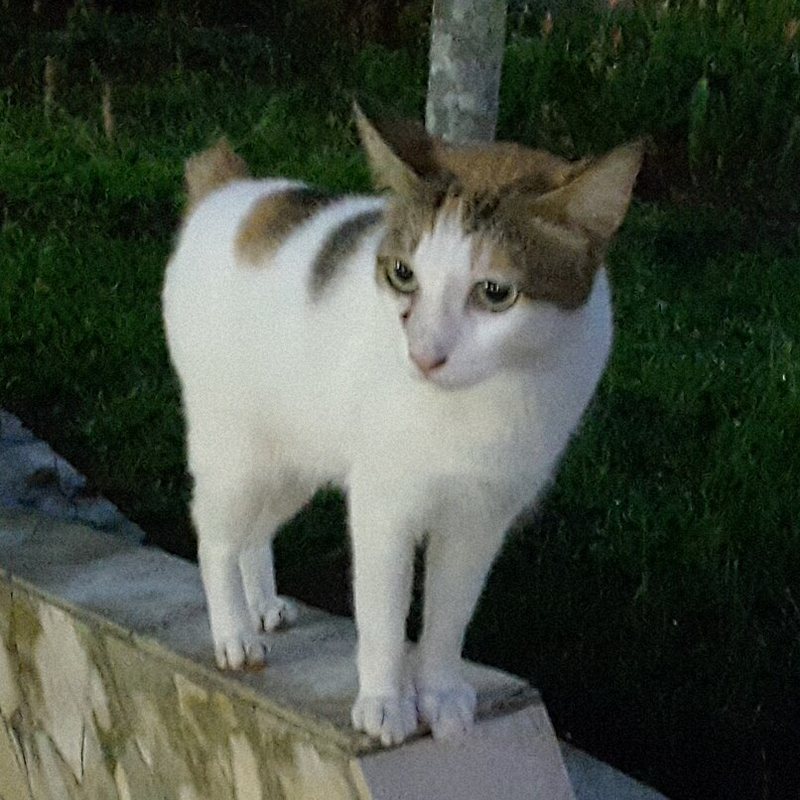

Japanese Bobtails have a short, distinctive tail and are often associated with Japan's beckoning-cat figures. The breed comes in shorthaired and longhaired varieties. Many are active and vocal, with an interest in play and interaction.
Quick facts
- Weight: 5 to 7 pounds for females and 8 to 10 for males (TICA)
- Life expectancy: 9 to 13 or more years (TICA)
- Coat: shorthair or longhair, with little tendency to mat
- Tail: short and kinked or curled, from a dominant gene variant
- Voice: talkative, often described as almost songlike
Temperament and daily life
Japanese Bobtails are usually busy, curious cats that like to be involved. TICA describes them as talkative, with voices described as almost songlike, and notes that many splash their paws in water, play fetch and perch on their people's shoulders, though they are not usually lap cats. CFA adds that their voices are soft rather than noisy.
Plan reliable interaction and care; compatible animal company may help some individuals. Climbing space, a tall scratching post, food puzzles and regular play sessions suit an active cat, and introductions and the individual cat's temperament matter with children and other pets. Some need extra time to accept other cats.
Grooming and care
Grooming is light. The shorthair coat needs combing several times a month, and the longhair coat does not tend to tangle or mat, although both shed more in spring and autumn. Handle the tail gently: it is sensitive, and the bones in it should never be pulled or straightened.
Health considerations
Published breed-specific health information is limited. CFA lists no specific health concerns for the breed and TICA considers it generally healthy, but that does not establish that Japanese Bobtails are free of inherited disease. Ask a breeder about the parents' health and rely on your veterinarian for the individual cat.
The tail itself has been studied. A 2016 study linked the Japanese Bobtail's kinked tail to a variant of a gene called HES7 that acts dominantly, so one copy is enough. Bobtailed cats typically lack one vertebra in the chest or lower back, but cats with two copies showed no additional abnormalities, and CFA reports no known problems associated with the tail. A separate study found the same variant in short-tailed feral cats in China, pointing to a common genetic basis, and treated the Manx-related T-box gene as a different cause of short tails (Xu and colleagues, 2016).
Japanese Bobtails come in many colors, often with white. White cats with blue eyes are at greatest risk of congenital deafness, so if a kitten is white, especially with blue eyes, have its hearing checked.
History
Cats are thought to have reached Japan from Korea or China as far back as the sixth century, although nobody knows whether those early cats had short tails. Bobtailed cats have been portrayed in Japanese manuscripts and paintings for at least 1,000 years. According to CFA's breed history, cat ownership was restricted to members of the court until 1602, when an imperial edict required all cats to be released into the streets. A tricolored cat with a raised paw and a bobbed tail, the maneki-neko, is a symbol of good fortune in Japan, although the figure does not establish the breed of any particular cat.
The first Japanese Bobtails reached the United States in 1968, when Judy Crawford sent cats from Japan to Elizabeth Freret. CFA granted championship status to the shorthair in 1976 and to the longhair in 1993, and TICA recognized the shorthair in 1979 and the longhair in 1991.
Appearance
The tail is short and can be kinked, curled or angled, with the fur fanning out over it. The rest of the cat is medium-sized and lean, with long legs and hind legs that are longer than the front, a triangular head and large, oval eyes. The classic coloring is mi-ke, a tricolor of white, red and black, but the breed comes in many colors. Breeders still bring in street cats from Japan to maintain diversity in the breed.
Before choosing a Japanese Bobtail
A Japanese Bobtail may suit a household where someone has time for daily play and conversation, and where the cat's tail will be handled gently. Expect a vocal, active cat rather than a quiet lap cat, and meet the individual cat to see how its temperament fits your home.
Japanese Bobtail FAQ
Is the Japanese Bobtail's tail related to the Manx's? No. Research links the Manx's short or absent tail to a different gene, T-box. The Japanese Bobtail's kinked tail is linked to a variant of the HES7 gene, which researchers have also found in short-tailed cats in China.
Are Japanese Bobtails hypoallergenic? No breed can be assumed safe for someone with a cat allergy. Spend time with the individual cat before committing.
Sources
- Cat Fanciers' Association: Japanese Bobtail
- The International Cat Association: Japanese Bobtail
- Lyons L.A. et al. (2016), Whole genome sequencing in cats identifies new models for blindness in AIPL1 and somite segmentation in HES7. BMC Genomics
- Xu X. et al. (2016), Whole genome sequencing identifies a missense mutation in HES7 associated with short tails in Asian domestic cats. Scientific Reports
- Cornell Feline Health Center: deafness
- PetMD: Japanese Bobtail
One question about the Japanese Bobtail cat
What is the most recognizable physical trait of the Japanese Bobtail?
Answer: Its short, kinked tail. The Japanese Bobtail is named for and defined by its short, kinked tail - no two are alike, and CFA's standard notes no health problems are linked to the trait, unlike some other short-tail genes in cats. Source