 Cat Trivia Games
iOS App
Meow in Different Languages: 31 Spellings and Words for Purr
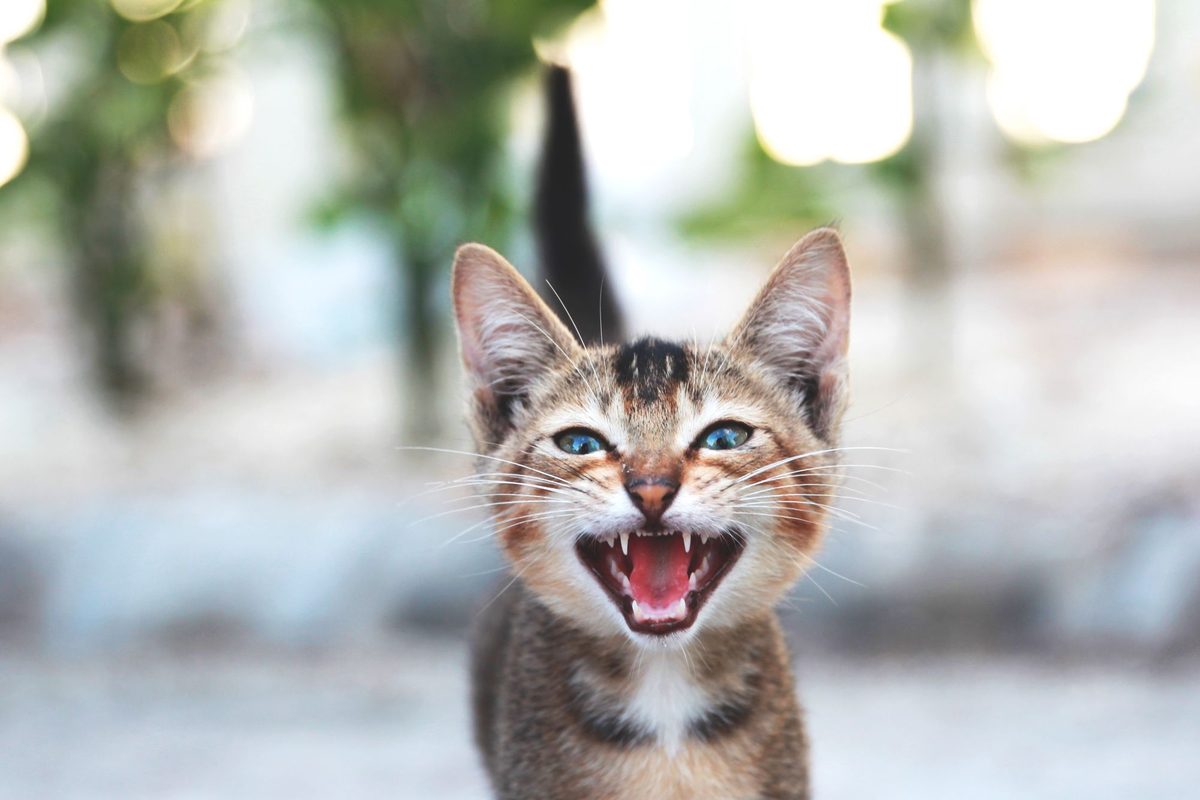
A cat's meow is miau in Spanish, German, Polish and Portuguese, miaou in French, mjau in Swedish and Norwegian, miyav in Turkish, ニャー (nyaa) in Japanese and 야옹 (ya-ong) in Korean. In 30 of the 31 languages below it starts with an m or an n, and Korean is the exception. Words for purr vary more, and several are also used for a spinning wheel, a mill or an engine.
Meow in 31 languages
Twenty-one spellings come from a 2023 Duolingo list by Mykhaylo Zakryzhevskyy and Alexander Mendes.1 The other ten come from dictionaries and, for Estonian, a linguistics journal. Doubled sounds (miau miau) follow the source.
| Language | Meow | Romanized, or a note | Source |
|---|---|---|---|
| Arabic | مياو مياو | meo meo | 1 |
| Bulgarian | мяу | myau; also a drawn-out мяу-у-у | 2 |
| Catalan | meu | A noun for the cat's cry; marrameu is a cat's cry, especially an enraged one | 3 |
| Chinese (Mandarin) | 喵 | miāo | 1 |
| Czech | mňau | 1 | |
| Danish | mjav | The Danish form cited in the Swedish Academy dictionary | 4 |
| English | meow, miaow | Miaow is British; meow is North American, also used in Britain | 15 |
| Estonian | näu | 6 | |
| French | miaou | 1 | |
| German | miau miau | 1 | |
| Greek | νιάου νιάου | niáu niáu | 1 |
| Hindi | म्याऊँ | myaun | 1 |
| Hungarian | miáu | 1 | |
| Indonesian | meong | 1 | |
| Irish | meamhlach | A noun, "a miaow" | 7 |
| Italian | miao | 1 | |
| Japanese | ニャー | nyaa; ニャン (nyan) appears in the Cat Day pun below | 18 |
| Korean | 야옹 | ya-ong | 1 |
| Latvian | ņau | 9 | |
| Norwegian | mjau | 10 | |
| Polish | miau miau | 1 | |
| Portuguese | miau | 1 | |
| Romanian | miau | Also miorlau | 11 |
| Russian | мяу-мяу | mjau-mjau | 1 |
| Slovenian | mijav | 12 | |
| Spanish | miau | 1 | |
| Swedish | mjau | Also miau; mau is recorded around 1755 | 4 |
| Thai | เหมียวๆ | meow meow | 1 |
| Turkish | miyav | 1 | |
| Ukrainian | м'яв-м'яв | myav-myav | 1 |
| Vietnamese | meo meo | 1 |
Why the spellings differ
Cats do not make one fixed sound. Susanne Schötz and colleagues at Lund and Linköping universities transcribe the typical meow as [miau], [ɛau] or [waʊ], the high-pitched mew as [mi], [wɪ] or [mɪu], and the moan as [moau] or [mæu].13 A written meow picks one of these.
Each language then fits that pick to its own speech sounds and rules for combining them, and the language you speak shapes what you hear in an animal's call, the Duolingo authors note.1
Fourteen of the 21 Duolingo meows share one pattern, Vivian Li found using phonetic transcription tools for The Pudding in 2025: a nasal such as m or n, then "ee", "ah" and "oo" vowels, as in miau.14 Among the near misses:
- Japanese stretches the "ah" and skips the "oo", likely because Japanese tends toward open syllables, Li says.14
- Turkish and Ukrainian end in a v instead of the "oo", possibly an areal feature shared by languages in one region, Li suggests.14
- Indonesian and Korean add a final ng. Korean also drops the m, and Indonesian and Vietnamese turn the middle vowels into a relaxed "e".14
Cat calls are consistent worldwide, so meow, Russian mjau, Spanish miau and Japanese nyan all have a nasal consonant and open vowels or a diphthong, note linguists Maria Flaksman and Alexander Kilpatrick. Yet their study of 1,317 English words that began as imitations suggests such words grow less like their foreign counterparts over time and more like ordinary words in their own language.15
Quick quiz: how well do you know cat behavior?
When researchers tested whether cats recognize their own name, how did most cats actually respond, according to the study?
Answer: Subtle cues, like ear or head movement. The study found cats showed recognition through subtle responses such as moving their ears, head, or tail, but fewer than 10 percent of cats actually got up and approached when their name was called. Source
When reward-based training shows diminishing returns, where a cat's response becomes slower or less reliable as training progresses, this performance decline is most likely due to:
Answer: Habituation to that specific reward type reducing its reinforcing strength. When performance deteriorates partway through training despite the cat initially being responsive, habituation to a single reward type is the primary culprit. The cat's nervous system adapts to that specific reward's sensory characteristics through repetition, diminishing its power to reinforce. Introducing a different reward type or varying between rewards restores the cat's responsiveness, proving the motivation remains intact, only that specific reward's effectiveness diminished. Source
When using Jackson Galaxy's 'Boil and Simmer' technique, the alternation between intense and calm phases mimics which aspect of a cat's natural hunting behavior?
Answer: The brief hunting bursts followed by rest pattern. The 'Boil and Simmer' method directly mirrors how wild cats hunt: they expend energy in short, intense bursts to capture prey, then rest and conserve energy before the next hunting episode. This pattern is ingrained in domestic cats' physiology and behavior, making it the most effective play style. Source
Words for purr, and what else they describe
Purr words vary far more than meows, and many are shared with something else that whirs or rumbles: a spindle or spinning wheel in Italian, Swedish, Czech and German, a mill in Norwegian, thunder in Japanese, and an engine in English, French and Irish.194212010816177
| Language | Purr | What the dictionary says | Source |
|---|---|---|---|
| English | purr | First recorded 1595 to 1605; also used of things, as in "the new motor of the car purred" | 16 |
| French | ronron | Built on the expressive root ron-; informally, a dull, continuous noise, as in "le ronron d'un moteur" (an engine's hum) | 17 |
| Spanish | ronronear | An onomatopoeic verb: to make "a kind of snore" as a show of contentment | 18 |
| Italian | fare le fusa | Fusa is the old plural of fuso, a spindle; the noise is likened to a spindle turning | 19 |
| German | schnurren | The same verb describes a spinning wheel's whirr: "das Spinnrad schnurrt" | 20 |
| Swedish | spinna | "To spin"; the cat sense, from a spinning wheel's whirr, is cited from 1795 | 4 |
| Norwegian | male | First, to grind grain in a mill; a purring cat "drones like a mill" | 10 |
| Czech | příst | First meaning, to spin fiber into thread; of a cat, to make sounds like a spinning wheel | 21 |
| Russian | мурлыкать (murlykat') | A quiet "mur-mur" rumble, of cats and other felines; colloquially, to sing barely audibly or speak softly | 22 |
| Japanese | ゴロゴロ (goro goro) | Also thunder and heavy things rolling; the purr example is from Natsume Sōseki's I Am a Cat | 8 |
| Irish | crónán | Used for a cat and for an engine | 7 |
Schötz and her colleagues describe purring as a low, regular sound made while air flows alternately out of and into the lungs, and list it in cats that are content, hungry, stressed, in pain, giving birth or dying.13 A purr alone does not tell you how a cat feels; the guide to why cats purr covers what else to watch.
Linguist Valeria Malysheva calls English purr the clearest case of the r sound standing for continuous vibration. The modern [pəː] comes from an older [pʊr].23
Calling a cat, and shooing one
The meow also shapes what people say to cats. Linguist Juan Carlos Moreno Cabrera collected the calls Iberian Peninsula languages use to summon and scare off animals, mainly from García de Diego's 1968 dictionary.24 For cats he lists:
- To call a cat: Spanish mini, minino, misino, mizo and micho; Catalan mix mix; Portuguese bich and bichinho; Basque miz, mix and mis.24
- To shoo a cat: Spanish zape, Catalan zap, Portuguese sape and Basque zapi.24
Most calling words contain the syllable mi, which he traces to the meow, written miau or similar in each language. The shooing words have no nasal stop such as m or n and are usually said with a sharp, startling sound.24
Meow in English, from mew to meow
Mew came first, in Middle English, first recorded between 1275 and 1325.16 Shakespeare's Hotspur uses it in Henry IV, Part 1: "I had rather be a kitten and cry 'mew' than one of these same meter balladmongers."25
Oxford dates miaow, now the British spelling, to the early 17th century.5 Dictionary.com first records meow, the North American one, between 1870 and 1875.16
Frequently asked questions
Do cats meow with an accent?
Possibly, but unproven. In 2016 the Meowsic project at Lund and Linköping universities set out to study about 30 cats and their owners. Robert Eklund said he believed cats speak dialects, likely by mimicking their owners, "but we don't know. Yet."26 The project's published examples compare meow melodies by situation (door, food, greeting, transport box) and mood, and note that not all cats used them.27
Why is Japan's Cat Day on February 22?
It is a pun on the cat's cry, ニャン・ニャン・ニャン (nyan nyan nyan), and the date 2/22. A committee organized by the Pet Food Industry Association (now the Pet Food Association) created it in 1987.8
Do cats meow at each other?
Seldom, as adults. Schötz and her colleagues note that adults mainly meow to people, so the adult meow may be a post-domestication extension of the mew kittens use with their mothers.13 True or False Cat Facts checks this claim too.
Up next
Christopher writes and runs Cat Trivia Games. The sources for this article are listed below, and how the site is made and corrected is on the editorial policy page. More about the author.
References
- Mykhaylo Zakryzhevskyy and Alexander Mendes, Duolingo Blog, November 22, 2023. Do cats "meow" in every language? back
- Institute for Bulgarian Language, Bulgarian Academy of Sciences. Dictionary of the Bulgarian Language (online): мяу. back
- Institut d'Estudis Catalans. Diccionari de la llengua catalana (DIEC2): meu and marrameu. back
- Swedish Academy. Svenska Akademiens ordbok (SAOB): mjau (published 1944, with the Danish form mjav) and spinna (published 1984). back
- Oxford Learner's Dictionaries. miaow (word origin and British and North American spellings). back
- Maria A. Flaksman and Pius W. Akumbu, SKASE Journal of Theoretical Linguistics 22(2), 2025. Introduction to Studies in Lexical Iconicity (Estonian näu). back
- Foras na Gaeilge, Teanglann.ie. de Bhaldraithe English-Irish Dictionary: miaow and purr. back
- Kotobank, from Shogakukan's Digital Daijisen and Digital Daijisen Plus. 猫の日 (Cat Day) and ごろごろ (goro goro). back
- Tēzaurs.lv. ņau. back
- Bokmålsordboka, Ordbøkene.no. mjau and male. back
- Dicționarul explicativ al limbii române (DEX '09), via dexonline. miau. back
- Slovar slovenskega knjižnega jezika (SSKJ2), via Fran.si. mijav. back
- Susanne Schötz, Joost van de Weijer and Robert Eklund, VIHAR 2017 workshop. Phonetic characteristics of domestic cat vocalisations. back
- Vivian Li, The Pudding, March 2025. Onomatopoeia Odyssey: How do animals sound across languages? back
- Maria Flaksman and Alexander Kilpatrick, SKASE Journal of Theoretical Linguistics 22(2), 2025. Against the tide: How language-specificity of imitative words increases with time (as evidenced by Surprisal). back
- Dictionary.com. purr, mew and meow. back
- Larousse. Dictionnaire de français: ronron. back
- Real Academia Española. Diccionario de la lengua española: ronronear. back
- Treccani. Vocabolario: fusa. back
- Duden. schnurren. back
- Czech Language Institute, Czech Academy of Sciences. Internetová jazyková příručka: příst. back
- T. F. Efremova, Sovremenny tolkovy slovar russkogo yazyka (Modern Explanatory Dictionary of the Russian Language), via Academic.ru. мурлыкать. back
- Valeria Malysheva, SKASE Journal of Theoretical Linguistics 22(2), 2025. Onomatopoeia in phonaesthemic groups: An interplay between iconicity and systematicity in English. back
- Juan Carlos Moreno Cabrera, SKASE Journal of Theoretical Linguistics 22(2), 2025. Animal-oriented interjections in the languages of the Iberian Peninsula. back
- Folger Shakespeare Library. Henry IV, Part 1, Act 3, scene 1. back
- Linköping University, via Phys.org, April 28, 2016. What does your cat say? back
- Meowsic project, Lund University. Listen to meows produced in different contexts and mental states. back
Written by Christopher Fox under our editorial policy.