 Cat Trivia Games
iOS App
Tama the Station Master Cat: Did She Really Save the Line?
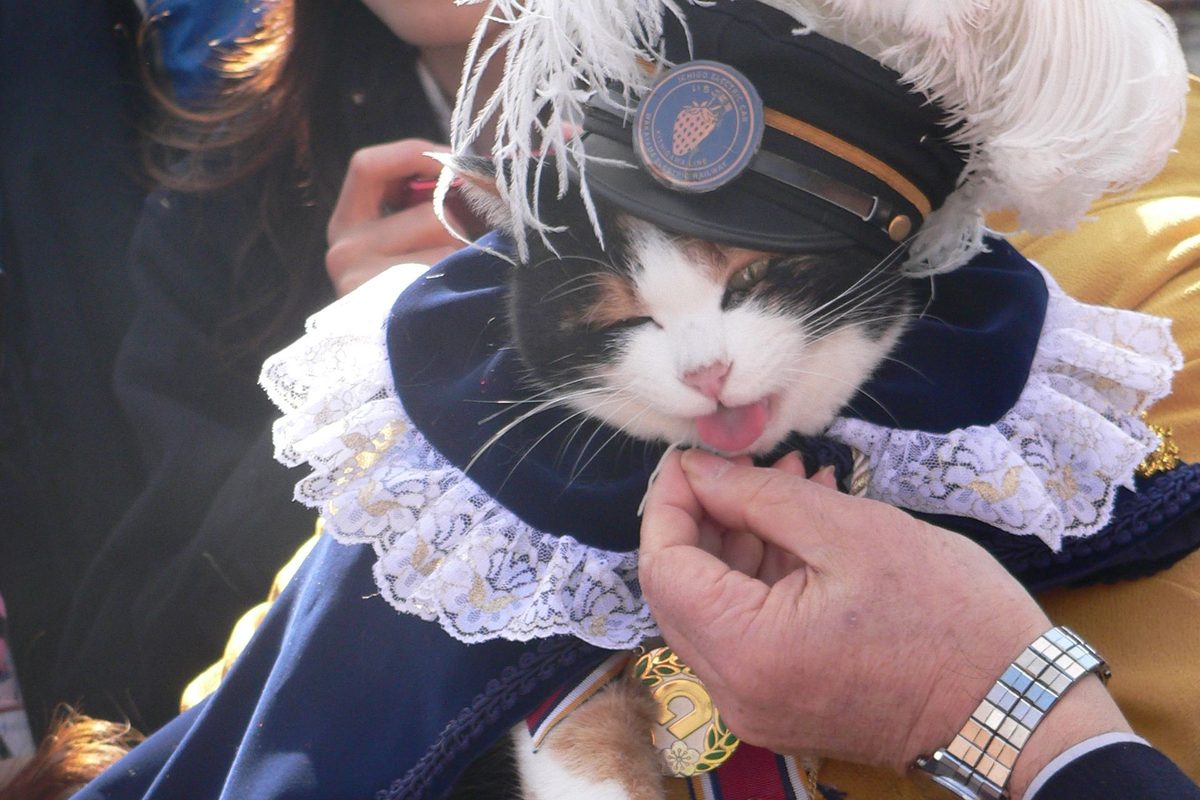
Tama the cat was station master of Kishi Station, the last stop on Wakayama Electric Railway's Kishigawa Line in western Japan, from 5 January 2007 until her death on 22 June 2015.1 A calico in a custom-made station master's cap, she was paid in cat food and drew tourists to a line that had nearly closed.23 Her successors still work at Kishi, in a station building modeled on a cat's face.41
A line that nearly closed
Nankai Electric Railway filed to abandon the Kishigawa Line in September 2004, after its ridership fell by almost half between fiscal 1974 and 2004 and ordinary losses passed 500 million yen. Residents organized to keep the trains running.5 The prefecture paid 230 million yen for the railway land, Wakayama City and the town of Kishigawa pledged up to 820 million yen of operating support over 10 years, and nine companies applied to run the line.6 The winner, Okayama Electric Tramway of the Ryobi Group, set up Wakayama Electric Railway, which took over on 1 April 2006.71
How a shop cat got the job
Tama, born a stray and raised at the Koyama shop beside Kishi Station, stayed when the station's last employee left in a 2006 cost-cutting drive.32 Railway president Mitsunobu Kojima later said the appointment began as an excuse to keep her there, "but she was really doing her job."8 Her mother, Miiko, and another cat, Chibi, started with her as assistant station masters.1 Her office was a converted ticket booth.9
Most of her promotions came in the first week of January:
- 5 January 2008: Super Station Master.4
- 28 October 2008: Wakayama Prefecture's first honorary knighthood, "Wakayama de Knight", from the governor, with a matching cape and hat in January 2009.14
- 21 March 2009: the Tama Densha, a train painted with 101 cartoon Tamas, entered service. The railway says Tama saved her New Year's money to join its supporters.10
- 2010 and 2011: executive officer, then managing executive officer, third in the company by the railway's count.4
- 5 January 2013: acting president; "Ultra Station Master" followed in January 2014.4
- 4 January 2015: president of the Tama Station Master Fund, set up by Kojima with 10 million yen of his lecture and writing fees about her.11
Did Tama save the line? What the numbers show
Tama is often credited with saving the Kishigawa Line,2 but the rescue was agreed in 2005, before she had any title,1 and most of the first rise in riders came before she started.12 The railway says she made a great contribution to its survival and revival.4
| Fiscal year | Riders | What was happening |
|---|---|---|
| 1974 | 3.61 million | The line's peak year6 |
| 1996 | 2.739 million | Run by Nankai12 |
| 2004 | 1.926 million | Nankai files to abandon the line125 |
| 2005 | 1.922 million | Nankai's last year; Okayama Electric Tramway chosen as operator in April 2005121 |
| 2006 | 2.114 million, up 10% | Wakayama Electric's first year; Tama appointed in January 20076 |
| 2007 | 2.118 million, up 0.2% | Tama's first full year7 |
| 2014 | 2.27 million | Reported by Kyodo News9 |
| Recent years | About 1.7 million a year | Governor of Wakayama, February 202613 |
The Guardian tied a 10% rise to 2.1 million riders to her first year on the job.2 That was fiscal 2006, Wakayama Electric's first year, and Tama started in its last quarter.6 A Wakayama Electric director's report of 6 March 2007 put riders from April 2006 through January 2007 at 111.6% of the year before and credited events, timetable leaflets and a monthly committee of residents, schools and officials. It does not mention Tama.12 Later estimates are kinder: in October 2008, AFP reported 55,000 more riders since her appointment than normally expected, without saying whose estimate that was.3
Her clearest effect was on how well known the line became. A transport ministry white paper lists the attention her appointment drew, with residents' campaigns and local government support, among the reasons ridership began to rise after the handover.14 Kansai University accounting professor Katsuhiro Miyamoto estimated in October 2008 that she brought 1.1 billion yen of economic effect in 2007.4 The white paper calls it an estimated ripple effect on the regional economy, tourism included.14 AFP reported her TV and other publicity was valued at 280 million yen.3 For scale, the line's transport revenue for all of fiscal 2007 was 320 million yen.7
Her death, funeral and shrine
Tama turned 16 in April 2015 and died of heart failure on 22 June.81 That April the railway marked her sanju, the Japanese 80th-birthday celebration, with a tree-planting.4 On the International Cat Care chart in our cat age calculator, 16 is about 80 in human years.
About 3,000 people attended her Shinto-style funeral at the station on 28 June, where mourners left flowers and tins of tuna.28 The railway named her Honorary Eternal Station Master.4 Kojima said Tama "really emerged like a savior, a goddess," and Wakayama's governor, Yoshinobu Nisaka, called her a "superstar of tourism".82
Tama Shrine went up on the Kishi platform on 11 August 2015, the day after her 50-day memorial rite, with Tama enshrined as Tama Daimyōjin.14 In February 2016 she became the first entry in the Wakayama Hall of Fame.1
Quick quiz: how well do you know cat history?
Cats evolved from desert ancestors. Which of these kidney adaptations did they inherit?
Answer: Highly efficient kidneys that concentrate urine and conserve water. Cats inherited highly efficient kidneys from their desert wildcat ancestors, allowing them to conserve water effectively by concentrating urine. This trait meant cats required significantly less fresh water than most other animals, making them ideal for ships with limited water supplies. Source
Cosey, the Maine Coon who won Best in Show at the 1895 Madison Square Garden cat show, had what coat color?
Answer: Brown tabby. Cosey was a brown tabby female owned by Mrs. Fred Brown, and her win at America's first major cat show helped launch the Maine Coon into the cat fancy. Source
Despite playing calm, lovable characters on screen, the Hollywood cat Orangey earned what nickname from a studio executive because of his real on-set temperament?
Answer: The world's meanest cat. One studio executive reportedly dubbed Orangey 'the world's meanest cat' after he repeatedly scratched and bit actors and crew, and would sometimes bolt after a scene wrapped, forcing productions to pause until he was caught. Source
Nitama and the cats who came after
Nitama, a calico raised in Okayama, was appointed on Tama's fifth anniversary, 5 January 2012, as Idakiso station master and acting Kishi station master, and took up the posts that February.14 In August 2015 she became "Tama II" and took the Kishi post.1 The later names count upward: the railway calls Yontama its fourth cat station master candidate, after Nitama and SUN Tamatama of Okayama Electric Tramway's museum.4
| Cat | Born | Key dates | Title now |
|---|---|---|---|
| Miiko, Tama's mother | Not listed | Assistant station master 5 January 2007; died 20 July 2009 | Permanent Assistant Station Master1 |
| Nitama | Not listed | Kishi station master 11 August 2015; acting president 5 January 2022; died 20 November 2025 | Honorary Special Station Master; enshrined as Nitama Ekimamori Ōkami115 |
| Yontama | 17 April 2016, Wakayama City | Idakiso station master 5 January 2018; Kishi station master 7 January 2026 | Kishi station master, at manager rank41 |
| Gotama | 28 January 2021, Okayama | "Fuku" station master 7 January 2025 | Idakiso station master and acting Kishi station master41 |
| Rokutama | 5 May 2025, Okayama | Arrived 7 January 2026 | Station master candidate4 |
Nitama was also chief priest of Tama Shrine from February 2022, and after her death was enshrined as Tama's attendant deity in a second shrine on the platform.115 The railway says Yontama, a rescued kitten, passed an interview with the company president.4 Gotama has a hooked tail, which the railway calls lucky in Japan, China and Europe, and her 2025 title "fuku" puns on the Japanese words for happiness and deputy.4 Her official profile says Rokutama, the newest recruit, dislikes loud noises and nail clipping.4
The cat-faced station and the line today
Kishi's current station, designed by Eiji Mitooka and finished on 4 August 2010, is modeled on a cat's face, with a hiwadabuki cypress-bark roof, the Tama Cafe and a Tama shop.1 A transport ministry summary said the old station had grown cramped as tourists increased.16 Mitooka also designed five of the line's themed trains, from the strawberry Ichigo train of August 2006 to the Tama Densha Museum train of December 2021.110
The line still runs at a loss: fiscal 2024 revenue was 316 million yen against costs of 571 million.17 The company says commuting and school travel fell sharply in the COVID-19 pandemic and have barely recovered, and its operating losses have topped 200 million yen a year recently.18
On 24 November 2025 the prefecture, the cities of Wakayama and Kinokawa and the railway agreed to move the infrastructure into public ownership, with private operation of the trains.113 After the Kinki District Transport Bureau approved higher fare caps on 12 June 2026, new fares were planned from 1 July.1718 The shortest adult trip now costs 220 yen, up from 190, and the full ride from Wakayama to Kishi 480 yen, up from 410.1918
Frequently asked questions
How do you get to Kishi Station?
Trains leave from platform 9 at JR Wakayama Station, and the 14.3 km ride to Kishi takes about 30 minutes.1 Kishi has no station staff, so pay at the fare box at the front of the train as you get off. The railway publishes a duty schedule for its cat station masters.204
What does the Tama Station Master Fund do?
It awards 500,000 yen a year, for a planned 20 years, to people who rescued or showed kindness to animals in trouble and to owners of animals that did good deeds. Entries close on 4 October, World Animal Day, and awards are presented in early January, on the anniversary of Tama's appointment.11
Up next


Christopher writes and runs Cat Trivia Games. The sources for this article are listed below, and how the site is made and corrected is on the editorial policy page. More about the author.
References
- Wakayama Electric Railway. Kishigawa Line guide and history, 1916 to 2026 (Japanese). back
- Justin McCurry, The Guardian (2015). Tama the cat: 3,000 attend elaborate funeral for Japan's feline stationmaster. back
- AFPBB News (5 October 2008). Wakayama's cat stationmaster Tama: economic effect of 1.1 billion yen (Japanese). back
- Wakayama Electric Railway. About the cat stationmasters, with Tama's history and the cat profiles (Japanese). back
- Ministry of Land, Infrastructure, Transport and Tourism. White paper on land, infrastructure, transport and tourism, fiscal 2006: local efforts to keep the Kishigawa Line (Japanese). back
- Ministry of Land, Infrastructure, Transport and Tourism. Wakayama Electric Railway Kishigawa Line: a local railway saved by community action and an operator tender (PDF, Japanese). back
- Ministry of Land, Infrastructure, Transport and Tourism (2009). Reviving a local railway through community and local government action: Wakayama Electric Railway (PDF, Japanese). back
- Mari Yamaguchi, Associated Press, in The Christian Science Monitor (2015). Japan mourns Tama, feline stationmaster and national icon. back
- Lucy Perkins, NPR, The Two-Way (2015), quoting Kyodo News. Tama, the cat that saved a Japanese train station, dies. back
- Wakayama Electric Railway. Trains of the Kishigawa Line: Ichigo, Tama, Umeboshi and Tama Densha Museum (Japanese). back
- Wakayama Electric Railway. Tama Stationmaster Fund (Japanese). back
- Wakayama Electric Railway managing director Watanabe (6 March 2007), published by the MLIT Policy Research Institute. Facing an era of fewer children, an aging society and population decline: aiming to be Japan's most warm-hearted local line (PDF, Japanese). back
- Governor of Wakayama Prefecture (2 February 2026). Message from the governor on the Kishigawa Line (Japanese). back
- Ministry of Land, Infrastructure, Transport and Tourism. White paper, fiscal 2008: column on Stationmaster Tama of the Kishigawa Line (Japanese). back
- Mitsunobu Kojima, Wakayama Electric Railway (January 2026). Honorary Special Stationmaster Nitama enshrined as Nitama Ekimamori Okami (Japanese). back
- MLIT Railway Bureau. Efforts to revitalize Wakayama Electric Railway (PDF, Japanese). back
- MLIT Kinki District Transport Bureau (12 June 2026). Approval of the fare cap change for Wakayama Electric Railway (PDF, Japanese). back
- Wakayama Electric Railway (30 April 2026). Kishigawa Line fare revision application (PDF, Japanese). back
- Wakayama Electric Railway. Fares: adult and child fare table, as of October 2026 (Japanese). back
- Wakayama Electric Railway. Kishi Station (Japanese). back
- Mitsunobu Kojima, Wakayama Electric Railway (May 2026). Birthday party for Stationmaster Tama and Stationmaster Yontama (Japanese). back
- Mitsunobu Kojima, Wakayama Electric Railway (June 2026). Stationmaster Yontama becomes priest at the 11th memorial rite for Stationmaster Tama (Japanese). back
Written by Christopher Fox under our editorial policy.