 Cat Trivia Games
iOS App
Why Do Cats Like Boxes?
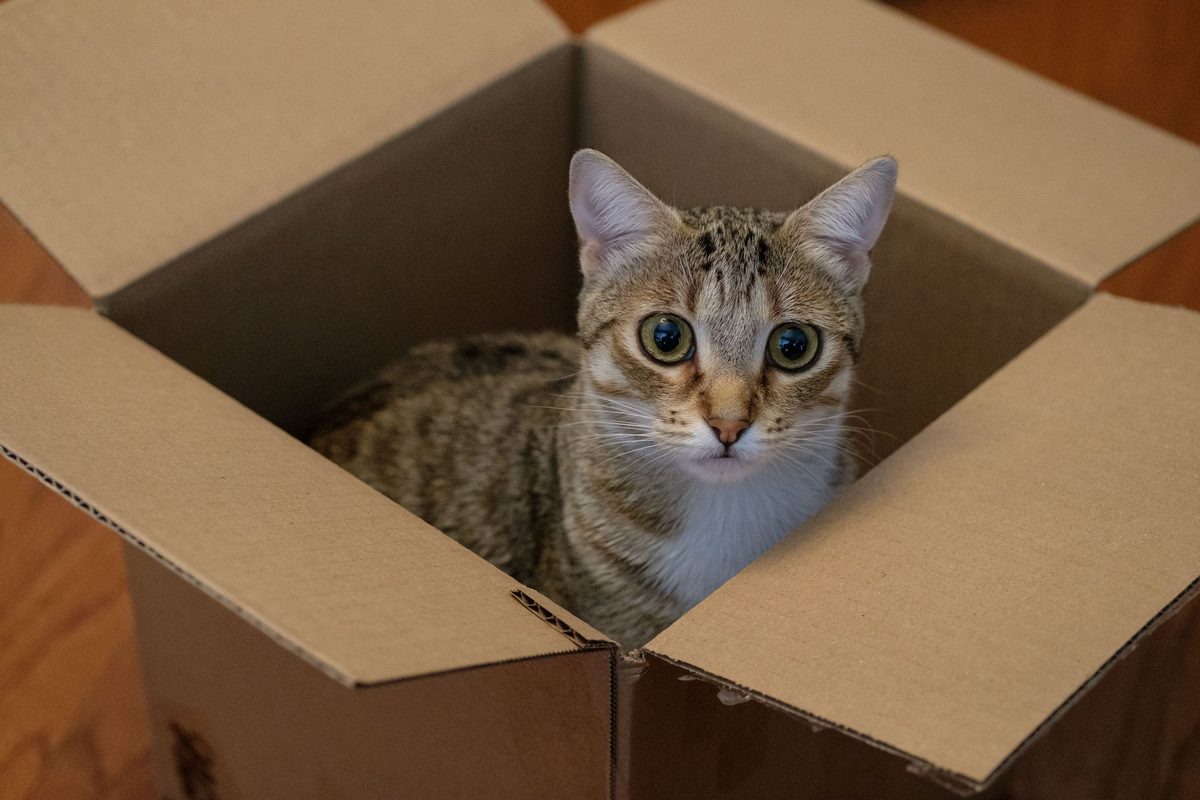
The best-supported reason cats like boxes is that a box is a place to hide, and hiding is one way cats cope with stress.4 In two Dutch shelter trials, new arrivals given a hiding box settled days sooner than cats without one.12 Warmth and ambush hunting may also play a part, but these trials did not test them, and the authors of a 2021 study of cats in illusory squares say the reason is still unknown.3
A box is a place to hide
Cats facing a threat, such as a move or a new cat, usually avoid it or hide, and fight only as a last resort. Feline veterinary guidelines from the AAFP and ISFM call hiding a coping behavior: a cat that cannot see a threat feels safer, even if part of its body shows. Their first suggested hiding places are cardboard boxes and cat carriers.4
In a 2014 trial at a Dutch shelter, new arrivals given a hiding box recovered faster.1 Claudia Vinke's team at Utrecht University gave boxes to 10 of 19 cats at random and scored stress for 14 days on the Kessler and Turner Cat-Stress-Score, a seven-level scale based on posture and behavior.5 The box cats scored lower on days 3 and 4, and by about day 3 had reached the level both groups shared on day 14.1
A 2019 trial near Arnhem found a seven-day head start: cats with a box reached a steady, lower stress score on day 2, and cats without one on day 9. W. J. R. van der Leij, Vinke and colleagues scored 23 quarantined cats, 12 with boxes, on seven of their first 12 days in late 2015. The cardboard boxes measured 44 by 31 by 26 cm, had two entrances and were never reused.2
Cats without a box may improvise: in several studies cited by the 2019 paper, stressed cats with no hiding place spent more time resting alertly behind the litter box.2
If I fits, I sits: the illusion study
Some cats will sit inside a square that exists only as an optical illusion. In 2017, Twitter posts of cats sitting in outlines taped on the floor, tagged #CatSquare, drew more than 82,000 retweets by the researchers' count.3
Gabriella Smith and Sarah-Elizabeth Byosiere of Hunter College, New York, and Philippe Chouinard of La Trobe University, Australia, turned the habit into a vision test. From June to August 2020, owners at home taped pairs of printed shapes on the floor for six daily trials, wore sunglasses so their eyes would not cue the cat, and filmed. The shapes were an 8-inch (20.32 cm) square outline; a Kanizsa square, four Pac-Man shapes with cut-out corners pointing inward to suggest a square with no drawn edges; and a control with the Pac-Men turned outward.3
Overall, cats chose the illusory square almost as often as the real one. A choice meant all four legs inside a shape for at least three seconds. Of 561 enrollments, 30 owners finished all six days, and nine of their cats made 16 choices: the square 8 times, the illusory square 7 and the control once. The authors concluded that cats may treat illusory edges as real ones, in line with a 1988 lab study in which two trained cats saw the illusion.3
Only one pairing was statistically significant: the illusion beat the control five times to none. The real square beat the illusion five to two and the control three to one, but neither gap was significant, and the authors call the square-versus-control result contrary to their expectations. They suggest repeating the work in controlled settings, with three-dimensional sides rather than flat shapes.3
Cat vision is well studied: by OpenAlex citation counts, five of the 10 most cited cat studies are Hubel and Wiesel's papers on the visual cortex.
Quick quiz: how well do you know cat behavior?
What's a safe way to stop a cat fight?
Answer: Use a barrier. Sliding a physical barrier, like a cushion, cutting board, or laundry basket lid, between fighting cats creates separation without putting your hands anywhere near their teeth or claws. Source
When a cat deposits a scent mark and leaves to hunt elsewhere, what is accomplished?
Answer: Leaving a message while hunting elsewhere. Scent marking serves as long-distance communication. By leaving a message and departing, a cat can establish territorial status without staying to defend it, allowing the cat to hunt efficiently while still communicating its presence to others. Source
When a cat is unsure about a strange new object in the room, it may glance back and forth between the object and its owner's face. What is this behavior called?
Answer: Social referencing. Social referencing is when an animal looks to a trusted person's emotional reaction to decide how to respond to something uncertain, and researchers have documented this in cats facing unfamiliar objects. Source
What each study showed, and what it did not
| Study | Cats and setting | Main finding | What it did not show |
|---|---|---|---|
| Kry and Casey, 2007 | Shelter cats with and without a hide box | Box cats were in or on their boxes 77% of the time; cats without tried to hide 36% of the time. Box cats approached more and retreated less5 | A difference in time to adoption5 |
| Vinke and others, 2014 | 19 new arrivals at a Dutch shelter, 10 with a box | Lower stress on days 3 and 4; box cats reached the day-14 level around day 31 | Long-term effects or group-housed cats, open questions the authors list1 |
| van der Leij and others, 2019 | 23 quarantined cats at a Dutch shelter, 12 with a box | Steady, lower stress by day 2 with a box, day 9 without2 | Protection from weight loss, or a difference in adoption rate or length of stay2 |
| Smith and others, 2021 | Pet cats at home: 561 enrolled, 30 finished, 9 chose a shape | Illusory square chosen 7 times, real square 8, control once3 | A significant pull of the real square over the control, or anything about solid boxes3 |
Boxes did not measurably slow weight loss in the 2019 trial: 6.3% with a box, 7.7% without. All but one cat lost weight in quarantine, 15 of the 23 by 5% or more in 12 days. The authors call that a serious health risk.2 All 12 box cats were adopted, against 9 of 11 without, after average stays of 22.9 and 24.1 days; neither gap was significant.2
Some shelter staff worry that adopters cannot see a cat hiding in a box. The 2019 boxes stayed in quarantine, but in Kry and Casey's study, boxes in the adoption ward made no significant difference to length of stay.2
Is it about warmth?
Possibly in part. A 2016 welfare review gives the cat's thermoneutral zone as 30 to 38°C (86 to 100.4°F), a National Research Council figure, and says most homes and laboratories keep cat housing closer to 22 ± 2°C (about 68 to 75°F).5 In the thermoneutral zone an animal spends no extra energy staying warm or cooling off.6 Thermal discomfort may be common, the review says, and it lists boxes, warm bedding, resting areas and heating elements as ways for cats to regulate their temperature.5
None of the studies above tested warmth. In the 2019 trial, towels covered the whole cage floor, the shelf and the inside of the box, so a preference for towels would not decide where cats rested.2
Is it about hunting?
Cats are predators, and a hunt starts with a silent stalk, watching and waiting for the right moment to strike, followed by a sprint and a strike with the front paws. Play uses predatory moves too, including stalking, ambushing and pouncing.7
The feline guidelines describe a safe box as one a cat can hide in and still see out of: a cardboard box turned on its side, with a roof, an easy way in and a perch on top for keeping watch.4 Seeing without being seen would also suit a stalking hunter, but none of these studies tested the ambush idea.
Frequently asked questions
How many boxes should a home with several cats have?
At least one safe place per cat, each sized for one and set apart from the others, the AAFP and ISFM guidelines suggest. Each should have more than one entry so another cat cannot block it. For kittens and older cats with limited mobility, boxes and perches should sit low or have a ramp.4
Does a cat sitting in a box mean it is stressed?
Not always. In the same guidelines, hiding is a way cats cope with stress, but a relaxed cat also uses its safe place to rest or sleep.4
Was the illusion study the first of its kind?
As far as its authors knew, it was the first published citizen science study of cat cognition and the first formal look at cats' attraction to flat rather than three-dimensional enclosures.3
Up next
Christopher writes and runs Cat Trivia Games. The sources for this article are listed below, and how the site is made and corrected is on the editorial policy page. More about the author.
References
- C. M. Vinke, L. M. Godijn and W. J. R. van der Leij, Applied Animal Behaviour Science 160 (2014), abstract at Utrecht University. Will a hiding box provide stress reduction for shelter cats? back
- W. J. R. van der Leij, L. D. A. M. Selman, J. C. M. Vernooij and C. M. Vinke, PLOS ONE (2019). The effect of a hiding box on stress levels and body weight in Dutch shelter cats; a randomized controlled trial. back
- Gabriella E. Smith, Philippe A. Chouinard and Sarah-Elizabeth Byosiere, Applied Animal Behaviour Science 240 (2021). If I fits I sits: a citizen science investigation into illusory contour susceptibility in domestic cats. back
- S. L. Ellis and others, Journal of Feline Medicine and Surgery (2013). AAFP and ISFM feline environmental needs guidelines. back
- Judith L. Stella and Candace C. Croney, The Scientific World Journal (2016). Environmental aspects of domestic cat care and management: implications for cat welfare. back
- American Veterinary Society of Animal Behavior blog, guest author (2021). Can we keep our cats warm enough? back
- ASPCA. Aggression in cats (predatory behavior and play). back
Written by Christopher Fox under our editorial policy.