 Cat Trivia Games
iOS App
Why Is My Cat Staring at Me?
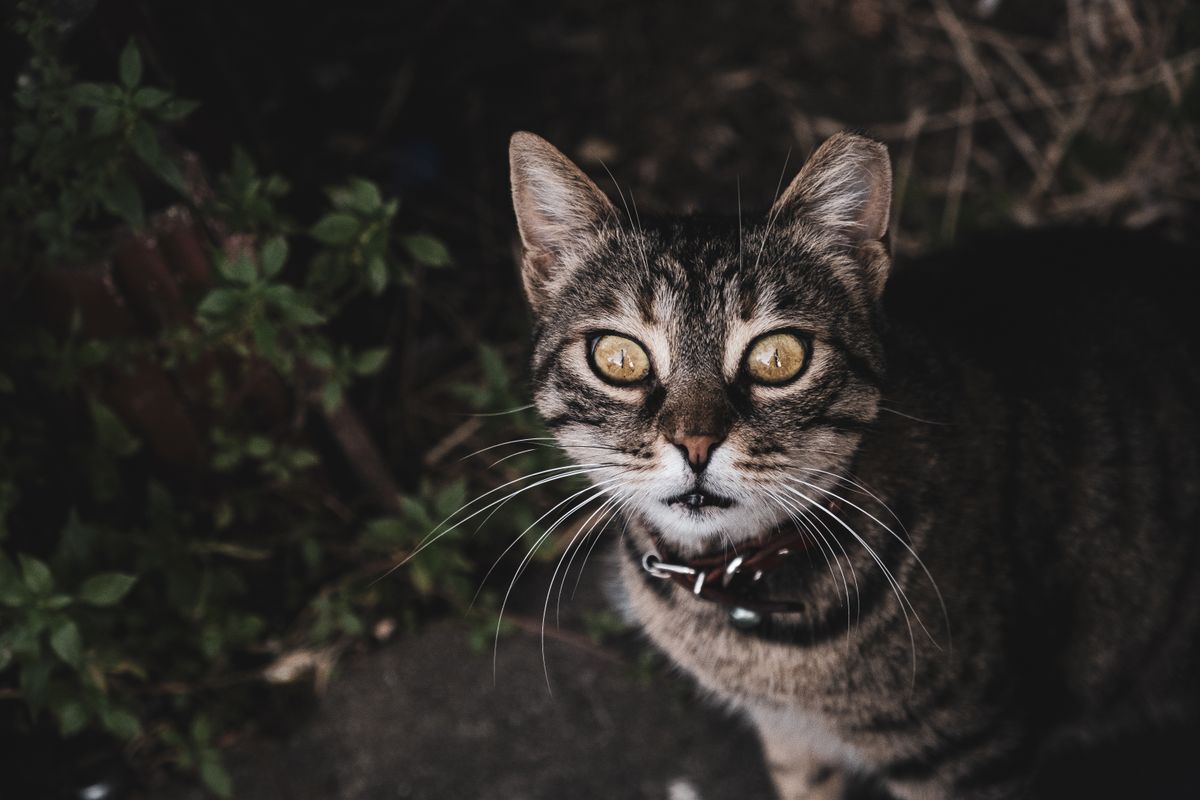
Your cat may be watching what you do, expecting food or attention, or getting ready to play. Its posture and the situation give you more information than the stare alone. A new behavior is worth noticing, especially if other things have changed too.
Common reasons cats stare
Veterinary behaviorist Wailani Sung, writing for PetMD, groups cat stares into a handful of common situations:1
- Asking for attention. Once it has your eye, the cat may slow blink, meow, roll over or rub against things nearby.
- Asking for food. Many cats stare at their people around feeding time. Moe, my Snowshoe, has strong opinions about exactly when dinner should happen.
- Inviting play. A crouched cat with wide pupils and a swishing tail may be about to pounce on a toy, or on your feet.
- Fear. Wide pupils, a lowered head, ears turned sideways or back, a crouched body and raised fur point to a frightened cat.
- A warning. A hard, unblinking stare with a stiff body and fur raised along the back and tail means back off.
- Relaxed contact. A soft gaze with slow blinks is generally read as a friendly signal.
Staring can also be learned. Cats Protection points out that if a stare has been followed by food or a fuss, a cat learns to try it again.2 And cats usually blink less often than people, which can make an ordinary look feel like a stare.3
What the rest of the cat tells you
Cats communicate with their facial expressions, ears, whiskers, posture and tail as well as their eyes and voice.4 International Cat Care notes that wide eyes with little blinking happen when cats face off with each other, or when a cat is fixed on a possible threat. Relaxed eyes that blink or half close are non-threatening signals. Ears facing forward in their normal position go with a relaxed cat, while flattened ears with wide pupils often mean fear.4
A loose, relaxed body is useful context, but it is not an all-clear on its own. Notice when the stare happens and what follows. Patterns around meals or play may tell you more than the length of the stare.
Moe has one pattern I can count on: when I talk to him from higher up than him, he meows back a response every time.
Distance matters too. Cats focus poorly on things closer than about 10 inches, PetMD explains, so a cat nose to nose with you relies on its whiskers as well as its eyes.5
What the slow blink study found
In 2020, psychologists at the Universities of Sussex and Portsmouth ran two experiments. In the first, cats narrowed their eyes more often when their owners slow-blinked at them than when the owners did not interact. In the second, cats were more likely to approach an unfamiliar researcher's outstretched hand after she slow-blinked at them than after she kept a neutral expression.67
A study found that cats were more likely to approach a person after a slow-blink interaction. That is evidence of a positive social response, not a translation of every blink. The authors themselves say more research is needed before drawing firm conclusions about the emotion involved.6
If you want to try it, Karen McComb, who supervised the study, suggests narrowing your eyes as you would in a relaxed smile, then closing them for a couple of seconds.7 Some cats answer with a slow blink of their own; some do not, and that is fine.
Early-morning stares and routines
A predictable routine helps many cats. Cats Protection suggests spreading meals and attention through the day, and the PDSA says a play session in the evening can help a cat that tends to wake you early.89 A familiar morning habit is different from a cat that suddenly seems much hungrier or thirstier than usual. That change is worth a vet visit: Cornell lists increased appetite and increased thirst among the common signs of an overactive thyroid.10
When staring is worth a vet visit
Key takeaways
- Most stares are about attention, food, play or simply watching you.
- Read the ears, pupils, tail and posture; they say more than the stare.
- Slow blinks went with friendlier approaches in a 2020 study, not with one fixed emotion.
- New staring, changes in the eyes or bumping into things deserve a vet visit.
Frequently asked questions
Is it rude to stare back at my cat?
A hard, unblinking stare is part of how cats face off with each other, so it can feel like a challenge, especially to a tense or unfamiliar cat. Soft eyes and a slow blink come across as friendlier.
Why does my cat stare at me while I sleep?
Cats are often most active around dawn and dusk, so yours may be up and looking for company or breakfast while you are still asleep. If it happens just before feeding time, it may be a learned request.
Why does my cat stare at nothing?
VCA says this is usually harmless. A cat may be watching a tiny insect or hearing sounds beyond our range; cats hear up to about 85,000 hertz, people only to about 20,000. If the staring comes with confusion, unsteadiness or other changes, call your vet.
Christopher writes and runs Cat Trivia Games. The sources for this article are listed below, and how the site is made and corrected is on the editorial policy page. More about the author.
References
- Sung, W., DVM, DACVB, PetMD. Why does my cat stare at me? 6 reasons cats stare and how to respond. back
- Cats Protection. Why does my cat stare at me? back
- PetMD. Do cats blink? back
- International Cat Care. Cat communication. back
- PetMD, with veterinary ophthalmologist Paul Miller. How do cats see the world? What to know about cat vision. back
- Humphrey, T. et al., Scientific Reports (2020). The role of cat eye narrowing movements in cat-human communication. back
- University of Sussex, via ScienceDaily (2020). The secret to building a rapport with cats: the slow blink. back
- Cats Protection. Why does my cat follow me around? back
- PDSA. Why do cats sleep so much? back
- Cornell Feline Health Center. Hyperthyroidism in cats. back
- PetMD. Head pressing in cats. back
This is general information, not veterinary advice. Written by Christopher Fox under our editorial policy.