 Cat Trivia Games
iOS App
Cats in Mythology and Folklore: From Bastet to the Yule Cat
Cats appear in myths and folk tales from Egypt to Iceland. The Egyptian goddess Bastet had a lioness's head long before she took a cat's form, and two cats draw the Norse goddess Freyja's car. Wales has Cath Palug, a monster cat that fed on warriors. In Japan, old cats were said to become man-eating nekomata. Scotland has the black, dog-sized Cat Sìth, and Iceland's Yule Cat comes for anyone without new clothes at Christmas.
The oldest written source I could check for each legend
The sources below run from about 2800 BCE to 1900, in date order. A legend told aloud can be older than its first written record.
| Culture | Cat | Oldest source checked | Date | What it says |
|---|---|---|---|---|
| Ancient Egypt | Bastet | Inscribed sherds among thousands of stone vessel fragments from burial galleries under Djoser's step pyramid, Saqqara2 | 2nd dynasty, around 2800 BCE | A woman with a lioness's head |
| Norse | Freyja's cats | The Prose Edda, credited to Snorri Sturluson3 | About 1230, per the translation's introduction | Freyja drives a car drawn by two cats |
| Wales | Cath Palug | Pa gur, poem 31 of the Black Book of Carmarthen45 | Manuscript from about 1250 | Cai faces the cat on Anglesey |
| Japan | Nekomata | Yoshida Kenkō, Tsurezuregusa, section 896 | About 1330 | Old cats can become people-eating nekomata |
| Iceland | The Yule Cat (jólaköttur) | Jón Árnason, Íslenzkar þjóðsögur og æfintýri7 | 1864 (collection printed 1862 to 1864) | Takes those with no new garment on Christmas Eve |
| Japan | The cat of Nabeshima | A. B. Mitford, Tales of Old Japan, retelling a family tradition8 | 1871 | A two-tailed cat takes the shape of a prince's favorite |
| Scottish Highlands | Cat Sìth (cait shìth, "elfin cats") | J. G. Campbell, Superstitions of the Highlands and Islands of Scotland1 | 1900, after the author's death | Black, dog-sized, a white spot on the breast |
Bastet was a lioness long before she was a cat
Bastet's oldest known mentions, from about 2800 BCE, show her as a woman with a lioness's head. So does her first appearance at Bubastis, her main cult center in the Nile Delta: a door lintel of Pepi I's reign, around 2270 BCE.2
The cat form came later. "From her earliest attestations until the later New Kingdom, Bastet is exclusively shown as a lioness," writes Eva Lange-Athinodorou of the University of Würzburg. The 12th-dynasty Loyalist teaching pairs her with Sekhmet, another lioness goddess: the ideal king "is Bastet who protects the two lands" and "Sekhmet against he who transgresses his order." Lange-Athinodorou reads the later cat as a feline goddess's gentler side. Pet cats first appear in tomb paintings in that period, the Middle Kingdom.2
Bastet, Sekhmet and other lioness goddesses were linked to the sun god Ra, often as his daughter or his eye. In the Myth of the Eye of Ra, on three demotic papyri of the 2nd century BCE, Ra's daughter rages as a lioness far south of Egypt until Thoth, as a baboon, calms her with music, dance and alcohol and brings her home. Lange-Athinodorou links this to the music, dancing and drinking at Bastet's Bubastis festival.2 More on Egypt's cats: what their mummy skulls show.
Freyja's cats, and the cat Thor could not lift
In the Prose Edda, Freyja "drives in a car drawn by two cats" when she goes abroad, and at Baldr's funeral "Freyja drove her cats." The cats get no names or description. The Edda's mythological part is credited to the Icelander Snorri Sturluson (born 1178, killed at Reykholt in 1241), though the translation's introduction says how much he wrote is uncertain.3
Cats turn up twice more, in the Fenris wolf's fetter and in a giant's hall. Dwarfs made the fetter, Gleipnir, from six things, first "the footfall of cats," and as proof the Edda notes that "a cat's footfall cannot be heard." In Utgard-Loki's hall, Thor tries to lift a large gray cat and raises only one foot off the floor. The giant later admits the cat "was in reality the Midgard-serpent, which surrounds all lands."3
Quick quiz: how well do you know cat history?
What was the real name of the famous internet cat known as 'Grumpy Cat'?
Answer: Tardar Sauce. Grumpy Cat's real name was Tardar Sauce. She became an internet sensation due to her naturally grumpy facial expression caused by feline dwarfism and an underbite, despite being a friendly and affectionate cat. Source
What wild species is considered the ancestor of all domestic cats?
Answer: The Near Eastern wildcat. Mitochondrial DNA studies show Near Eastern wildcats, Felis silvestris lybica, are the maternal ancestors of every domestic cat alive today. Source
When British antiques dealer Ben Rea died in 1988, he left his entire multi-million-pound fortune to which of his fifteen cats, making her the world's wealthiest feline?
Answer: Blackie. Blackie, the last surviving of Rea's fifteen cats, inherited roughly seven million pounds, an amount later split between cat charities tasked with caring for her. Source
Cath Palug, the monster cat of Anglesey
The oldest Cath Palug text I could check is Pa gur, a poem in the Black Book of Carmarthen. The University of Cambridge dates the manuscript from 1250 and calls it the earliest surviving medieval manuscript written solely in Welsh, a collection of 9th to 12th century poetry.4 In it, Arthur lists his men's deeds to a gatekeeper.9 Cai "went to Mona" (Anglesey), shield ready against Cath Palug: "Nine score before dawn / Would fall for its food." Nine score is 180. One line later the manuscript breaks off.5
The Welsh Triads give the cat's birth. The swineherd Coll's sow Henwen, whose offspring were prophesied to harm Britain, bore a wolf cub, an eagle and a kitten. Coll threw the kitten into the Menai Strait; it landed on Anglesey and grew into one of the Three Great Oppressions of Anglesey.9
Scottish and French writers picked up the story. John of Fordun's 14th-century chronicle of the Scots says "some old hags" blamed a cracked boulder by Dunbar castle on the cat's claw in its fight with Kay. In the Estoire de Merlin, Arthur kills a similar monster near Lausanne: a fisherman's kitten "blacker than mulberry" that grew huge, sank its claws into his shoulders and sent more than 300 links flying from his mail shirt.9
Japan's nekomata and shape-shifting cats
Section 89 of Yoshida Kenkō's essays, Tsurezuregusa, is the oldest Japanese cat-monster text I could read. It reports talk of a people-eating nekomata deep in the mountains, and says that even away from the mountains, old cats can become nekomata and take people. An annotated 1925 to 1926 edition glosses the nekomata as an old cat with a split tail, commonly believed to cause uncanny events and turn ferocious.6
Kenkō then tells how this talk fooled a monk, a writer of linked verse. Walking home alone late one night, he was leapt on beside a stream by something going for his neck and fell in, shouting about the nekomata. Neighbors with torches found a monk they knew, his prize fan and box soaked. The attacker was his own dog, which had recognized him in the dark.6
Cats, foxes and badgers, A. B. Mitford wrote, were credited in Japan with taking human shape to bewitch people, and in story-books they "even play a part in the histories of ancient and noble families." His Tales of Old Japan retells a tradition of the Nabeshima family, princes of Hizen: a large cat kills the prince's favorite, O Toyo, takes her shape and drains the prince night after night, until a foot soldier stays awake on guard by stabbing his thigh. Tradition, Mitford adds, gave the cat two tails.8
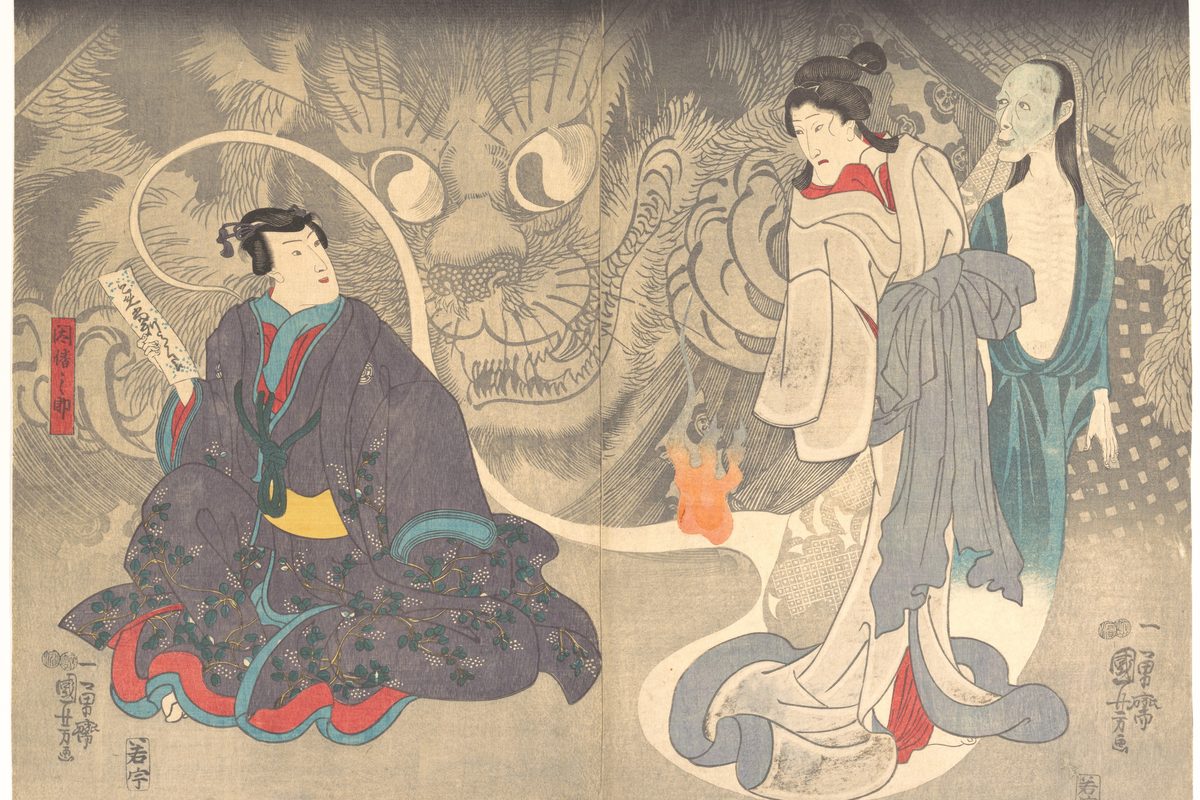
Cat monsters reached kabuki and woodblock prints too. The Metropolitan Museum of Art has Utagawa Kuniyoshi's Scene from a Ghost Story: The Okazaki Cat Demon (about 1850)10 and an 1870 triptych of actors in the kabuki play Tōkai Kidan Nekomata Yashiki.11
A Mitford footnote says cats were found in Japan, as on the Isle of Man, "with stumps, where they should have tails," some by human hand ("the result of art") and some naturally. It also says Edo's cats had a "bad repute as mousers," which he blamed on "much petting at the hands of ladies."8 More on Japan's short-tailed cats: the Japanese Bobtail.
Scotland's Cat Sìth and Iceland's Yule Cat
John Gregorson Campbell's two-sentence entry on Highland elfin cats (cait shìth) calls them a wild breed, "as large as dogs, of a black colour, with a white spot on the breast," with arched backs and bristling fur, and says many held them to be "witches in disguise," unconnected with the fairies. His book was "collected entirely from oral sources."1 The entry has nothing on the saucer of milk at Samhain or the soul-stealing at wakes that some modern retellings attach to the Cat Sìth.12 More black cat lore: black cat facts.
Written records of Iceland's Yule Cat go back only to the 19th century.13 The oldest I could check is Jón Árnason's folk tale collection: besides the Yule Lads, he writes, people believed a monster called the jólaköttur was about at Christmas. It harmed no one with a new garment for Christmas Eve, but those who got none "all went into the Yule Cat," which took them (Jón adds a doubtful "ate?") or at least their Christmas food. So children and farmhands worked hard for their masters to earn something new.7
Jóhannes úr Kötlum retold the story in his poem "Jólakötturinn," where the cat hunts people and has no interest in mice. To keep it from snatching the little ones, women work at their looms and spinning wheels so every child gets something new. Near the end the poem suggests readers might help children who may still get nothing.14
Frequently asked questions
Did a cat ever kill King Arthur in a legend?
Possibly. André de Coutances, in his satire Le Roman des Franceis, mocked the French for a tale in which Arthur, instead of falling at Camlann, was "heaved into a bog by the Cat Palug," which then ruled Britain. Minjie Su, writing for Medievalists.net, reads this as a sign such an ending may once have existed.9
Is the Yule Cat Grýla's pet?
In some modern accounts. The Reykjavík Grapevine says it is thought to be the house cat of the troll Grýla, her husband Leppalúði and the Yule Lads.13 Jón Árnason does not make that link: he names the Yule Lads, then the cat as a separate monster.7
What does the name Bastet mean?
It is not settled. Lange-Athinodorou writes that it may come from the word for an ointment jar, a possible link to royal regalia, and that Bastet may first have been a deity of the royal residence.2
Up next
Christopher writes and runs Cat Trivia Games. The sources for this article are listed below, and how the site is made and corrected is on the editorial policy page. More about the author.
References
- John Gregorson Campbell, via Project Gutenberg. Superstitions of the Highlands and Islands of Scotland (Glasgow, 1900), "Cats" and editor's note. back
- Eva Lange-Athinodorou, American Research Center in Egypt. The goddess Bastet and the cult of feline deities in the Nile Delta. back
- Snorri Sturluson, translated by Rasmus B. Anderson, via Project Gutenberg. The Younger Edda, also called Snorre's Edda, or the Prose Edda. back
- University of Cambridge, 2015. Ghosts from the past brought back to life (the Black Book of Carmarthen). back
- Celtic Literature Collective, translation from W. F. Skene's The Four Ancient Books of Wales (1868). Arthur and the Porter, Black Book of Carmarthen XXXI. back
- Yoshida Kenkō, Japanese text of the 1925 to 1926 annotated edition, via Wikisource. Tsurezuregusa, section 89. back
- Jón Árnason, via Wikisource (Icelandic). Íslenzkar þjóðsögur og æfintýri, "Jólanóttin" (Christmas night). back
- A. B. Mitford, via Project Gutenberg. Tales of Old Japan (1871), "The Vampire Cat of Nabéshima." back
- Minjie Su, Medievalists.net, 2019. The kitten that nearly killed King Arthur. back
- The Metropolitan Museum of Art. Utagawa Kuniyoshi, Scene from a Ghost Story: The Okazaki Cat Demon, about 1850. back
- The Metropolitan Museum of Art. Toyohara Kunichika, actors in the kabuki play Tōkai Kidan Nekomata Yashiki, 1870. back
- Kathryn Copeland, Catster, updated 2026. Cat Sìth: the "King of Cats" from Celtic mythology. back
- Haukur S. Magnússon, The Reykjavík Grapevine, 2008. The Christmas cat. back
- Jóhannes úr Kötlum, Skáldasetur Jóhannesar úr Kötlum (Icelandic). Jólakötturinn (the poem). back
Written by Christopher Fox under our editorial policy.