 Cat Trivia Games
iOS App
Cat Tongue Facts: Hollow Spines, Lapping and No Sweet Taste
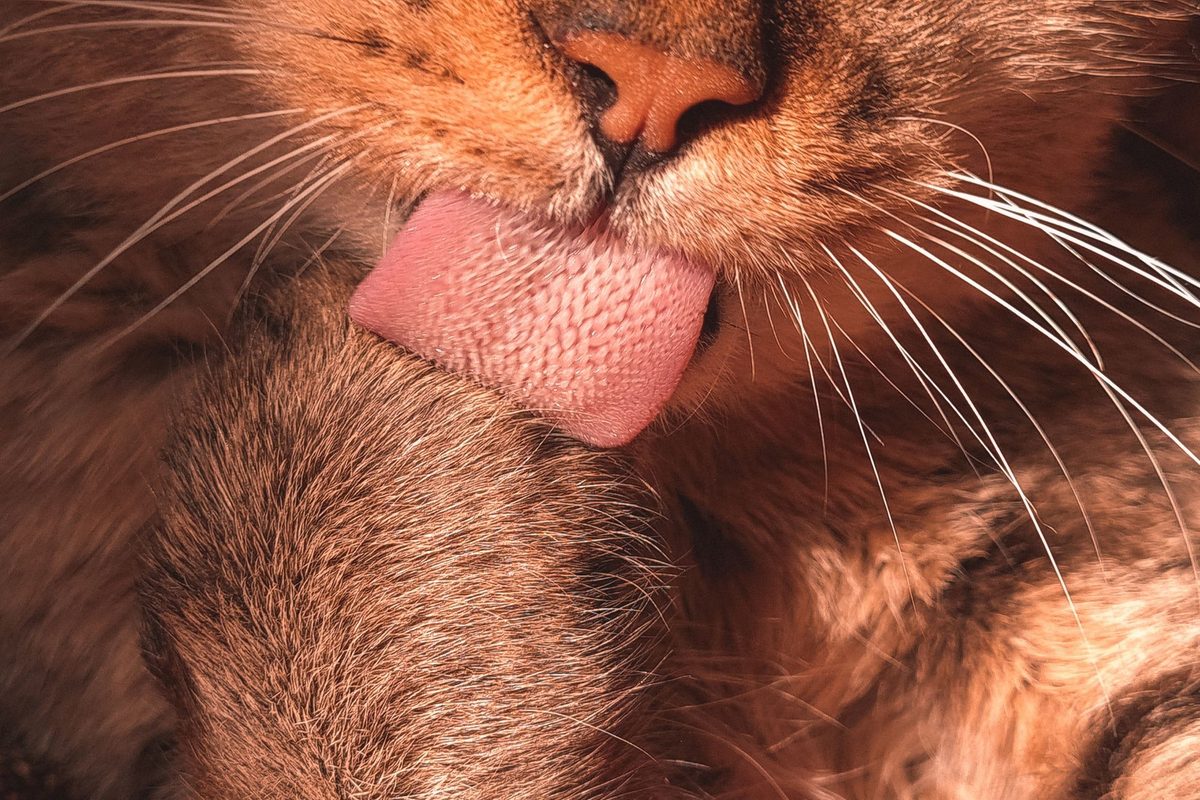
A cat's tongue feels like sandpaper because it is covered in hundreds of backward-facing spines called papillae, made of keratin and about as stiff as a human fingernail.12 The large spines that touch the fur have hollow, scoop-shaped tips that wick up saliva and carry it down to the roots of the fur during grooming.1 The same tongue cannot taste sugar,3 and it drinks by pulling water up in a column with its top surface.4
Why a cat's tongue feels rough
The rough spines are filiform papillae, and they point back toward the throat. In lab tests, a domestic cat papilla was about five orders of magnitude stiffer than the tongue tissue around it.1
The spines stand up during a lick. As the tongue spreads and stiffens, high-speed video shows them rotating until they are perpendicular to its surface, where they make more contact with the fur.1
The large spines turned out to be hollow. A 1982 study concluded that each papilla is a solid cone, a view the 2018 paper says went undisputed for two decades. Micro-CT scans from six cat species then showed Alexis Noel and David Hu a U-shaped cavity at the tip, and they named the spines cavo papillae.1 The discovery also appears in my hard cat trivia set.
How the hollow spines groom and cool
Each hollow tip fills itself. A drop of food coloring touched to the tip of a domestic cat or tiger papilla rose into the cavity in about 0.1 seconds, stayed put even with the papilla upside down, and came out when the tongue touched fur.1
The cavities hold little saliva, but they put it deep in the fur. The 290 large papillae on a domestic cat's grooming area hold 4.1 microliters in all, about 5% of the fluid on top of the tongue. Saliva on the tongue's surface gets only about 0.54 millimeters into the fur, while the papillae stand about 2.3 millimeters tall and spread it along the hair roots.1
Papilla height is nearly the same in all six species studied, from domestic cat to lion, though their body weights span more than 30-fold. Comparing that height with how flat each cat's back fur gets under the tongue, the authors calculated that an American short-haired domestic cat's fur compresses from 37 to 1.2 millimeters, well within reach. A Persian's compresses from 81 to 2.6 millimeters, and two Persian breeds were the only cats in the comparison whose compressed fur was deeper than the papillae could reach.1
Grooming also cools. Cats have sweat glands only on their paws, and thermal images showed a temperature difference of up to 17 °C between skin and topcoat once saliva on the fur evaporated. In the authors' best-case estimate, evaporating saliva from the papillae alone could carry off nearly a quarter of the heat a resting 2.2-kilogram domestic cat needs to shed.1
House cats can spend up to 24% of their waking time grooming. At 1.4 licks per second, the authors calculate, a cat could spread up to 48 grams of saliva a day through its papillae alone.1
Quick quiz: how well do you know cat biology?
What structures cover a cat's tongue and help with food consumption and grooming?
Answer: Papillae. A cat's tongue is covered in tiny, backward-curving spines called papillae. The most common type, filiform papillae, work like a built-in hairbrush and meat-scraper, helping a cat rasp meat off bones and comb loose fur out of its coat while grooming. Source
What two main factors combine to cause muscle loss in healthy aging cats?
Answer: Reduced nutrient absorption and decreased mobility. Senior cats become less efficient at digesting and absorbing nutrients and often have decreased mobility, both of which contribute to muscle mass loss (sarcopenia). This is a normal age-related process rather than a disease. Source
When a sound wave strikes the tympanic membrane and sets the ossicular chain in motion, how does the stapes convey this vibration to the inner ear?
Answer: By pushing the oval window membrane, which creates pressure waves in the perilymph fluid. The stapes has a footplate that sits in the oval window, a membrane-covered opening in the cochlea. When the stapes vibrates, it pushes against the oval window membrane, transferring the mechanical vibrations to the perilymph (fluid) within the cochlea. This fluid motion deflects the basilar membrane and stimulates the hair cells of the organ of Corti. Source
Why cats cannot taste sweet
Cats have a broken Tas1r2 gene, one of the two genes that make the proteins of the sweet taste receptor. A 2005 study found that the other gene, Tas1r3, looks functional in cats, while Tas1r2 has a 247-base-pair deletion and several stop codons, with no sign that it makes RNA or protein. Without that protein, a working sweet receptor cannot form, so the cat lacks the receptor likely needed to detect sweetness.3
A similar deletion and stop codons turned up in six more domestic cats, a tiger and a cheetah, and the paper notes that tigers and cheetahs show no preference for sweetened water. The cat's other tastes work: its taste nerves respond to salty, sour and bitter stimuli, amino acids and nucleotides.3
Other meat eaters broke the same gene independently. A 2012 study of Tas1r2 in 12 species of the order Carnivora found it broken in seven, all exclusive meat eaters: the sea lion, fur seal, Pacific harbor seal, Asian small-clawed otter, spotted hyena, fossa and banded linsang. In behavior tests, the otter showed no preference for sweet compounds, while the spectacled bear, whose gene is intact, did. Sea lions and bottlenose dolphins have lost all three sweet and umami receptor genes.5
A 2023 study proposed umami as the cat's main appetitive taste. Changes at two key binding positions keep the cat receptor from responding to glutamic or aspartic acid, which the human receptor detects. It responds to nucleotides, and 11 amino acids strengthen that response when paired with one. The authors suggest this may help explain the appeal of tuna, which is high in the nucleotide inosine monophosphate and in free histidine, a pairing that gives the cat receptor a strong umami boost.6
Bitter taste works too: a 2015 search of the cat genome found 12 intact bitter receptor genes, and at least seven of the receptors worked in cell-based tests.7
How cats drink
A lapping cat touches the water with only the top of its tongue, high-speed video showed in 2010.4 Cats and dogs have incomplete cheeks, so they drink with the tongue.4 The cat curls the tip backward so the top touches the liquid first, as a 1940 film by MIT's Harold Edgerton had already shown.8 As the tongue pulls back quickly, water rises with it in a column, and the cat closes its mouth to pinch off the top before gravity pulls it back down.48
Lapping balances inertia, which carries the water up, against gravity, which pulls it down. Domestic cats lap about four times a second, and big cats such as tigers lap more slowly. Measurements across the cat family supported the team's prediction for how lapping frequency changes with body mass.48 The star of their videos was an 8-year-old cat named Cutta Cutta.8 When I start drinking water, my cat Moe stands on my lap and licks water from the bottle cap.
Dogs also drink a water column, with tongues that accelerate harder. MIT's 2010 report described dogs as dipping their tongues like ladles, but a 2015 study of 19 dogs found that the curled tongue tosses most of that water aside, and the dog, like a cat, drinks the column its retreating tongue pulls up. Dog tongues pulled up at 1 to 4 times the pull of gravity (about 2 g in a small example dog, about 4 g in a large one), against roughly 1 to 2 g for a cat's. The authors conclude that the two species lap in different physical regimes.9
More cat tongue measurements
| What was measured | Figure | Source |
|---|---|---|
| Saliva held by one grooming papilla | 0.014 microliters | 1 |
| Fluid one lick leaves on fur (grooming machine test) | About 56.6 microliters, nearly 50% of the fluid on the tongue | 1 |
| A grooming lick | About 63 mm long, at about 220 mm per second | 1 |
| Papilla stiffness | 1.66 to 1.94 GPa (three tests on one domestic cat papilla) | 1 |
| Taste buds in one circumvallate papilla | About 400 | 3 |
| Lapping frequency and body size | Falls with body mass to the minus one-sixth power, in cats and dogs | 9 |
Frequently asked questions
Do lions and tigers have the same kind of tongue?
Their grooming spines are built the same way. The 2018 study found hollow cavo papillae in all six species it examined: domestic cat, bobcat, cougar, snow leopard, tiger and lion. The lion's were the longest, at 2.7 millimeters, 35% longer than a domestic cat's. That lion was female, and the authors suggest that male lions may have longer papillae for grooming and wetting their manes.1
How often do cats bring up hairballs?
Bringing one up once every week or two is not uncommon, according to a veterinarian quoted by the Cornell Feline Health Center. As a cat grooms, the backward-slanted papillae on its tongue propel loose hair down its throat. Most passes through the digestive tract, and some can collect in the stomach as a hairball. Long-haired breeds such as Persians and Maine Coons may be at greater risk. A cat that is lethargic, refuses to eat for more than a day or two, or has repeated episodes of unproductive retching or true vomiting should be examined by a veterinarian without delay.2
Has anyone built a brush that copies a cat's tongue?
The 2018 team did. Their tongue-inspired grooming (TIGR) brush is a domestic cat tongue at 400% scale, with 3D-printed papillae set in flexible silicone. Pulled through faux fur, it settled at a grooming force of 0.2 newtons, less than half that of a human hairbrush, and one swipe along the spines removed nearly all the trapped fur.1
Up next
Christopher writes and runs Cat Trivia Games. The sources for this article are listed below, and how the site is made and corrected is on the editorial policy page. More about the author.
References
- Noel AC, Hu DL. Proceedings of the National Academy of Sciences, 2018. Cats use hollow papillae to wick saliva into fur. back
- Cornell Feline Health Center, Cornell University College of Veterinary Medicine. The danger of hairballs. back
- Li X, Li W, Wang H, et al. PLoS Genetics, 2005. Pseudogenization of a sweet-receptor gene accounts for cats' indifference toward sugar. back
- Reis PM, Jung S, Aristoff JM, Stocker R. Science, 2010. How cats lap: water uptake by Felis catus. back
- Jiang P, Josue J, Li X, et al. Proceedings of the National Academy of Sciences, 2012. Major taste loss in carnivorous mammals. back
- McGrane SJ, Gibbs M, Hernangomez de Alvaro C, et al. Chemical Senses, 2023. Umami taste perception and preferences of the domestic cat (Felis catus), an obligate carnivore. back
- Lei W, Ravoninjohary A, Li X, et al. PLoS ONE, 2015. Functional analyses of bitter taste receptors in domestic cats (Felis catus). back
- MIT News, Denise Brehm (November 12, 2010). The surprising physics of cats' drinking. back
- Gart S, Socha JJ, Vlachos PP, Jung S. Proceedings of the National Academy of Sciences, 2015. Dogs lap using acceleration-driven open pumping. back
This is general information, not veterinary advice. Written by Christopher Fox under our editorial policy.