 Cat Trivia Games
iOS App
Maine Coon Cat Breed
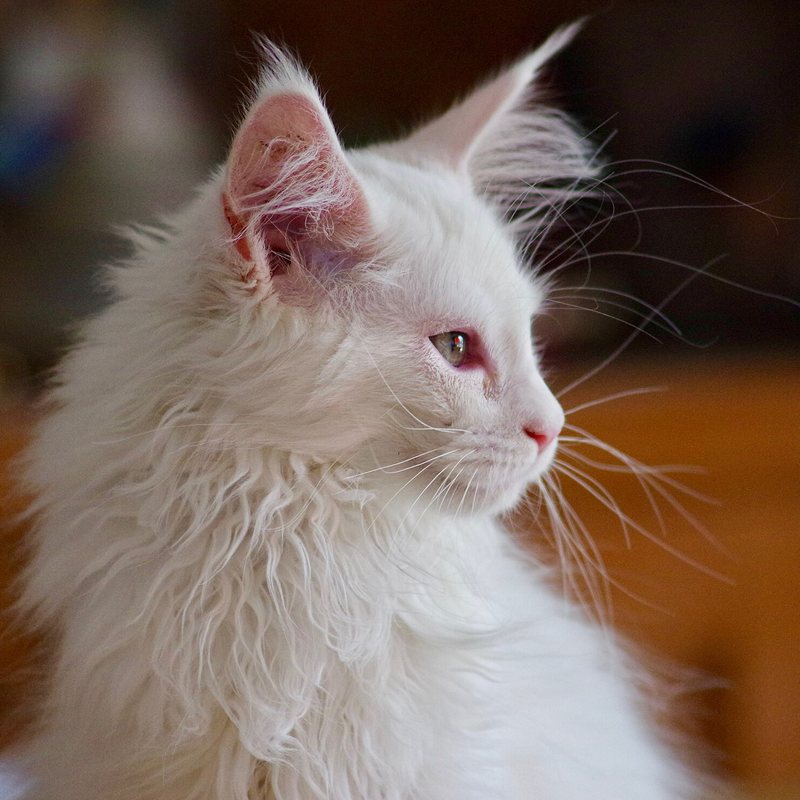

Maine Coons are large, longhaired cats with tufted paws and long, bushy tails. Many are sociable and playful, although size does not tell you how cuddly a particular cat will be. Their coat, body size, and documented inherited health concerns all affect day-to-day care.
Quick facts
- Size: one of the largest cat breeds; CFA notes that a mature male can reach or exceed 20 pounds, while females are usually smaller
- Weight: about 10 to 14 pounds for females and up to 25 for males (PetMD)
- Maturity: slow; up to three years to reach full growth (CFA), or three to five (TICA)
- Life expectancy: about 13 years (PetMD); TICA gives 12.5 or more
- Coat: heavy and shaggy, shorter on the shoulders and longer on the sides, stomach and back legs
Temperament and daily life
CFA describes Maine Coons as friendly, sweet-tempered and easy to train, sociable and loyal but fairly independent, and says they need a moderate amount of human interaction and will ask for it when you are around. Size does not predict how much a particular cat wants to be held. Their conversation runs to chirps, trills and purrs with an occasional meow, and they are not considered a talkative breed; the small chirping voice can seem unexpected in such a large cat. A big cat also needs big equipment: a large litter box, wide bowls and cat trees sturdy enough for its weight. Introductions and the individual cat's temperament matter with children, dogs and other cats.
Grooming and care
Breeders recommend combing a Maine Coon two or three times a week to control shedding and prevent mats and hairballs, and most do not need regular baths. Pay extra attention to the armpits, the area between the hind legs and between the toes, where knots form most easily. If you find a mat, tease it apart gently with your fingers and never use scissors; a tight mat close to the skin is a job for a veterinarian or qualified groomer. Ask your veterinarian to check body condition at routine visits, since body shape is hard to judge under a long coat.
Health considerations
Hypertrophic cardiomyopathy (HCM), a thickening of the heart muscle, is the best-documented concern. The Maine Coon is among the breeds in which HCM is more common. A DNA test detects one variant associated with HCM in the breed, A31P in the MYBPC3 gene, but UC Davis, which offers the test, says it detects only that variant and that the variant is not the sole cause of HCM in Maine Coons. A negative result for one HCM-associated variant does not rule out every cause of HCM. TICA advises breeding only from cats that test negative for the variant and show no heart disease on an echocardiogram.
Spinal muscular atrophy (SMA) is a recessive condition with a DNA test. Affected kittens develop muscle weakness from about three to four months of age, although the condition is neither painful nor fatal. Hip dysplasia is rare in cats compared with dogs but more prevalent in certain breeds, such as Maine Coons, and breeders screen for it with x-rays. Polycystic kidney disease also appears on breed health lists, and the Maine Coon is among the breeds for which a PKD1 DNA test is offered, although no rate for the breed is given. Ask a breeder which tests and examinations the parents have had, and what the results were.
History
The breed's roots lie in New England, where shorthaired ship cats arrived with early settlers, and its history is documented back to the 1850s. The bushy, ringed tails of brown tabby Maine Coons once prompted a theory that cats had mated with raccoons, which is genetically impossible, hence the "Coon" in the name. A brown tabby named Cosey was chosen Best Cat at the first U.S. cat show in 1895. In the early twentieth century, other longhaired breeds rose to prominence and the Maine Coon faded from the show halls; breeders pushed for recognition in the 1960s and 1970s, and CFA granted championship status in 1976. Maine designated it the official state cat in 1985.
Appearance
The coat is thick and shaggy, shorter at the shoulders and longer on the sides, stomach and back legs, ending in a long, plumed tail. The head is rectangular with a square, strong muzzle and a gently concave profile, the ears are large and usually tufted, and the paws are broad and tufted.
Before choosing a Maine Coon
A Maine Coon may suit a home with room for sturdy equipment and time for regular grooming and play. Ask about documented health screening and discuss the individual cat's needs with your veterinarian. Meeting the individual cat tells you more about its temperament than its size or the breed's reputation.
Maine Coon FAQ
Is the Maine Coon the largest cat breed? It is one of the largest. CFA calls it the largest of all pedigreed cats and TICA one of the largest breeds, but neither gives a defined measurement, and individual cats vary widely in size.
Does a clear HCM DNA test mean a Maine Coon will not get heart disease? No. The test covers only the A31P variant, and UC Davis notes that other causes of HCM in the breed are not yet known. An echocardiogram, an ultrasound scan of the heart, is used to look for the disease itself.
Are Maine Coons hypoallergenic? No breed can be assumed safe for someone with a cat allergy. Spend time with the individual cat before committing.
Sources
- Cat Fanciers' Association: Maine Coon Cat
- The International Cat Association: Maine Coon
- PetMD: Maine Coon
- Cornell Feline Health Center: hypertrophic cardiomyopathy and hip dysplasia
- UC Davis Veterinary Genetics Laboratory: HCM (Maine Coon), spinal muscular atrophy and PKD1
- International Cat Care: grooming your cat
Quick quiz: 3 questions about the Maine Coon cat
A Maine Coon's large, tufted paws are often said to act like what?
Answer: Natural snowshoes. Their wide, tufted paws help them walk on top of snow, like built-in snowshoes. Source
Cosey, the Maine Coon who won Best in Show at the 1895 Madison Square Garden cat show, had what coat color?
Answer: Brown tabby. Cosey was a brown tabby female owned by Mrs. Fred Brown, and her win at America's first major cat show helped launch the Maine Coon into the cat fancy. Source
Besides the Ragdoll, which two breeds were specifically linked to their own distinct FGF5 mutations in the original study?
Answer: Norwegian Forest Cat and Maine Coon. Alongside a widespread mutation shared by most long-haired breeds, researchers traced separate breed-specific mutations to Ragdolls, Norwegian Forest Cats, and Maine Coons. Source