 Cat Trivia Games
iOS App
Why Do Cats Have Whiskers?
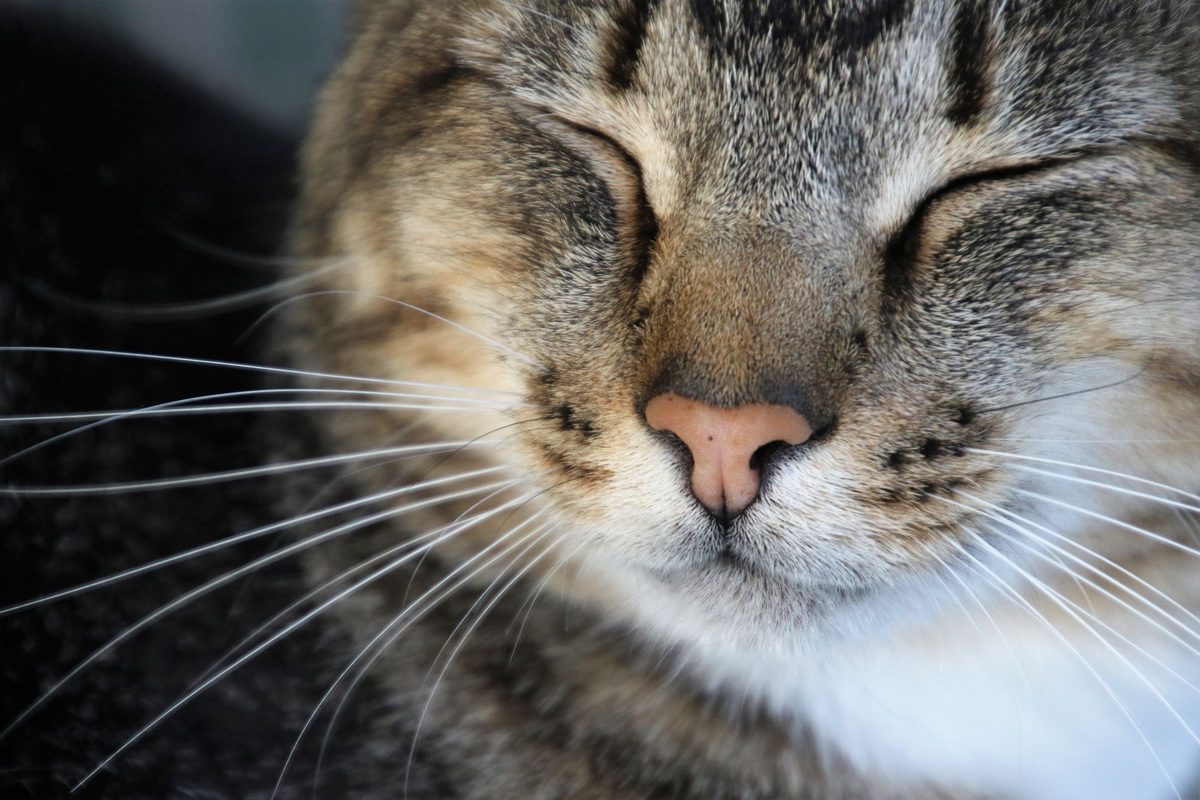
Cats have whiskers to feel what is too close to see clearly. Each whisker grows from a follicle packed with nerves and blood vessels, so a light touch or a shift in air currents tells the cat about the size, shape and speed of nearby objects. Most cats have 12 on each side of the muzzle in four rows, plus more above the eyes, on the chin and on the front legs.1
How whiskers work
A whisker, or vibrissa, is a thick, specialized hair that senses at the root. Its follicle is five to six times the size of an ordinary hair follicle, holds a single hair and is attached to muscles under voluntary control.2 The shaft itself has no nerve endings. Nerves in the follicle respond as a touch or the wind bends the whisker.3
A 1986 study of whisker follicles in cats, rabbits and five rodent species found the same basic structure and nerve supply in all seven; the deep nerve serving each follicle carried the most nerve fibers in the cat.4
Whiskers cover a gap in cat eyesight. Cats focus poorly up close, one of the trade-offs in how cat eyes work, and a 1986 review calls whiskers a possible "near-the-face substitute for vision". It also cites some evidence that whiskers help cats and rats kill mice, with touch especially important for the bite.2
Cats do little or none of the whisking that rats and mice do, a quick, continuous back-and-forth sweep of the whiskers.5 The 1986 follicle study grouped cats with guinea pigs and rabbits as species that whisk minimally or never.4
Where a cat's whiskers grow
A cat usually has 24 muzzle whiskers, four rows of three on each cheek,6 though the exact pattern and location vary with breed.1 Researchers name each set by where it grows,2 and a few also grow near the ears.1
| Set (scientific name) | Where and how many | What they do |
|---|---|---|
| Muzzle (mystacial) | Upper lip and cheeks, usually 12 per side in four rows1 | Stimulating the whisker pad made the eyeball on that side retract, then turn outward, in a 1981 experiment; a 1986 review reads this as a sign they probably help protect the face and eyes2 |
| Above the eyes (superciliary) | Over each eye, like eyebrows1; about three per eye7 | A speck of dust landing on one makes a cat blink or shake its head1 |
| Chin and jaw | A few shorter whiskers on the chin7, and some along the jawline6 | With the face and paw whiskers, they help a cat feel how captured prey is lying3 |
| Backs of the front legs (carpal) | A few on the back of each wrist7 | Help a cat feel caught prey, and help with jumping and climbing3; in a 1973 study of anesthetized cats, moving them set off signals in the ulnar nerve fibers that supply their follicles8 |
A cat's whisker count can be odd. Cats Protection says the count is always even, with whiskers arranged symmetrically, yet also that one or two normally fall out every so often,6 and losing one leaves an odd total until it regrows. Whisker researchers also note that individual whiskers can be missing, damaged or at different growth stages.9
What whisker position can tell you
Whiskers move with a cat's mood and focus, and one position can mean several things. Relaxed whiskers resting against the face likely mean calm; forward whiskers can mean curiosity or excitement, and pulled-back whiskers anxiety or fear.6 A threatened cat may pull its muzzle whiskers taut, flare them and point them at the threat,1 and a stalking cat holds them flared and a little forward.3
Forward whiskers can also signal pain. On the Feline Grimace Scale, a 2019 tool that scores ear position, orbital tightening, muzzle tension, whiskers and head position for acute pain, the whisker sign is movement forward and away from the face, "as if standing on end". Whiskers were the hardest to score: raters marked them "not possible to score" in 10.2% of images (muzzle 3.6%, eyes none), and agreement between raters was moderate for whiskers and muzzle, good for the rest.10 Read whiskers together with the ears, eyes, posture and situation.
Quick quiz: how well do you know cat biology?
Hookworm larvae most often infect a cat by doing what?
Answer: Burrowing directly through the skin. Infective hookworm larvae in soil or bedding can actively penetrate a cat's skin on contact, which is one route of infection alongside swallowing larvae. Source
How does maintaining healthy body weight affect quality of life in senior cats?
Answer: Adequate mass is linked to better outcomes and longevity. Proper nutrition and maintaining appropriate lean body mass in senior cats supports their overall health and can extend lifespan. Inadequate nutrition and excessive weight loss are associated with poor health outcomes in aging felines. Source
How many matings within a 24 hour window are typically needed to reliably trigger ovulation in a female cat?
Answer: About 3 to 4 matings. Because cats are induced ovulators, most queens require roughly three to four matings within a 24 hour period for the surge that triggers ovulation to occur reliably. Source
Why not to trim whiskers
Trimming whiskers may reduce a cat's awareness and cause confusion,1 and it has no benefit.6 Cutting one does not hurt, because the shaft has no nerve endings. Pulling one out does: it is rooted deep in the skin in a follicle lined with nerve endings.3 Whiskers trimmed for medical reasons grow back if the follicle is not damaged.7
Mother cats sometimes trim their kittens' whiskers, perhaps to establish a dominance hierarchy or to keep the kitten near the nest, according to a 2021 review that cites a 1997 study.5
Whiskers are often described as proportionate to body width,6 so trimmed whiskers no longer reflect the cat's size when it judges an opening.3 That is a rule of thumb: I found no study measuring whisker span against body width in cats.
Shedding a few whiskers is normal; each usually regrows in six weeks to three months. A cat that loses many at once may be unwell or injured and should see a vet.6
Whisker fatigue: what the evidence shows
Whisker fatigue, or whisker stress, is the idea that whiskers brushing the sides of food and water bowls overwhelm their receptors and stress the cat. Claimed signs include pacing at the bowl, seeming hungry but not eating from it, and pawing food onto the floor to eat. It is not a disease, and veterinarians still debate whether it exists.11
The only test of a whisker-friendly dish I found is small, and the dish did not measurably improve eating. Jennifer Slovak and Taylor Foster enrolled 40 indoor cats; 38 finished. Owners filmed each cat eating from its usual dish after a 12-hour fast, then switched to a shallow, wide dish sold as whisker-friendly for seven days and filmed again. Eating time (P = 0.8), dropped food (P = 0.9) and amount eaten (P = 0.7) showed no evidence of improvement.12
Owners still reported that most cats preferred the new dish: 24 of 38 in a side-by-side choice the next day, against 9 for the usual bowl and 5 with no preference. The authors list the limits: the usual dish always came first, meals were watched for five minutes at most, owners knew which dish was which, and 18 cats finished their measured portion from either dish, so the test could not show whether they would have eaten more. Before this study, they write, the term whisker stress appeared only in commentary and opinion writing.12
A wide, shallow dish is easy to try, and some cats prefer one.12 A cat whose eating changes significantly needs a prompt vet visit to rule out causes such as dental disease, kidney disease and nausea.11
Frequently asked questions
Do all cats have whiskers?
No. The CFA standard for the hairless Sphynx says whiskers are usually absent, and short and sparse when present.13 Curly-coated cats can have curly whiskers,3 and CFA describes Selkirk Rex whiskers as curly, fragile and prone to breaking off, though Selkirks seem able to navigate just fine without them.14
Why are my cat's whiskers changing color?
Many cats' whiskers get darker with age.3 In some coat colors, a regrown whisker can come back a different color, white to black or the reverse, and color does not affect how it works.7
Do blind cats grow bigger whiskers?
In one 1992 study, yes: cats deprived of vision from birth showed supernormal whisker growth. The authors suggested heavier whisker use may stimulate it, and noted that such cats adapt well, with little behavioral impairment.15
Up next
Christopher writes and runs Cat Trivia Games. The sources for this article are listed below, and how the site is made and corrected is on the editorial policy page. More about the author.
References
- VCA Animal Hospitals, Courtney Barnes, Anne Dagner, Tammy Hunter and Lynn Buzhardt (updated January 30, 2026). Why do cats have whiskers? back
- Ahl AS. Veterinary Research Communications, 1986. The role of vibrissae in behavior: a status review. back
- CatWatch newsletter, with the Cornell Feline Health Center (June 17, 2023). 5 things to know about whiskers. back
- Rice FL, Mance A, Munger BL. Journal of Comparative Neurology, 1986. A comparative light microscopic analysis of the sensory innervation of the mystacial pad. I. Innervation of vibrissal follicle-sinus complexes. back
- Grant RA, Goss VGA. Mammal Review, 2022 (online 2021). What can whiskers tell us about mammalian evolution, behaviour, and ecology? back
- Cats Protection (April 18, 2024). Why do cats have whiskers? back
- PetMD, by Jamie Lovejoy, DVM (August 31, 2021). Why do cats have whiskers? back
- Gottschaldt KM, Iggo A, Young DW. Journal of Physiology, 1973. Functional characteristics of mechanoreceptors in sinus hair follicles of the cat. back
- Dougill G, Brassey CA, Starostin EL, et al. Journal of Morphology, 2023. Describing whisker morphology of the Carnivora. back
- Evangelista MC, Watanabe R, Leung VSY, et al. Scientific Reports, 2019. Facial expressions of pain in cats: the development and validation of a Feline Grimace Scale. back
- PetMD, by Sarah Wooten, DVM (updated February 23, 2026). Whisker fatigue in cats: what it is and how to help. back
- Slovak JE, Foster TE. Journal of Feline Medicine and Surgery, 2021 (online June 2020). Evaluation of whisker stress in cats. back
- The Cat Fanciers' Association. Sphynx breed profile and standard. back
- The Cat Fanciers' Association. Selkirk Rex breed profile and standard. back
- Rauschecker JP, Tian B, Korte M, Egert U. Proceedings of the National Academy of Sciences, 1992. Crossmodal changes in the somatosensory vibrissa/barrel system of visually deprived animals. back
This is general information, not veterinary advice. Written by Christopher Fox under our editorial policy.