 Cat Trivia Games
iOS App
Sphynx Cat Breed
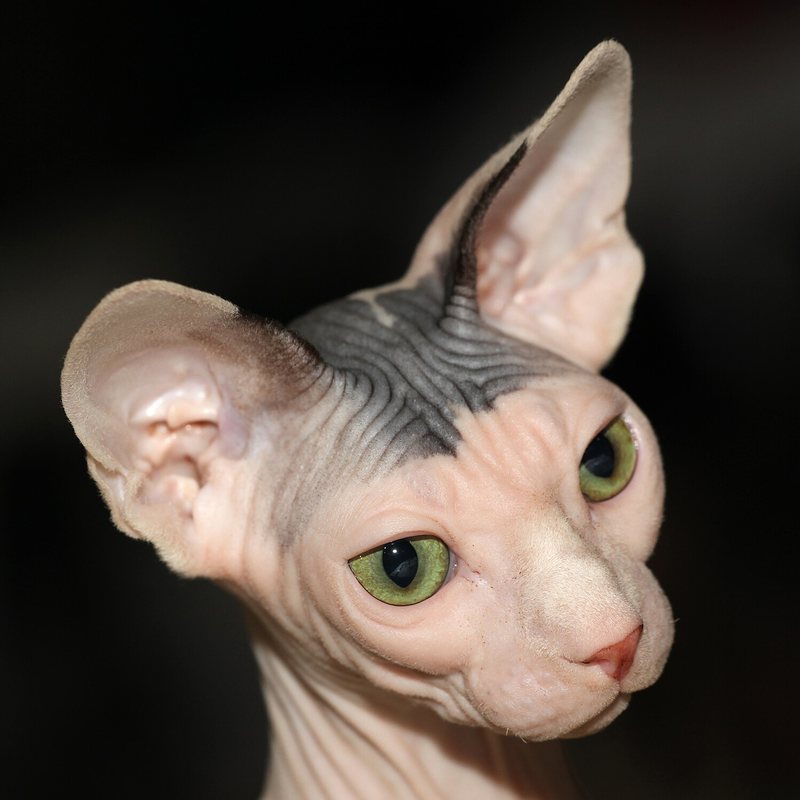

The Sphynx is known for its nearly hairless appearance, large ears and often outgoing behavior. Its care includes attention to skin, temperature and health screening. Having little fur changes the grooming routine; it does not remove it.
Quick facts
- Origin: hairless kittens born to domestic cats in Canada and Minnesota from 1966 onward
- Coat: hairless or covered in a fine, peach-like fuzz, from a recessive variant of the KRT71 gene
- Size: TICA gives 8 to 12 pounds for males and 7 to 10 for females; PetMD gives 6 to 14
- Life expectancy: 7 to 15 years (TICA); GCCF says 15 years or more
- Registries: CFA registration in 1998 and championship status in 2002; also recognized by TICA, FIFe and GCCF
Temperament and daily life
CFA describes Sphynx cats as "curious, outgoing, very intelligent, and anything but shy", often keeping up a stream of chatter as they follow their people from room to room. CFA suggests that prospective owners consider a pair; another cat can add companionship, but it can also add stress, so it depends on the cats involved and on how much time someone is at home.
Without a coat, a Sphynx loses and gains heat more easily than other cats. PetMD's guide to hairless cats suggests cozy sweaters in winter and cooling mats in summer, while GCCF cautions that extra heat can simply make a Sphynx sweat more, so aim for a comfortable home rather than a hot one. Bare skin also burns easily, which is one reason to keep a Sphynx indoors and away from strong sun.
Skin, grooming and care
Skin oil that a coat would normally absorb builds up on the skin, and sources disagree about how often to bathe. CFA says the oily skin requires regular bathing; TICA calls weekly washing a misconception and warns that over-bathing can upset the skin's natural balance; PetMD says baths help prevent bacterial and fungal skin infections but that bathing too often can dry the skin. The useful answer is the one for your cat: ask your veterinarian how often to bathe it and which products to use. The ears also collect oil and wax and are prone to yeast and bacterial infections, so ask about a routine for them too.
Health considerations
The Sphynx is on the Cornell Feline Health Center's list of breeds in which hypertrophic cardiomyopathy (HCM) is more prevalent. HCM is diagnosed by echocardiography, and a 2024 review of HCM gene variants advises routine genetic testing only for one variant in Maine Coons and one in Ragdolls, so ask a breeder about heart screening rather than relying on a DNA result, and ask your veterinarian what screening suits your cat.
Hereditary myopathy, also called congenital myasthenic syndrome, is a recessive muscle condition linked to a variant of the COLQ gene. A 2015 study found carriers among Devon Rex and Sphynx cats but none in more than 350 cats of other breeds, and UC Davis offers a DNA test for it in both breeds. Researchers have suggested the variant may have reached the Sphynx through Devon Rex outcrosses made from the 1970s to the 1990s, but that remains a hypothesis. International Cat Care also lists the Sphynx among breeds affected by inherited hypokalaemia, which causes episodes of muscle weakness and has a gene test. CFA's breed page adds breathing problems in kittens, the skin condition urticaria pigmentosa and gum disease.
Welfare groups raise the coat itself as a concern: International Cat Care lists hairless cats among the traits that it believes should not be continued through further breeding where they compromise a cat's health or welfare.
History
In 1966 a black and white domestic cat named Elizabeth, in Toronto, gave birth to a hairless kitten named Prune. That early line did not last: there was no formal standard and the gene pool was small, and breeding eventually stopped. The modern breed comes mainly from hairless kittens found in the mid-1970s in Minnesota, where Milt and Ethelyn Pearson's cats produced Epidermis and Dermis, and in Toronto in 1978, where a kitten named Bambi was followed by Punkie and Paloma. Breeders crossed them with other breeds, including American Shorthairs, domestic shorthairs and Devon Rex.
CFA accepted the Sphynx for registration in 1998 and for championship status in 2002, and FIFe recognized it in 2002. Outcross rules now differ by registry: CFA still allows American Shorthair, Devon Rex and domestic shorthair outcrosses, with only Sphynx parents allowed for cats born on or after December 31, 2033, while GCCF allows Russian Blue and domestic shorthair outcrosses and no longer accepts Devon Rex.
Appearance
The CFA standard describes a medium-sized, substantial cat with sturdy bones, good muscle and a large, rounded belly. The head is a modified wedge, slightly longer than wide, with prominent cheekbones, large ears and lemon-shaped eyes. Wrinkles are desirable around the muzzle, between the ears and around the shoulders. The skin may be completely bare or covered in soft, peach-like fuzz, often compared to warm suede, and whiskers are usually absent or short and sparse. Sphynx come in a wide range of colors and patterns, which CFA notes can be difficult to distinguish.
Before choosing a Sphynx
Plan for skin care set with your veterinarian, protection from sun and temperature extremes, an indoor life and regular health checks, including heart screening. Ask a breeder which DNA tests and heart checks the parents had. Meeting the individual cat tells you more about how outgoing it is than the breed's reputation does.
Sphynx FAQ
Are Sphynx cats hypoallergenic? No. International Cat Care notes that even cats with very little hair, such as the Sphynx, can still cause allergic reactions, because the allergy is not to the hair itself. No breed can be assumed safe for someone with a cat allergy.
Do Sphynx cats need sunscreen? Shade and an indoor life are the first protection. If you use sunscreen, International Cat Care advises using only a product made specifically for pets and checking that its label says it is appropriate and safe for cats; a pet product is not automatically suitable for every cat, so ask your veterinary team before using one.
Sources
- Cat Fanciers' Association (CFA): Sphynx and its breed standard, What you don't know about Sphynx (2025) and registration rules
- The International Cat Association (TICA): Sphynx
- Governing Council of the Cat Fancy (GCCF): Sphynx, breeding policy and registration policy
- PetMD: Sphynx and hairless cats
- International Cat Care: allergies to cats, sunscreen, hypokalaemia and inherited disorders
- Cornell Feline Health Center: hypertrophic cardiomyopathy and Boeykens F. et al. (2024), Frontiers in Veterinary Science
- Gandolfi B. et al. (2015), COLQ variant associated with Devon Rex and Sphynx feline hereditary myopathy. Animal Genetics and Abitbol M. et al. (2015), A COLQ missense mutation in Sphynx and Devon Rex cats with congenital myasthenic syndrome. PLOS ONE
- UC Davis Veterinary Genetics Laboratory: Sphynx and Devon Rex coats and list of cat DNA tests
Quick quiz: 3 questions about the Sphynx cat
Sphynx cats come in nearly every feline color and pattern. Which of these is NOT a coat pattern found in domestic cats?
Answer: Merle. Colorpoint, tabby, and solid are all recognized cat coat patterns, and the Sphynx is accepted in every color and pattern. Merle, a patchy mottled pattern produced by the canine PMEL gene, occurs in dogs but not in domestic cats. Source
The Sphynx breed traces to a spontaneous hairless mutation born in which country in 1966?
Answer: Canada. A hairless kitten was born to a domestic cat in Toronto in 1966, and breeders there developed the recessive mutation into the Sphynx breed. Source
How is a Sphynx's bare skin most often described to the touch?
Answer: Warm and soft like chamois leather. VCA describes the Sphynx's skin as feeling like warm chamois leather, lightly dusted with soft, fine down that is nearly impossible to see, rather than anything cold or rough. Source