 Cat Trivia Games
iOS App
Selkirk Rex Cat Breed
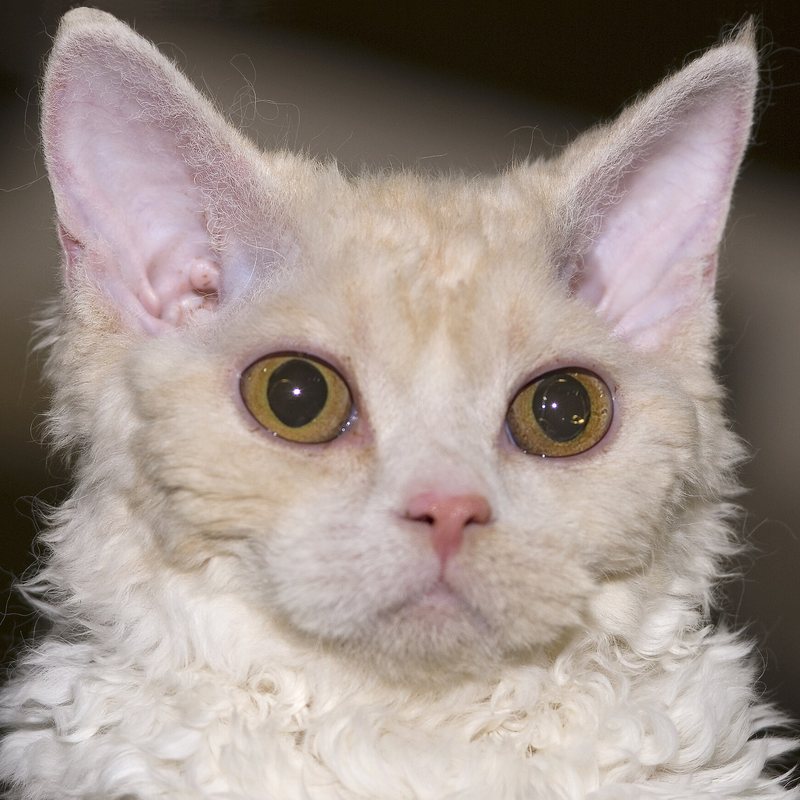

The Selkirk Rex combines a sturdy build with a curly coat that can be short or long. Many are described as relaxed and affectionate. Their curls need care suited to the individual coat, with comfort and preventing tangles more important than preserving a particular look.
Quick facts
- Origin: a curly-coated kitten born in Montana in 1986 (CFA) or 1987 (TICA)
- Coat: shorthair or longhair, with loose, individual curls, most prominent on the neck, flanks and underside
- Size: medium to large and heavy-boned; CFA gives 12 to 15 pounds for adult males, with females smaller
- Life expectancy: 10 to 15 or more years (TICA); 14 to 20 years (PetMD)
- Registries: TICA championship status in February 1994; CFA registration in 1992 and championship status in 2000
Temperament and daily life
CFA describes Selkirks as "more interactive than active": their focus is on their people, many like a warm lap, and they are most comfortable with four feet on the floor, though they will still charge through the house after a toy. They are not particularly vocal but often "talk" back when spoken to. Many are patient about being picked up and hugged. Introductions and the individual cat's temperament matter with other pets, and children need to handle any cat gently.
How well a Selkirk copes with long hours alone depends on the cat. Ask the breeder or shelter how the cat you are meeting handles time on its own, and plan daily play and attention either way.
Grooming and care
How often to groom depends on the coat. CFA suggests a good combing once or twice a month, with your fingers used in between to fluff the curls, while TICA and PetMD suggest combing or brushing about twice a week. Longhaired Selkirks and cats that tangle or shed heavily need the more frequent routine; a hair pick helps separate large clumps of curls. Heavy brushing can frizz the curls, so keep the touch gentle, but do not skip combing where tangles start, because preventing mats matters more than the look of the coat. Baths are rarely needed. If one is, let the cat air dry somewhere warm and draft-free rather than using a blow dryer.
Health considerations
CFA says Selkirks are known for robust good health rather than for breed-specific health concerns, and published breed-level data are limited. British Shorthairs, Exotics and Persians were used to develop the breed, so breeders typically screen for conditions known in those breeds, including polycystic kidney disease (PKD), hip dysplasia and hypertrophic cardiomyopathy (HCM). Blood type incompatibility can also occur, and most breeders test blood type before breeding.
UC Davis includes the Selkirk Rex in its PKD1 DNA test, which covers that one variant; a genetic test does not show how seriously a cat is affected, and Cornell notes that ultrasound gives the definitive diagnosis. There is no recommended DNA test for HCM in the Selkirk: a 2024 review of feline HCM gene variants advises routine genetic testing only for one variant in Maine Coons and one in Ragdolls. HCM is diagnosed by echocardiography (Cornell Feline Health Center).
History
The breed began with a kitten with curly whiskers and a curly coat, born in Montana in 1986 according to CFA or 1987 according to TICA, which describes her mother as a feral blue tortie and white cat. Persian breeder Jeri Newman took the kitten and named her Miss DePesto of NoFace, because she pestered for attention. Bred to a black Persian male, Miss DePesto produced three curly kittens in a litter of six. The litter helped establish that the curl trait was inherited differently from those of the Cornish and Devon Rex: the Selkirk curl is dominant, while theirs are recessive (TICA). Newman named the breed after her stepfather's family name, Selkirk.
TICA accepted the Selkirk Rex into its New Breed program in 1990 and for championship competition in February 1994. CFA accepted it for registration in 1992 and granted championship status in 2000. Under CFA's current rules, Persian outcrosses were allowed for kittens born before January 1, 2020, and British Shorthair or Exotic outcrosses for kittens born before January 1, 2025; kittens born since then must have only Selkirk Rex parents.
Appearance
The Selkirk is a medium to large cat with a solid, muscular body and heavy boning, which gives it surprising weight. The head is round and full-cheeked, with prominent whisker pads, round eyes and medium-sized ears. The curls are well defined and individual, either short and slightly crisp or long and loose, rather than the tight wave of a Cornish Rex or the soft waves of a Devon Rex. The whiskers are curly too, and fragile enough to break off. The breed's nickname, "the cat in sheep's clothing", comes from that coat.
Before choosing a Selkirk Rex
Plan for daily play and company, and for a grooming routine matched to the coat in front of you, with more combing for a longhaired cat. Ask a breeder which health screening the parents had, including PKD testing and blood typing, and remember that a curly coat sheds like any other. Meeting the individual cat tells you more about its temperament than the breed description does.
Selkirk Rex FAQ
Why do some Selkirk Rex cats have straight coats? The curl gene is dominant, so a kitten needs only one copy to be curly, and kittens that do not inherit it have straight coats. Straight-coated Selkirks are often less expensive. Curly coats also change as cats mature, and they tend to look their best on mature neutered males and spayed females.
How is a Selkirk Rex different from a Cornish or Devon Rex? In coat, build and genetics. The Selkirk has loose, individual curls on a heavy-boned, round-headed body, while the Cornish Rex has a tight, even wave on a slender frame and the Devon Rex has soft waves and large ears. The Selkirk curl is dominant, while the Cornish and Devon coats are inherited as recessive traits.
Are Selkirk Rex cats hypoallergenic? No breed can be assumed safe for someone with a cat allergy, and a curly coat does not change that. Spend time with the individual cat before committing.
Sources
- Cat Fanciers' Association (CFA): Selkirk Rex and its breed standard
- The International Cat Association (TICA): Selkirk Rex
- PetMD: Selkirk Rex
- UC Davis Veterinary Genetics Laboratory: polycystic kidney disease (PKD1) test
- Cornell Feline Health Center: polycystic kidney disease and hypertrophic cardiomyopathy
- Boeykens F. et al. (2024), Classification of feline hypertrophic cardiomyopathy-associated gene variants according to the American College of Medical Genetics and Genomics guidelines. Frontiers in Veterinary Science
Quick quiz: 2 questions about the Selkirk Rex cat
How would you describe the overall expression of a Selkirk Rex cat?
Answer: Sweet and gentle. Their round eyes and broad, full-cheeked head soften every feature, giving Selkirk Rex cats a sweet, approachable look rather than a sharp or wary one. Source
The Selkirk Rex breed was first developed from a curly-coated kitten found in which U.S. state?
Answer: Montana. A single curly kitten rescued in Montana in 1987 was the only one in her litter with the mutation; because breeders bred forward from just that one cat, every Selkirk Rex today traces back to that Montana litter. Source