 Cat Trivia Games
iOS App
Hermitage Museum Cats: St Petersburg's Mousers Since 1745
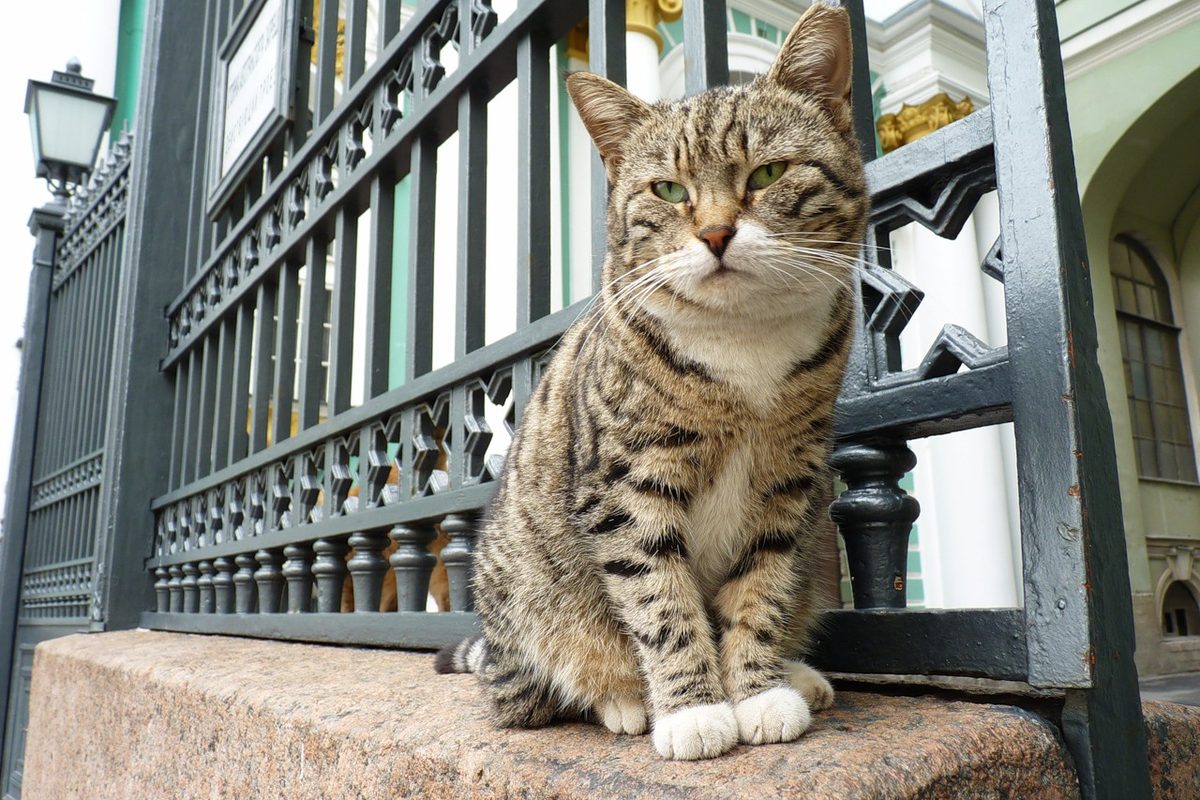

The State Hermitage Museum in St Petersburg has kept cats since 1745, when Empress Elizabeth ordered Kazan's thirty best and biggest neutered tomcats sent to her court to catch mice.1 The tradition broke off in the siege of Leningrad, and after the war the colony grew back into the dozens.2 About fifty cats lived in the museum's basements in 2025, when their spring festival, the Day of the Hermitage Cat, fell on 31 May.34
The 1745 decree and the court cat orders
On 2 November 1745 Elizabeth, daughter of Peter the Great, ordered "the best and biggest thirty" castrated cats in Kazan, "suited to catching mice," sent to her court by cart "immediately," with an attendant to feed them. Kazan's governor, A. G. Zagryazhsky, had to announce the search in public; owners of such cats had three days to report them or be fined.1
Cultural historian Irina Chirskova traced the text in 2021 to a copy made by the Sviyazhsk provincial chancellery on 4 November 1745 and printed in 1871 in Russkaya Starina. The decree never entered the official Complete Collection of Laws of the Russian Empire. Only castrated cats were taken and the mice kept coming back, so the court had to recruit often.1 ABC News once dated Elizabeth's order to 1774,6 twelve years into Catherine the Great's reign.7
The Hermitage's own story starts earlier, with Peter the Great settling a cat from Holland in the Winter Palace.3 Chirskova found two versions of that legend, a cat Peter brought from Europe himself and a big fluffy cat said to be called Vasily from a Dutch merchant's house in Vologda, and neither is documented.1
Three later decrees from Elizabeth appeared in Istoricheskii Vestnik in 1880:8
- 12 March 1750. Collect up to thirty cats from the New Winter Palace, buying more if needed, carry them in boxes to the new Summer Palace, and feed them a week or more before releasing them into the empress's rooms.8
- 27 October 1753. Gather up to three hundred cats for the Golovin palace's new winter rooms, feed them there so they would not run off, and keep that many at court for good, with a feeding room nearby.8
- October 1754. Feed the cats in the empress's apartments game instead of beef and mutton: hazel grouse and black grouse, "one each" every day.8
Catherine the Great and the Russian Blue story
Catherine the Great, who founded the museum, made the cats guards of the picture galleries, according to the Hermitage.3 Chirskova writes that Catherine did not love cats but understood the palace needed them. Under her, court cats were split into yard cats and room cats; the room cats, chosen mostly for looks, guarded the galleries and decorated palace life.1 AFP reported that by 1762, when Catherine took power, the cats were official residents, later called the Winter Palace cats.7
The story that Catherine kept Russian Blues as indoor cats rests on tradition; I have not found a document behind it. The New Yorker in 2012 wrote that she "is thought to have favored" them;9 the Telegraph in 2013 wrote "we know."5 Chirskova writes that a breed later called the Russian Blue is believed to date to Elizabeth's time, but pedigreed cats did not yet exist and selective breeding began only in the 19th century.1
The siege of Leningrad and the cats' return
The cats lived through the Napoleonic wars and the 1917 revolution and disappeared only in the Second World War, the BBC reported in 2007; during the siege the cellars were bomb shelters and the main treasures were in the Urals.10 Maria Haltunen, the museum's press secretary for its cats, told the Telegraph that in the 900-day siege, "when the people were starving," the cats "did not survive."5
Museum lore, as AP reported it in 2009, has two railway wagons of new cats reaching Leningrad when the war ended;11 the cats' adoption site says cats came into the city by the wagonload, some to serve in the Winter Palace.12 I have not found a document behind either version. By the 1960s, AFP reported in 2015, there were so many cats that the authorities got rid of them; the rats multiplied, and a few years later the cats were back.7
Quick quiz: how well do you know cat history?
What ultimately forced Pat Sullivan to abandon silent Felix cartoons for sound production in 1929?
Answer: Rival studios' sound cartoons proving the format could succeed. Sullivan resisted sound after 1927's The Jazz Singer, but once Fleischer, Van Beuren, and Disney's Steamboat Willie proved sound cartoons could succeed, he switched; the sound Felix shorts flopped anyway and ended by 1932. Source
What was Tom the cat's original name in his very first cartoon, before a studio naming contest renamed him?
Answer: Jasper. In the 1940 debut short 'Puss Gets the Boot,' Tom was called Jasper; an MGM staff naming contest later chose Tom and Jerry for the pair. Source
What was the real name of the famous internet cat known as 'Grumpy Cat'?
Answer: Tardar Sauce. Grumpy Cat's real name was Tardar Sauce. She became an internet sensation due to her naturally grumpy facial expression caused by feline dwarfism and an underbite, despite being a friendly and affectionate cat. Source
How many cats live at the Hermitage?
Press counts since 2007 run from about 50 to 74, and the number changes as strays arrive and cats are adopted. In 2015 Irina Popovets, who runs the cats' care unit, told AFP: "People very often discreetly bring us their cats."7
| Year | Cats reported | Source |
|---|---|---|
| 2007 | 50, "officially" | BBC News10 |
| 2009 | Around 60 | AP11 |
| 2010 | 50 permitted by the director, "really around 60" | ABC News, quoting Haltunen6 |
| 2011 | About 50 in the basements | RIA Novosti13 |
| 2012 | "Some seventy" | The New Yorker9 |
| 2013 | 74, all neutered | The Telegraph5 |
| 2014 | About 50 | Gorod+, quoting the cats' vet14 |
| 2015 | "70-odd" | AFP7 |
| 2015 | 50 | Rossiyskaya Gazeta, quoting Haltunen15 |
| 2020 | Nearly 70 | AFP16 |
| 2022 | "Significantly fewer" than 74 | RIA Novosti, from the Hermitage17 |
| 2023 | About 50 to 60 | RIA Novosti2 |
| 2025 | About 50 | Fontanka4 |
The Telegraph's 2013 count of 745 later turned up on a Russia card in an American board game, Cultures of the World. Spotting it in 2022, the museum said there were now significantly fewer cats and that some find homes and loving families.17
How the cats are cared for
The cats' modern care began in the late 1990s, when Haltunen and a colleague found strays half-starving in the heating system, fed them after work with staff canteen leftovers, then took up a staff collection: "A rouble for a cat."915 By 2007 two full-time employees looked after the cats.10 The museum calls them its "furry staff."17
In 2013 the Telegraph found three volunteers, overseen by security chief Tatiana Danilova, spending six hours a day underground, with kitchens for the cats' food ("they all have different preferences"), a small hospital, and a ledger of every cat's name, living quarters, working area and diet.5
Each cat had its own passport and veterinary card, the cats' vet, Anna Kondratyeva, said in 2014, and twice a year vets caught part of the colony for parasite treatment and vaccination. With 18 kilometres of basements, she said, the cats spread out: some live in the General Staff arch, some by the Atlantes.14
Gifts have helped pay the bills. In 2013 the charity Pro Animale gave €400 a month for food and medicine, Royal Canin was a sponsor, and staff still donated.5 On 1 December 2020 director Mikhail Piotrovsky said a French citizen had left part of his estate to the cats;18 AFP reported that he was a doctor.16 After taxes it came to about 3,000 euros, for repairing and enlarging their basement quarters, and the museum could not find out what inspired the gift.18 In 2023, accepting a cat house shaped like Zelenogradsk's House with Dragons, Piotrovsky called the cat program an extension of the museum's inclusion programs and "maybe one of the most successfully developing programs."2
Poison took over the rat-catching, the BBC reported in 2007,10 and Haltunen told the Telegraph the cats' presence "is a deterrent in itself."5 In 2012 the cats were kept out of the galleries and the director's wing, but the friendlier ones had the run of the staff offices.9
The Day of the Hermitage Cat
The festival began in 1998 as a staff-only "Day of the March Cat," the Hermitage press service said in 2011, the first year it was in the museum's official exhibition calendar.13 Gorod+ gave the same start in 2014 and said it had been held regularly since 2005;14 the Telegraph dated its founding to 2009.5 By April 2012 it was called the Day of the Hermitage Cat and held every spring.3
The program mixes children's art with visits to the cats' cellars. For 2011 the museum announced that the winning drawings would hang in the Jordan Gallery for a week, labeled like the permanent exhibits.13 In 2012 a game through the halls ended at the Hermitage's only cat mummy, an Egyptian one shown for that day only.39 The 2018 festival, on 12 and 13 May, opened in the Great Hall of the Winter Palace and offered the young artists in its drawing contest a cellar tour.19
In 2015, 270 years after Elizabeth's decree, the museum applied to register "Hermitage cat" as a trademark. Rossiyskaya Gazeta noted that the cats' service is older than the museum: they began guarding the palace twenty years before the first art collection was assembled.15
Frequently asked questions
Can visitors see the Hermitage cats?
Not in the galleries. In summer, Haltunen told AP in 2009, the cats who like people come out onto the square, the embankment and the big courtyard; the rest stay in the basement.11 The basements are normally closed to the public except on the Day of the Hermitage Cat,5 and visitors could still go down to see the cats in 2025.4
Is the Hermitage cat a breed?
No. Elizabeth's court took only castrated toms, and Chirskova says that undercuts the myth of a special palace breed.1 In 2014 their vet said they could not be a registered breed because all were neutered and had no kittens; she called them "not a breed, but a special kind."14 Most came in from the streets.10
Can you adopt a Hermitage cat?
Yes, through the cats' Russian-language adoption site, hermitagecats.ru, which says the museum does not need such a large four-legged army.12 In 2015 new owners got an "Owner of a Hermitage cat" certificate that gave free entry to the museum's exhibitions, Rossiyskaya Gazeta reported.15
Up next
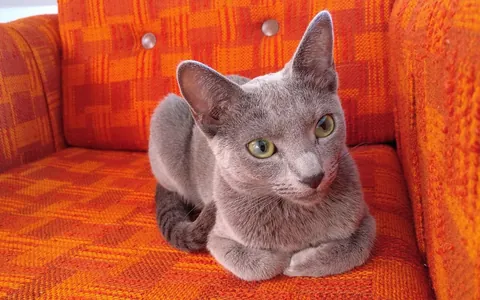 Cat BreedsRussian BlueThe blue breed that tradition links to Catherine's palace.
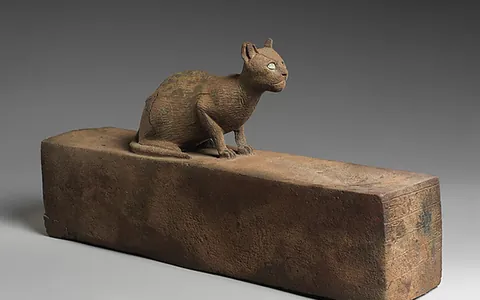 Cat Science NewsEgyptian cat mummy skullsWhat 131 mummy skulls say about how those cats lived.
Breed photos: mostly Wikimedia Commons contributors under free licenses, cropped. Every photographer and license is on the photo credits page.
Christopher writes and runs Cat Trivia Games. The sources for this article are listed below, and how the site is made and corrected is on the editorial policy page. More about the author.
References
- Irina Chirskova, Verkhnevolzhsky Philological Bulletin, no. 4 (2021), pp. 231 to 237 (in Russian, English abstract). Cats' state service in the 18th century Russia. back
- RIA Novosti (1 March 2023, in Russian). Hermitage cats given a copy of the House with Dragons from Zelenogradsk. back
- State Hermitage Museum announcement on Museum.ru (April 2012, in Russian), archived copy. Day of the Hermitage Cat 2012. back
- Fontanka.ru (31 May 2025, in Russian). The Day of the Hermitage Cat is held in St Petersburg. back
- Teresa Levonian Cole, The Telegraph (23 May 2013), archived copy. St Petersburg: the cats of the Hermitage. back
- Alexander Marquardt, ABC News (30 July 2010). St. Petersburg's Hermitage Museum home to masters... and cats. back
- AFP, in Hurriyet Daily News (17 November 2015). The nine lives of Russia's Hermitage Museum cats. back
- Istoricheskii Vestnik, no. 2 (1880), from the papers of M. D. Khmyrov; online text at Vostochnaya Literatura (in Russian). Personal decrees of Empress Elizabeth Petrovna, 1750 to 1754. back
- Sally McGrane, The New Yorker (25 September 2012). Russia's museum cats. back
- James Rodgers, BBC News (5 October 2007). Hermitage palace is cat's whiskers. back
- Associated Press video report, National Geographic News (12 June 2009), archived copy. Cat "army" guards treasures. back
- Hermitage Cats adoption site (in Russian). Hermitage cats: looking for a family. back
- RIA Novosti (26 March 2011, in Russian). Day of the March Cat to be held at the Hermitage on Saturday. back
- A. Golubnichaya, Gorod+ (22 October 2014, in Russian), archived copy. Anna Kondratyeva: Hermitage cats are the soul of Petersburg. back
- Rossiyskaya Gazeta (5 November 2015, in Russian). The Hermitage will register a cat trademark. back
- AFP, in Gulf News (8 December 2020). French doctor leaves legacy to Russia's Hermitage cats. back
- RIA Novosti (2 February 2022, in Russian). Hermitage cats end up in an American board game. back
- Fontanka.ru (25 February 2021, in Russian). The Hermitage names the inheritance the cats will get from a French donor. back
- Rossiyskaya Gazeta (12 May 2018, in Russian). The Day of the Hermitage Cat begins in St Petersburg. back
Written by Christopher Fox under our editorial policy.