 Cat Trivia Games
iOS App
Russian Blue Cat Breed
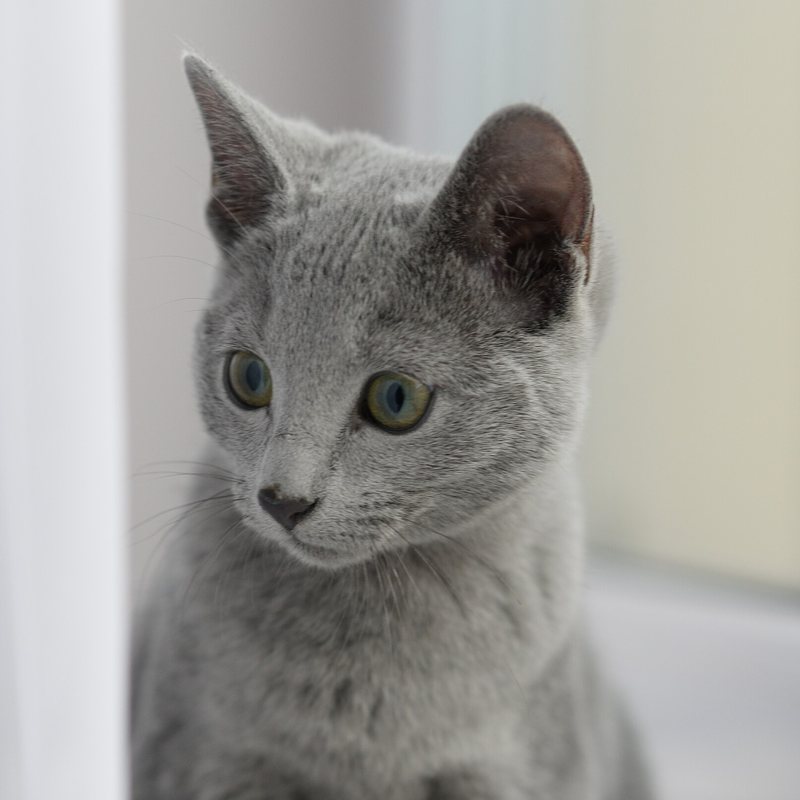

The Russian Blue has a short, dense blue coat with silver tipping and green adult eyes. Many are reserved with unfamiliar people and affectionate with those they know. Their quieter reputation can appeal to people who enjoy a steady routine, but personalities vary.
Quick facts
- Coat: short, dense, fine and plush, a double coat that stands out from the body, blue with silver tips
- Eyes: vivid green in adults; kittens' eyes change through yellow to green
- Weight: males rarely over 10 pounds and females 5 to 8 (CFA); PetMD gives 7 to 12
- Life expectancy: estimates differ, from 10 to 20 years (TICA) to 15 to 20 (PetMD)
- Colors: blue only in CFA and TICA; the WCF, GCCF and some other registries also accept white and black versions
Temperament and daily life
Many Russian Blues are wary of newcomers at first: it is typical for one to hide under the sofa when a guest arrives, until curiosity brings it out to investigate. CFA also calls the breed mechanically minded: "every closed cabinet, every shut drawer, even sealed canisters or jars represent a tempting challenge". Many enjoy a predictable routine, so watch for changes in behavior, such as hiding more or changes in litter box use, when routines change, and talk to your veterinarian if they last. Introductions and the individual cat's temperament matter with children and other pets.
Grooming and care
The coat needs little work: registry advice ranges from combing two or three times a month (CFA) to brushing or combing once or twice a week (TICA). Many Russian Blues have hearty appetites and can become overweight, so measure meals and check body condition with your veterinarian. A quiet place to retreat when visitors come helps a cat that is wary of strangers.
Health considerations
Published breed-specific health information is limited. CFA notes that the breed is not known to have specific genetic problems, which reflects the limited data rather than a guarantee; it adds that some believe the relatively small gene pool may make the cats more susceptible. Ask a breeder about the parents' health and rely on your veterinarian for the individual cat.
As with any cat, a cat straining or unable to pass urine needs a veterinarian right away: urethral obstruction is a true medical emergency, and male cats are at greater risk. Urinary signs are linked with being overweight, getting little exercise and drinking less water, so fresh water, play and a healthy weight are worth attention; diagnosis and any change of diet are for your veterinarian to decide.
History
The breed is believed to have come from the Archangel Isles in northern Russia, but there is very little written history before the late 1800s. Russian Blues took part in the early English cat shows, where they were called Archangel Cats, and they were given their own class, the Foreign Blue, in 1912 (TICA). From the early twentieth century until the Second World War, Scandinavian breeders led its development. English breeders later used blue British Shorthairs or blue point Siamese, Scandinavian breeders used Siamese and a blue cat named Pierette, and American breeders later combined English and Scandinavian bloodlines. CFA accepted the Russian Blue for registration in 1949.
Appearance
The dense, plush coat usually catches the eye first: the silver tips glisten in the light, and fingers drawn through the coat leave little marks behind. The standard calls for a fine-boned, long, firm and muscular body, a smooth, medium wedge-shaped head, large ears broad at the base and set far apart, and wide-set, vivid green eyes, and the face can appear to be smiling at some secret joke. Any color other than blue is disqualified in CFA, which allows no outcrosses.
Before choosing a Russian Blue
A Russian Blue may suit a calm household with a steady routine, time for play, and a quiet place for the cat to retreat when visitors come. Ask a breeder about the parents' health, and meet the individual cat; some take time to warm up, so a short first meeting may not show its full personality.
Russian Blue FAQ
Why are my Russian Blue kitten's eyes changing color? As Russian Blue kittens grow, their eyes change through yellow to green. A green ring around the pupil is expected by about four months, and the green usually deepens with age. Cloudiness, discharge or a sudden change in one eye is a reason to see your veterinarian.
Are Russian Blues hypoallergenic? No. A Russian Blue is not guaranteed to be safe for someone with cat allergies, and no breed can be assumed safe. Spend time with the individual cat before committing.
Is a Russian Blue the same as a blue British Shorthair or a Chartreux? No. They are separate breeds with their own standards. The Russian Blue has vivid green eyes and a fine-boned body under a coat that stands out from it, the Chartreux has gold-to-copper eyes and a woolly coat, and the British Shorthair has a stockier, semi-cobby build.
Sources
- Cat Fanciers' Association: Russian Blue and the 2001 breed article
- The International Cat Association: Russian Blue and the Russian Blue breed standard
- PetMD: Russian Blue
- World Cat Federation: EMS code and championship status (updated June 2026)
- Cornell Feline Health Center: feline lower urinary tract disease
One question about the Russian Blue cat
Under the Cat Fanciers' Association standard, which trait is a disqualification in the Russian Blue show ring?
Answer: A long, silky coat. The CFA standard lists a long coat as a disqualification because the breed must be short-haired; traits like eye shade or body type may be faulted but are not automatic disqualifications. Source