 Cat Trivia Games
iOS App
Why Do Cats Have Slit Pupils? What a 214-Species Study Found
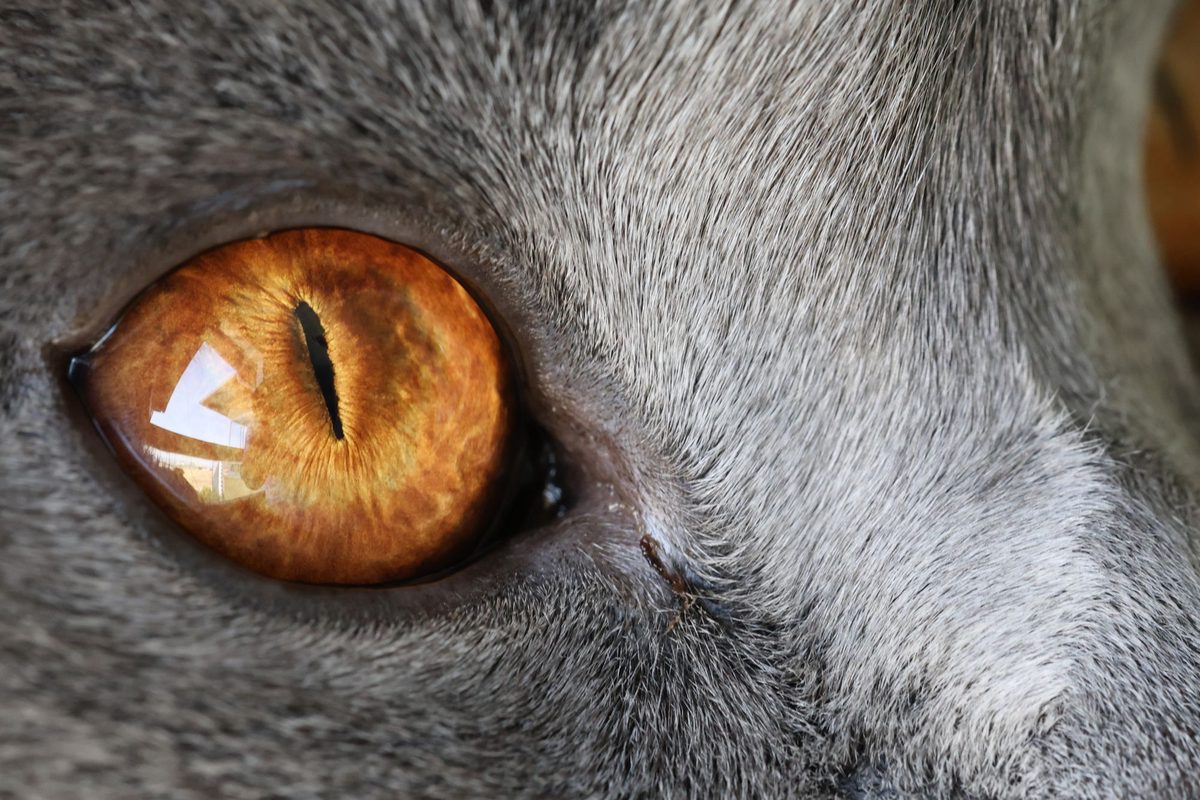
Cats have slit pupils to control light and, a 2015 study suggests, to judge distance while hunting. A slit opens and closes much further than a round pupil: a domestic cat's pupil area changes about 135-fold, a human's about 15-fold, a range that suits an animal active day and night. The study of 214 land species linked vertical slits to ambush predators, especially short ones. Lions and tigers have round pupils.
A slit opens and closes further than a circle
A slit pupil can change its area far more than a round one: about 135-fold in a domestic cat between constricted and dilated, against about 15-fold in a human.1 A round pupil narrows with a ring of muscle; a slit adds two muscles that squeeze it from the sides.1
Gordon Walls, a UC Berkeley optometry professor, proposed in a 1942 book that slit pupils allow a greater range of light into the eye, and it became the generally accepted view.2 Martin Banks, the Berkeley vision scientist who led the 2015 study, said slit pupils give species active night and day, like domestic cats, "the dynamic range needed to help them see in dim light yet not get blinded by the midday sun."2
Light range does not explain why the slit is vertical. "Why don't we see diagonal slits?" Banks asked.2 None of the land species in his team's data had them.1
Why the slit is vertical: the 2015 study
Published in Science Advances on August 7, 2015, the study matched vertical slits with sit-and-wait ambush predators active by day and night, horizontal pupils with plant-eating prey whose eyes sit on the sides of the head, and round pupils with hunters that chase prey down.2 Banks's team at Berkeley and Durham University had sorted 214 land species by pupil shape, time of activity and feeding style.1
Ambush predators cannot judge depth by moving the head (motion parallax), since moving could give them away. That leaves stereopsis, which compares the two eyes' views, and defocus blur.1
A vertical slit keeps vertical edges sharp in front of and behind the point of focus while horizontal edges blur, and stereopsis is most precise for roughly vertical edges. The authors argue this lets a forward-eyed ambush predator such as a cat judge the distance of upright outlines, like standing prey, with both eyes, and distances along the ground from blur.1
Short hunters have slits, tall hunters round pupils
Blur cues work better for short animals than tall ones, the team calculated, so slits should help most in ambush predators near the ground.2 Of 65 forward-eyed ambush predators, 44 had vertical pupils and 19 round. Of the vertical group, 82% stood under 42 cm (16.5 inches) at the shoulder; of the round group, only 17%.12
William Sprague, a postdoctoral researcher in Banks's lab, called the link to short predators surprising: domestic cats have vertical slits, "but bigger cats, like tigers and lions, don't. Their pupils are round, like humans and dogs."2 More from the paper:
- 214 species, nearly half of them snakes. The link between pupil shape, hunting style and time of day held with the snakes removed.1
- 36 of 42 plant-eating prey species had horizontal pupils.1
- Six times. The team's reconstruction of the cat family tree suggests today's cats descend from an ambush predator with vertical slits, active at night or by day and night. Round pupils evolved from it six times, near-round ones two to four times.1
- Time of day. Within the cat family, pupil shape tracked when a species is active. Hunting style varies too little across cats to test.1
Quick quiz: how well do you know cat biology?
Which muscle in cats is primarily responsible for extending the elbow joint?
Answer: Triceps brachii. The triceps brachii runs along the back of the upper foreleg and acts as the elbow's primary extensor. Gait studies in cats confirm this directly: when the triceps brachii is paralyzed or impaired, the elbow can no longer straighten properly and the limb struggles to bear weight during a stride. Source
Which muscle is described as the largest muscle suspending a cat's trunk between its two front legs?
Answer: Serratus ventralis. The serratus ventralis is the largest of the extrinsic limb muscles and holds the weight of the trunk as it hangs suspended between the thoracic limbs, acting like a sling. Source
Which muscle is primarily responsible for driving air into a cat's lungs during breathing?
Answer: Diaphragm. The diaphragm is a dome-shaped muscle beneath the lungs; when it contracts, it expands the chest cavity, drawing air into the lungs during inhalation. Source
Pupil shapes across the cat family and beyond
| Animal | Pupil shape | What the sources add |
|---|---|---|
| Domestic cat | Vertical slit | Area changes about 135-fold1 |
| Lynx | Vertically elongated, close to round1 | Medium-sized; the Eurasian lynx's eye design falls between small and large cats'3 |
| Pallas's cat | Round4 | Small wild cat, mostly active at dawn and dusk4 |
| Clouded leopard | Described as broadly elliptical; one specimen looked round at rest5 | Usually considered a twilight or night species; may also be active by day5 |
| Lion and tiger | Round2 | Large cats have single-focus lenses3 |
| Human | Round | Area changes about 15-fold1 |
| Gecko | Round when dilated; three or four pinholes in a vertical line when constricted | Area changes about 300-fold1 |
| Goats, sheep and horses | Horizontal, roughly rectangular | Plant-eating prey, eyes on the sides of the head12 |
| Skimmers | Vertical slit | The only birds known to have one; the black skimmer, active at twilight or night, feeds by flying low with its lower beak in the water1 |
Other explanations and exceptions
Lens optics offer a second explanation. Many animals have multifocal lenses, whose rings each focus a different range of colors onto the retina. In bright light a narrowing round pupil shades the outer rings, while a slit keeps the whole lens width in use. A 2006 survey of land vertebrates by Malmström and Kröger found slit pupils only with multifocal optics: small cats had both, while large cats had single-focus lenses and round pupils. What large cats gain without multifocal optics "remains mysterious," they wrote, since other large-eyed land vertebrates have them.3 The 2015 team notes the idea covers only multifocal eyes and does not explain why some slits are vertical and others horizontal.1
The Pallas's cat, or manul, a small, stocky wild cat of Central Asia, has round pupils, unlike most small cats.4 A 2026 anatomy paper calls the pupils of lions, clouded leopards and the much smaller Pallas's cat broadly elliptical. Yet in its own post-mortem specimens, which the authors say need cautious reading, the pupils looked round at rest in the clouded leopard and Pallas's cat and horizontally oval in the lions.5
Lions complicate the time-of-day link. The 2026 paper notes that lions' pupil shape is often called typical of daytime animals, yet lions hunt mainly at dusk, dawn and night.5 A 2011 study of lions and the moon in Tanzania cites field work in South Africa and Uganda that found hunting success highest on dark nights.6
In Science News, Lund University vision scientist Ronald Kröger warned against assuming an animal's habits caused its pupil shape, since some predators lack slit pupils and some plant-eaters have them. The article adds that most birds, which the study left out, have round pupils. Banks said the new hypotheses cover only one aspect of how vision evolved: "There are multiple forces that push the eye to evolve in multiple ways."7
Pupils react to more than light
The ASPCA lists partly or fully dilated pupils among a defensive cat's postures, constricted pupils among offensive ones, and dilating pupils among the signs that a cat wants petting to stop.8 In each list the pupils are one sign among several, with the ears, tail and body posture.8 More on those signs: what 66 owners reported about bites during petting.
Frequently asked questions
Do dogs and foxes have slit pupils too?
Dogs have round pupils, like people.2 Science News counts foxes, with cats, among the ambush predators with vertical pupils.7 For the dog family, the 2015 analysis estimated a common ancestor with near-round pupils, from which vertical slits and round pupils each evolved twice.1
Why do goats and sheep have sideways pupils?
A horizontal pupil gives a grazing animal a wide view along the ground, so it can spot predators from different directions and see where it is running.1 When goats, antelope and other grazers lower their heads to eat, their eyes rotate to keep the pupils level with the ground. Banks saw it at the Oakland Zoo, and Gordon Love of Durham University in sheep and horses on nearby farms. Each eye can rotate 50 degrees or more, about 10 times the range of human eyes.2
What if my cat's pupils are different sizes?
Unequal pupils, called anisocoria, are a sign of an underlying problem such as a corneal ulcer, glaucoma, inflammation inside the eye or nerve damage. VCA advises treating sudden anisocoria as an emergency and getting veterinary care right away, to lessen the chance of lasting damage to vision.9
Up next

Christopher writes and runs Cat Trivia Games. The sources for this article are listed below, and how the site is made and corrected is on the editorial policy page. More about the author.
References
- Banks MS, Sprague WW, Schmoll J, Parnell JAQ, Love GD. Science Advances, 2015. Why do animal eyes have pupils of different shapes? back
- UC Berkeley News, Sarah Yang (August 7, 2015). Pupil shape linked to animals' place in ecological web. back
- Malmström T, Kröger RHH. Journal of Experimental Biology, 2006. Pupil shapes and lens optics in the eyes of terrestrial vertebrates. back
- Brookfield Zoo Chicago. Pallas's cat. back
- Klećkowska-Nawrot J, Badenhorst S, Borawski W, et al. BMC Veterinary Research, 2026. Descriptive comparative morphology of the eye and ocular adnexa in Felidae: observations from a clouded leopard, African lion and Pallas's cat. back
- Packer C, Swanson A, Ikanda D, Kushnir H. PLOS ONE, 2011. Fear of darkness, the full moon and the nocturnal ecology of African lions. back
- Science News, Sarah Schwartz (August 7, 2015). Power of pupils is in their shape. back
- ASPCA. Aggression in cats (body postures and petting-induced aggression). back
- VCA Animal Hospitals. Anisocoria in cats. back
This is general information, not veterinary advice. Written by Christopher Fox under our editorial policy.