 Cat Trivia Games
iOS App
Why Cats Bite When You Pet Them: What 66 Owners Reported
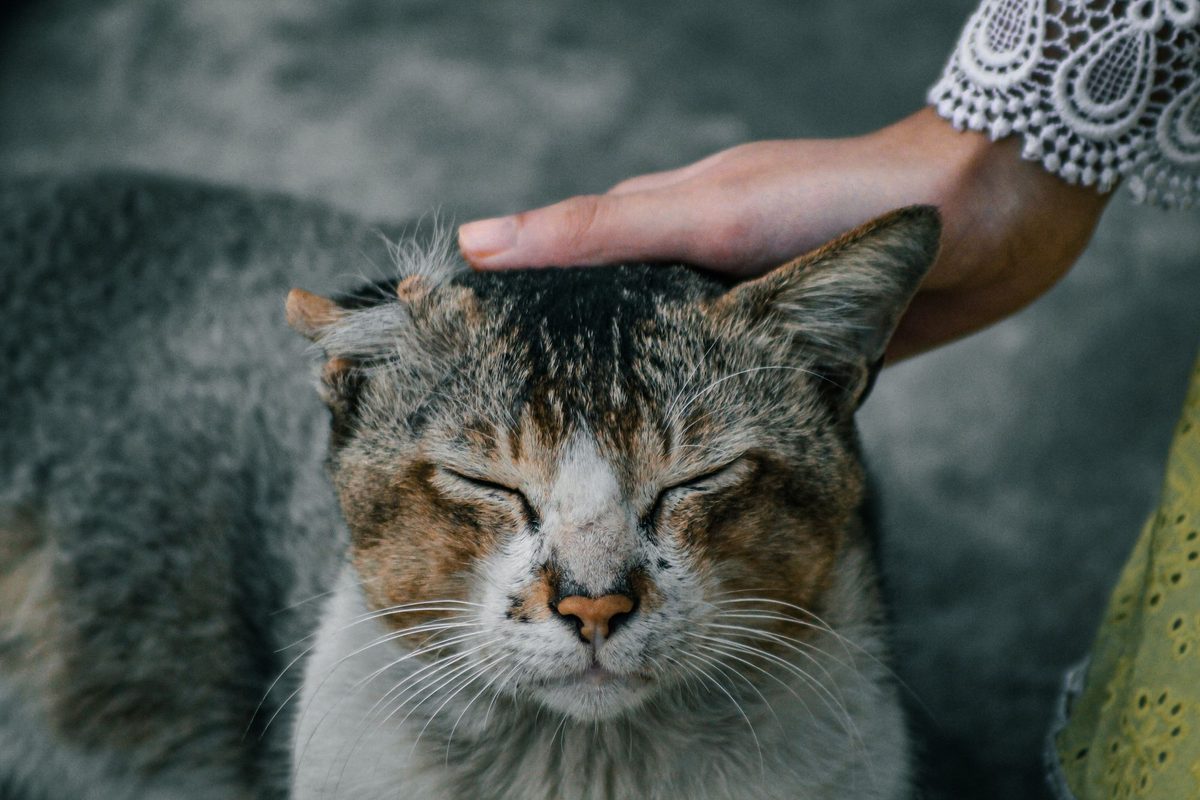
Most cats enjoyed their logged petting sessions in a study of 66 owners, yet 32.2% of owners said they had been scratched or bitten during petting at some point. The odds were higher for owners who had scolded the cat or stopped petting after earlier incidents, though the study found associations, not causes.1 The ASPCA calls this petting-induced aggression. It says the behavior is not well understood and that behaviorists think repeated stroking can quickly become unpleasant.5
The study at a glance
| Detail | What the paper reports |
|---|---|
| Journal | Applied Animal Behaviour Science, volume 305, article 107209 |
| Published | Online October 5, 2026, in the December 2026 issue |
| Authors | Kristina A. O'Hanley, David L. Pearl, Mary Klinck and Lee Niel |
| Sample | 66 owners completed the petting log; the abstract gives no separate count of cats |
| Method | A one-day log of three petting sessions, plus an online survey |
| Location | Authors include researchers at the Ontario Veterinary College, University of Guelph, Canada; the owners' location is not stated |
| Open access | Yes, under a CC BY 4.0 license |
| DOI | 10.1016/j.applanim.2026.107209 |
What the researchers did
Each owner logged three petting sessions on a single day. For each one they noted how long it lasted, how often petting happened, how the cat responded and anything that might have influenced the response.1
An online survey asked about the owner, the cat, the household and how the cat had reacted to petting over its lifetime, including scratches and bites. The team used logistic regression, which estimates whether a factor goes with higher or lower odds of an outcome such as a bite, and mixed models where one person contributed several records.1
What they found
Most logged sessions went well. Across the three sessions, 82.7% to 90.6% of cats reportedly enjoyed being petted, and 10.9% to 12.7% showed warning behaviors, the signals that can come before a swat or a bite.1
Lifetime incidents were common. Besides the 32.2% of owners who had been scratched or bitten themselves, 23.7% said their cat had scratched or bitten another person during petting.1
The logged day showed no links. No factor tested was significantly associated with how cats responded in the logged sessions, so every association below comes from the lifetime answers.1
The results are odds ratios (OR): 1 means no difference, above 1 means higher odds and below 1 lower odds. The 95% confidence interval (CI) is the range the data are reasonably compatible with.
| What the owner reported | Outcome | Odds ratio | 95% CI |
|---|---|---|---|
| Using verbal corrections such as "No!" after earlier incidents | Owner scratched or bitten during petting | 14.2 | 2.2 to 93.7 |
| Stopping petting after earlier incidents | Owner scratched or bitten during petting | 6.9 | 1.4 to 34.8 |
| Explorative enrichment at home, such as boxes and tunnels | Owner scratched or bitten during petting | 0.15 | 0.03 to 0.81 |
| Stopping petting after earlier incidents | Cat scratched or bit another person during petting | 8.0 | 2.1 to 31.2 |
The intervals are wide, as is typical of a small sample. The figure for verbal corrections fits anything from about twice to about 94 times the odds.1 Each interval stays on one side of 1, so the direction of each association is clearer than its size.
What the study cannot tell us
- Which came first. The authors write that causation is unclear: owners may reinforce or accidentally provoke the reactions, or simply respond this way to cats already prone to aggression.1 A cat that often scratches gives its owner more chances to say "No!" or pull a hand away.
- What an observer would see. All the data came from owners, through their logs and survey answers.1 Owners can miss or misread signals, and answers about a cat's lifetime depend on memory.
- Why the logged day looked calmer. The logs were calmer than the lifetime answers, and the study did not test why.1 One possibility is that a single day is too short to catch less frequent incidents.
- Who took part. Owners who sign up for a petting study may differ from other owners. This summary draws on the abstract and journal record, so details such as the cats' ages are not covered.
How it fits earlier research
Petting has come up in earlier work on cat aggression. In a 2009 survey of 107 owners in the Sao Paulo region of Brazil, owners reported aggression toward people in 49.5% of their cats, most often around petting and play. Sensitivity to being stroked was one of the two most widespread risk factors.2
A 2015 University of Lincoln study looked at where and by whom cats were stroked. Cats responded more negatively when a familiar person did the stroking than when an unfamiliar person did (a score of 8.5 against 5.0), and the area near the base of the tail drew the most negative responses.3
A 2021 study at Battersea Dogs and Cats Home in London tested handling guidelines called CAT with 120 members of the public, and 100 cats were analyzed. CAT stands for choice and control, attention to body language, and touch kept mainly to the base of the ears and the cheeks, plus under the chin for cats that like it. At least one hiss, growl, swipe or bite was recorded for 27% of cats before the training and 16% after it.4
When to stop petting
The ASPCA advises stopping as soon as a cat signals that it wants the petting to stop. Its warning signs include a twitching or flipping tail, ears flattening or rotating, restlessness and dilating pupils.5
The new study's finding concerns a different moment: owners who stopped petting after earlier incidents had higher odds of being scratched or bitten. The authors call for further research to work out which way that link runs.1
Quick quiz: how well do you know cat behavior?
Which technique involves gradually exposing a cat to a feared stimulus while pairing it with positive experiences?
Answer: Desensitization and counterconditioning. Desensitization gradually reintroduces the feared trigger at a low intensity while counterconditioning pairs it with something the cat loves, so the trigger itself comes to predict good things instead of fear. Source
Which tool helps a cat learn to follow directional cues?
Answer: A target stick. A cat learns to touch its nose to the tip of a target stick, then follow it as it moves. Caregivers use this to guide the cat's direction, such as into a carrier or away from another cat, without physical contact. Source
Why do cats leave urine marks around their home environment?
Answer: To deposit pheromones that send messages to other cats. A cat's urine carries pheromones, chemical messages that announce presence, establish territorial boundaries, or signal readiness to mate, functioning as a form of scent-based communication with other cats. Source
Frequently asked questions
What is petting-induced aggression?
It is the ASPCA's name for a cat that suddenly becomes irritated while being petted, nips or lightly bites, then jumps up and runs off.5
What counts as explorative enrichment?
Things in the home a cat can investigate, such as the boxes and tunnels the paper gives as examples. The study did not add enrichment and measure the result; owners who already provided it had lower odds of being scratched or bitten.1
Does saying "No!" make a cat bite?
The study cannot say. Owners who used verbal corrections after past incidents had higher odds of having been scratched or bitten, and the authors say the direction of that link is unclear.1
Up next
Christopher writes and runs Cat Trivia Games. The sources for this article are listed below, and how the site is made and corrected is on the editorial policy page. More about the author.
References
- O'Hanley, Pearl, Klinck and Niel, Applied Animal Behaviour Science, volume 305, article 107209, 2026 (open access). The petting diaries: Investigating owner-cat petting styles, responses and preferences. back
- Ramos and Mills, Journal of Feline Medicine and Surgery, 2009 (PubMed Central). Human directed aggression in Brazilian domestic cats: Owner reported prevalence, contexts and risk factors. back
- Ellis, Thompson, Guijarro-Clarke and Zulch, Applied Animal Behaviour Science, 2015. The influence of body region, handler familiarity and order of region handled on the domestic cat's response to being stroked. back
- Haywood, Ripari, Puzzo, Foreman-Worsley and Finka, Frontiers in Veterinary Science, 2021. Providing humans with practical, best practice handling guidelines during human-cat interactions increases cats' affiliative behaviour and reduces aggression and signs of conflict. back
- ASPCA. Aggression in cats (petting-induced aggression). back
Written by Christopher Fox under our editorial policy.