 Cat Trivia Games
iOS App
Cat Purring Model: The Larynx Hums, the Brain Turns It On
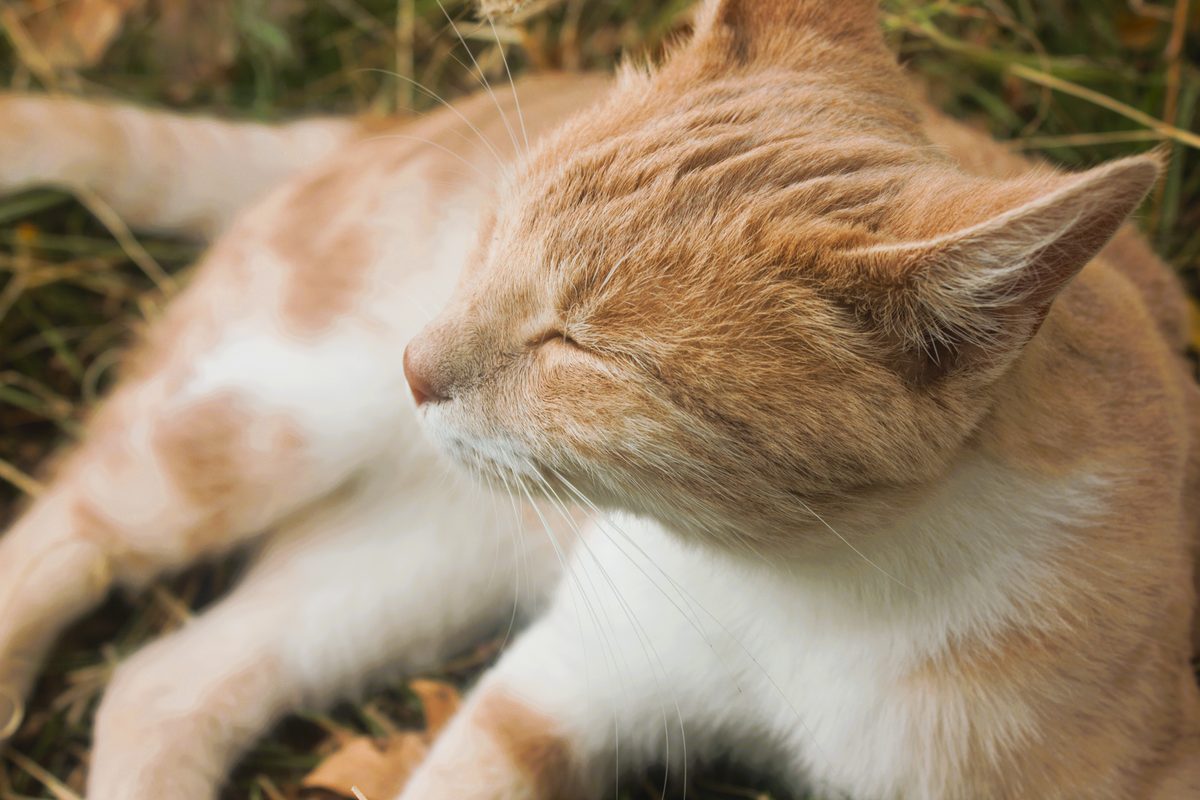
A cat's larynx can keep a purr going by itself, and the brain recruits and adjusts that vibration without directly generating every cycle, a new mathematical model accepted by Physical Review E concludes.1 It is a hybrid answer to a long argument over how purring works, and its abstract describes no new measurements of cats.
The study at a glance
| Detail | What the journal page reports |
|---|---|
| Journal | Physical Review E, accepted paper; version of record still to come |
| Published | Accepted October 29, 2026 |
| Authors | K. B. Blyuss and Y. N. Kyrychko |
| Sample | None given: a mathematical model, with no cats reported in the abstract |
| Method | A reduced equation for the larynx coupled to a neural oscillator, analyzed mathematically |
| Location | Not stated on the journal page |
| Open access | Not stated on the journal page; this summary uses the abstract only |
| DOI | 10.1103/37y1-ms8v |
What the researchers did
The authors describe the purr as a self-sustained vibration of the larynx that continues while the cat breathes in and out. Its rate, near 25 to 30 Hz or cycles a second, is the only frequency the abstract gives. They boiled the larynx's mechanics down to one cubic-quintic equation.1
They linked that equation to a Stuart-Landau oscillator, here a rhythm generator in the brainstem. A shared activation variable, a sort of dial, changes how easily the larynx vibrates and how strongly the neural signal pushes on it.1
What they found
The abstract sets the model against decades of debate between two explanations.1 In active muscle contraction (AMC), neural bursts drive the laryngeal muscles. In the myoelastic-aerodynamic (MEAD) account, laryngeal tissue keeps oscillating by itself.2
- Neural input makes the purr easier to start. AMC-like coupling can lower the activation needed and bring the purr on earlier than the passive MEAD setting alone.1
- The larynx keeps its own behavior. Even with that coupling, it retains the model's built-in hysteresis: its state depends on the path taken to reach it.1
- A simpler calculation overstates the brain's push. An approximation exaggerates neural forcing because it ignores the shifting timing between push and response.1
- Purring after the trigger ends got its own test. A second, slower layer of control let the authors test whether purring persists after the direct stimulus fades. The abstract ties this to separate roles for fast rhythmic drive and slower central control.1
What the study cannot tell us
- What happens in a living cat. A model shows what is possible under its assumptions, and the abstract describes no test against recordings from cats.
- Whether the math holds up in detail. This summary rests on the journal's accepted-paper abstract. Equations, parameter values and any supplement were not reviewed, and the journal says supplements arrive with the version of record.1
- Why a cat purrs. The abstract covers mechanism only, with nothing on what a purr means or what a cat feels when purring.
How it fits earlier research
A 2023 experiment sharpened this debate. All eight excised larynges from domestic cats produced self-sustained oscillations at purring rates with no neural input or muscle contraction. Connective tissue masses up to 4 mm across inside the vocal folds may allow such low frequencies. The team said its results do not fully rule out a muscle contribution.2
Descriptive studies of purring are few, a 2011 acoustic paper on four cats pointed out. It lists frequencies of 26.5 Hz from a 1991 paper and 22.6 Hz from a 2010 one, and a 1972 study by Remmers and Gautier that timed a purr's out-breath phase at 730 ms and in-breath at 690 ms.3
Cats may also layer other sounds onto a purr. A 2009 study reported that purrs recorded while cats sought food contain a high-pitched, cry-like element, and that people rated them as more urgent. Removing the element lowered those ratings.4 The new model's abstract does not mention it.
Quick quiz: how well do you know cat behavior?
Kneading, the paw-pressing motion cats do on soft surfaces, traces back to which kitten behavior?
Answer: Pressing on the mother's belly to stimulate milk flow while nursing. Kneading originates in nursing kittens, who press against their mother's belly to encourage milk let-down, and the motion is retained into adulthood as a comforting behavior. Source
Reviews of feline social behavior note that naturally tailless cats carry a specific communication handicap with other cats. Which pair of affiliative signals is a tailless cat, such as the Manx, least able to produce?
Answer: The upright 'tail-up' approach and tail-wrapping. The vertically raised 'tail-up' signal and conspecific tail-wrapping are both affiliative displays that literally require a working tail, so a Manx or other tailless cat cannot perform them. Grooming, scent-marking, and facial signals are unaffected, which is why only the tail-based greetings are compromised. Source
Some cats develop fixations on light sources like reflections or shadows after frequent laser pointer play. This behavioral shift is an example of what?
Answer: Generalization of the light-chasing behavior to other light sources. Cats can become conditioned to chase any light source, watch reflections, sunlight, ceiling reflections, after frequent laser play. This generalization of the behavior can lead to obsessive light-chasing, a problematic compulsive behavior noted in behavioral studies. Source
Frequently asked questions
Why is purring so hard to explain?
A purr generally has a pitch around 25 Hz, less than half the 55 Hz of exceptionally low choir singers, and cats purr breathing both out and in. Most people can voice only on the out-breath.5
Up next
Christopher writes and runs Cat Trivia Games. The sources for this article are listed below, and how the site is made and corrected is on the editorial policy page. More about the author.
References
- Blyuss and Kyrychko, Physical Review E, accepted paper, 2026. Mathematical model of cat purring. back
- Herbst, Prigge, Garcia, Hampala, Hofer, Weissengruber, Svec and Fitch, Current Biology, 2023. Domestic cat larynges can produce purring frequencies without neural input. back
- Schötz and Eklund, Proceedings from Fonetik 2011, KTH, Stockholm. A comparative acoustic analysis of purring in four cats. back
- ScienceDaily, July 2009, reporting McComb, Taylor, Wilson and Charlton, Current Biology. News report on the cry embedded within the purr. back
- Liberman, Language Log, October 9, 2023. How cats purr. back
Written by Christopher Fox under our editorial policy.