 Cat Trivia Games
iOS App
Cat and Owner Oxytocin Levels Were Linked in a One-Month Study of 29 Cats
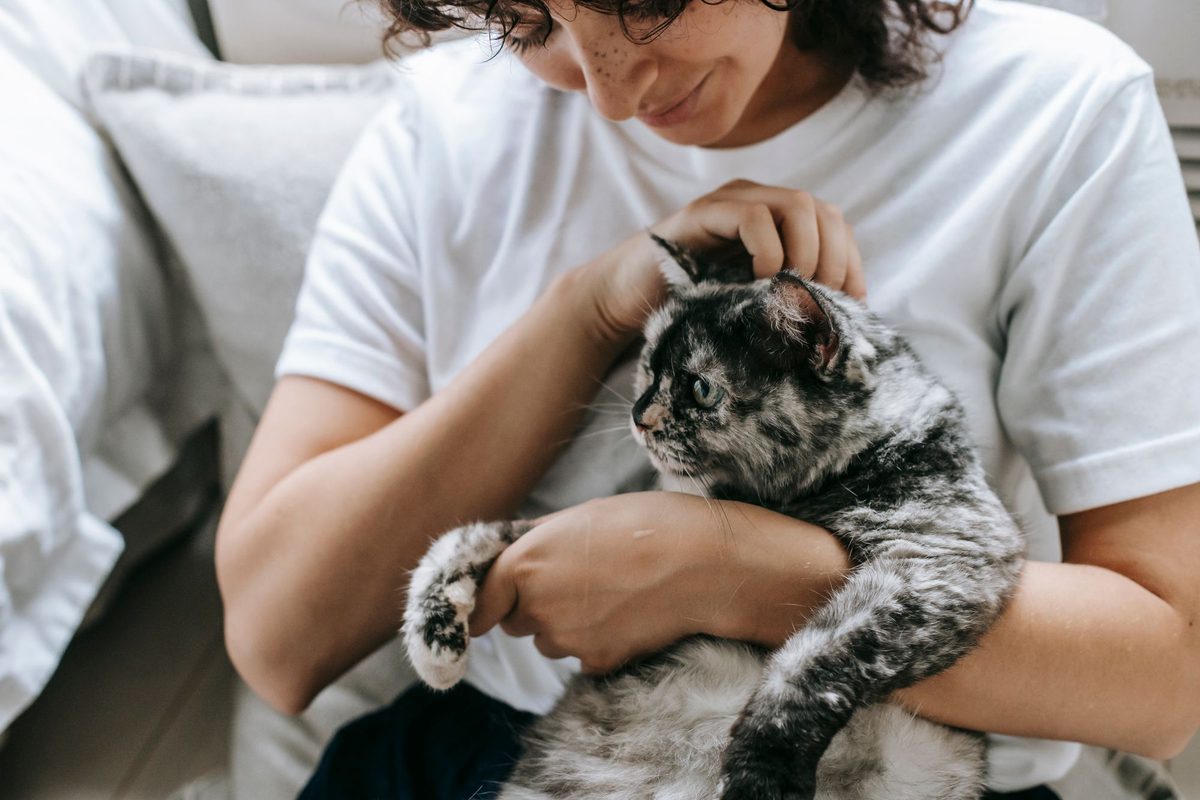
In a one-month study of 19 owners and 29 pet cats, researchers in Japan found that owners with more oxytocin, a hormone linked to social bonding, tended to have cats with more oxytocin too. Cats with more oxytocin also had owners with lower cortisol, a stress hormone, and fewer negative moods. These are associations, not evidence that one affects the other.
| Detail | What the paper reports |
|---|---|
| Paper | Cats and humans show correlated affiliative physiological states |
| Journal | iScience (Cell Press), article 117934, October 2026 |
| Cats and people | 29 cats and 19 owners enrolled; hormone data from 24 cats and 17 owners |
| Method | Urine tests for oxytocin and cortisol, Bluetooth beacons on cat collars, owner mood questionnaires, an approach test |
| Open access | Yes (CC BY 4.0) |
| DOI | 10.1016/j.isci.2026.117934 |
What the researchers did
The team recruited 29 cats and their 19 owners through flyers and social media and followed them for one month.2 Saho Takagi of Kyoto University led the work with Taisuke Tsubomura, Miho Nagasawa and Takefumi Kikusui of Azabu University.1
Urine samples were tested for oxytocin and for cortisol, which helps regulate the body's response to stress and its use of energy.3 Each result was the average of three samples, and urine could be collected from 24 of the 29 cats.3
To measure closeness, each cat wore a Bluetooth collar beacon that signaled the owner's phone. The signal estimated how near the cat was on ordinary days at home, but not what the two were doing: a cat asleep beside its owner and a cat being stroked could look the same.3
Owners also filled in a questionnaire on their moods over the previous few weeks: anger, confusion, anxiety, depressed mood, and vigor, a sense of energy.3 Last, an owner or a stranger sat inside a marked circle while the team watched whether the cat came over.2,3
What they found
- Oxytocin went together. Owners with higher oxytocin tended to have cats with higher oxytocin.1
- Cortisol mostly did not. Owner and cat cortisol showed little association.1
- Cat oxytocin and owner mood. Cats with more oxytocin had owners with lower cortisol and less negative mood, and owners with higher cortisol reported more negative mood.1 Kyoto University's release adds that the cats' oxytocin was more closely tied to their owners' negative moods than the owners' own oxytocin was.2
- Closeness and energy. Owners who were generally closer to their cats in daily life scored higher on vigor.1
- Approach. In exploratory analyses (checks not registered before the study began),3 cats with more oxytocin were more likely to approach people, and cats with more cortisol approached strangers less.1
The abstract reports the direction of each link. Effect sizes are in the full paper.
What the study cannot show
- It is small. Hormone data came from 24 cats and 17 owners, and 16 of the 19 owners were women.3
- It shows associations, not causes. It cannot tell whether cats reduce their owners' stress or whether people who feel better interact more with their cats.3
- The home may explain part of it. The authors say the correlations may partly reflect a shared household environment.1 Some owners had more than one cat, and when the team grouped the data by household, only the links between cat oxytocin and owner confusion and anxiety remained statistically supported.3
- It compared averages. The team did not test whether a cat's levels rose and fell with its owner's. Takagi told ScienceAlert that showing synchrony would need hormones measured at multiple time points.3
How it fits earlier research
Hormone links between owners and pets had been documented in dogs but not tested in cats, the authors write.1 Nagasawa and Kikusui were also on a 2015 dog study in Science. When dogs gazed at their owners, the owners' urinary oxytocin rose, their friendly behavior toward the dogs increased, and the dogs' oxytocin rose too. Gazing by wolves did not raise owners' oxytocin.4
For stress, a 2019 Linköping University study in Sweden measured hair cortisol in 58 dog and owner pairs, all Shetland sheepdogs or border collies. Owner and dog cortisol were linked in samples covering both summer and winter.5 In the cat study, owners gave urine samples in the morning, and cat samples were taken whenever possible. Cortisol rises and falls through the day, so that timing may have made a cortisol link harder to detect.3
In cats, a 2019 Oregon State University study used criteria from research on human infants and found that cats show distinct attachment styles toward their caregivers, traits once attributed to dogs and humans alone.6
A 2026 study led by researchers at South China Agricultural University sampled saliva from 20 pet cats before and after owners interacted with them at home. Passive interactions went with rises in oxytocin and drops in cortisol, and forced interactions with the opposite. Cats classed as insecurely attached had higher baseline oxytocin than secure cats.7 A high oxytocin level on its own is not a measure of a closer bond.
What is new about it
The authors describe the hormone synchrony reported between people and dogs as centered on cortisol, and suggest that in people and cats it may center on oxytocin.1 Takagi said the comfort and peace many owners feel when a cat climbs onto their lap may be partly reflected in this hormonal connection.2
Quick quiz: how well do you know cat behavior?
Which of these citrus fruits do most cats naturally avoid because of the smell?
Answer: Oranges and lemons. Cats strongly dislike the smell of citrus fruits like oranges, lemons, limes, and grapefruit because the compounds in these fruits irritate their sensitive olfactory system. This aversion makes citrus a useful tool for discouraging cats from unwanted areas. Source
Which of these is an example of positive reinforcement in cat training?
Answer: Giving the cat a treat right after it sits on cue. This is positive reinforcement: adding something pleasant, the treat, right after the desired behavior so the cat is more likely to repeat it. 'Positive' means something was added, not that the behavior was good. Source
Which of these is true about when cat owners typically notice a silent meow?
Answer: It often happens during greetings or excited, attention-seeking moments. Silent meows are common during excited or attention-seeking moments and are generally not a cause for concern, according to Hill's Pet Nutrition. Source
Frequently asked questions
Does this study show that cats love their owners?
No. Hormone readings are not direct measurements of happiness or stress, and oxytocin also plays roles in childbirth and milk release.3
Up next
Christopher writes and runs Cat Trivia Games. The sources for this article are listed below, and how the site is made and corrected is on the editorial policy page. More about the author.
References
- Takagi S, Tsubomura T, Nagasawa M, Kikusui T. Cats and humans show correlated affiliative physiological states. iScience, article 117934, October 2026. Open access (CC BY 4.0). back
- Kyoto University. Owners who spend more time close to their cats tend to have more positive moods. Research news, October 16, 2026. back
- Esra Öz, ScienceAlert. Cats and their owners seem to share a weird, hormonal connection. October 2026, with comments from Saho Takagi. back
- Nagasawa M, Mitsui S, En S, et al. Oxytocin-gaze positive loop and the coevolution of human-dog bonds. Science 348(6232):333-336, 2015. back
- Sundman AS, Van Poucke E, Svensson Holm AC, et al. Long-term stress levels are synchronized in dogs and their owners. Scientific Reports 9:7391, 2019. back
- Vitale KR, Behnke AC, Udell MAR. Attachment bonds between domestic cats and humans. Current Biology 29(18):R864-R865, 2019. back
- He X, Huang H, Chang H, et al. The hormonal effects of owner-cat interactions on pet cats of different potential attachment styles. Journal of Feline Medicine and Surgery 28(10), 2026. back
Written by Christopher Fox under our editorial policy.