 Cat Trivia Games
iOS App
Cat Shyness Tracks Fear, but Some Shy Cats Still Approach
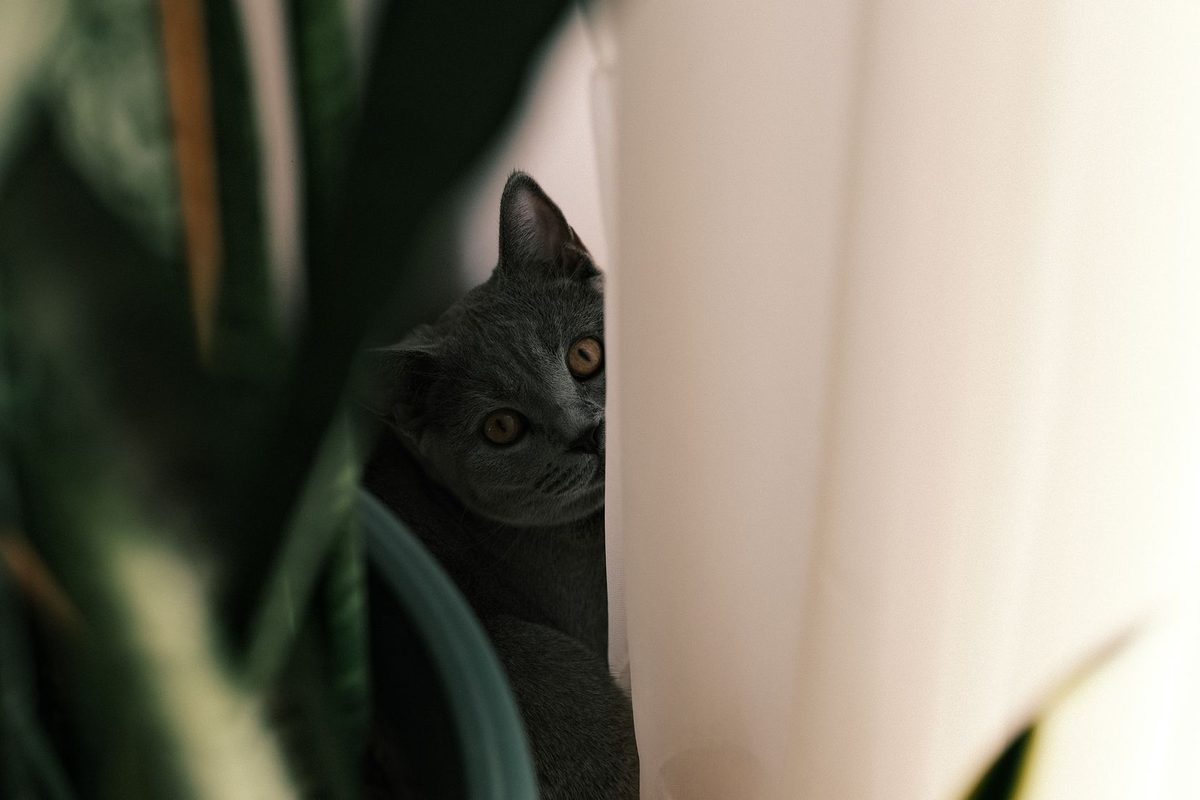
In two owner surveys, cats rated as shy were also rated as fearful, and the curved link to approach that the researchers predicted from human shyness did not appear.1 An exploratory follow-up found one group, 48 of 114 male cats in the second survey, high on both fear and approach.
The study at a glance
| Detail | What the paper reports |
|---|---|
| Journal | PLOS ONE, volume 21, issue 11, article e0360035 |
| Published | November 4, 2026 |
| Authors | Madoka Hattori, Atsuko Saito and Shinya Yamamoto |
| Sample | Three surveys: 82 cats of both sexes, 114 male cats, and 114 stray-born male cats |
| Method | Preregistered online owner questionnaires adapted from human infant and child temperament scales |
| Location | Authors at Kyoto University and Sophia University, Japan; no country named for the cats |
| Open access | Yes, under a CC BY 4.0 license |
| DOI | 10.1371/journal.pone.0360035 |
What the researchers did
The team borrowed a human idea: infant shyness as a conflict between approaching and avoiding. If cats work the same way, very shy and very outgoing cats should both score high on approach, a curved line on a graph.1
Owners, all women aged 20 to 50 with spayed or neutered cats aged 1 to 7, were recruited through social media. Shyness scores ran from 5 to 25, with items such as "My cat takes a long time to warm up to strangers". Fear and approach ran from 1 to 7, on an infant scale with items such as "gets very excited when given a new toy".1
The first survey hinted at a sex difference, with too few males to be sure, so the second used only males. That survey raised a question about stray-born males, the focus of the third.1
What they found
Shyness and fear moved together. The rank correlation, where 1 is a perfect match, was 0.788 in the first survey and 0.846 in the second.1
The predicted curve did not appear. The curved term was not statistically significant in the first survey (p = 0.170) or the second (p = 0.269), so the main hypothesis was not supported.1
Sorting the cats into groups suggested four types. This step was exploratory and tested no prediction.1
| Authors' label | Cats | Shyness (5 to 25) | Fear (1 to 7) | Approach (1 to 7) |
|---|---|---|---|---|
| Highly Sociable | 21 | 6.143 | 2.593 | 5.929 |
| Sociable | 33 | 10.061 | 3.240 | 4.618 |
| Human infant-like shyness | 48 | 21.813 | 5.285 | 4.656 |
| Fearful | 12 | 23.750 | 5.263 | 2.875 |
The two shy groups were nearly equal on fear and far apart on approach. Among the 114 stray-born males of the third survey, a similar high-fear, high-approach group held 35.1
Months of breeding showed no clear link. Among stray-born males, this measure (the paper's term) ranged from 6 to 82 and, after accounting for age, had no significant link to shyness, fear or approach. The authors found no evidence that these cats shifted type.1
What the study cannot tell us
- What the cats feel. Every score is an owner's interpretation. The authors say watching cats with owners and strangers would give a fuller picture.1
- Whether the scales fit cats. They come from tools for human infants and children, and the authors say validity in cats still needs checking.1
- Whether the four types are real. The authors call them candidates, and the strong overlap of shyness and fear may have shaped the groups. In the second survey, neither age nor stray-born background differed significantly across groups (23 of the 48 infant-like cats were stray-born).1
- How a cat changes over time. Each survey was a single questionnaire with no repeat ratings reported, and stray origin rests on owners' reports. The authors call for following cats over time.1
How it fits earlier research
The shyness-fear link matches the 2017 "Feline Five" survey of 2,802 pet cats in South Australia and New Zealand, which placed shyness under neuroticism with insecurity, anxiety, suspicion and fear of people.2
Shyness may also be partly inherited. A 2019 owner survey of 5,726 cats put the heritability of shyness toward strangers at 0.40 in Ragdolls and 0.47 in Maine Coons and Turkish Vans. Russian Blues had the highest probability of it among breeds, Burmese the lowest.3 An individual cat can differ from its breed.
Early socialization may matter too. A 2008 UK study gave 37 rescue kittens standard or extra socialization at 2 to 9 weeks of age. In owner interviews at about a year, fewer of the extra-socialized cats showed behavior suggesting fear of humans. The paper says the sensitive period for socialization to people ends in the seventh or eighth week of life.4
Shy cats are also easy to misjudge. In a 2013 study of 297 cats in a shelter-like setting, 66 of 212 rated as more socialized (31%) did not meet its behavior checklist. The authors suggest very shy and very aloof cats are hardest to identify. On day 1, 55% of the more socialized cats showed none of the checklist's strong behaviors, and 17% showed none until day 3.5
Quick quiz: how well do you know cat behavior?
When multiple cats in a household compete for resources, Jackson Galaxy's Cat Mojo framework suggests this reflects what underlying need?
Answer: Cats feel insecure about territory and resource ownership. Jackson Galaxy connects resource competition to territorial insecurity. When cats lack confidence in owning their territory and resources, conflict increases. According to PetMD, inter-cat aggression and resource-guarding behaviors stem from cats feeling threatened over high-value items and spaces, reflecting underlying lack of territorial security. Source
When researchers tested whether cats recognize their own name, how did most cats actually respond, according to the study?
Answer: Subtle cues, like ear or head movement. The study found cats showed recognition through subtle responses such as moving their ears, head, or tail, but fewer than 10 percent of cats actually got up and approached when their name was called. Source
When reward-based training shows diminishing returns, where a cat's response becomes slower or less reliable as training progresses, this performance decline is most likely due to:
Answer: Habituation to that specific reward type reducing its reinforcing strength. When performance deteriorates partway through training despite the cat initially being responsive, habituation to a single reward type is the primary culprit. The cat's nervous system adapts to that specific reward's sensory characteristics through repetition, diminishing its power to reinforce. Introducing a different reward type or varying between rewards restores the cat's responsiveness, proving the motivation remains intact, only that specific reward's effectiveness diminished. Source
Frequently asked questions
What does "human infant-like shyness" mean here?
It is the authors' label for cats rated high on both fear and approach, after the conflict described in infant shyness. It describes owner ratings, and the study did not observe any such conflict in the cats.1
Could the results differ for female cats?
Possibly. The curved pattern was not significant in the first survey's 38 females either (p = 0.202), but the two larger surveys covered only males.1
Up next

Christopher writes and runs Cat Trivia Games. The sources for this article are listed below, and how the site is made and corrected is on the editorial policy page. More about the author.
References
- Hattori, Saito and Yamamoto, PLOS ONE, volume 21, issue 11, article e0360035, 2026 (open access). Exploration of complex shyness and the relationship between fear and approach behaviors in domestic cats (Felis catus). back
- Litchfield, Quinton, Tindle, Chiera, Kikillus and Roetman, PLOS ONE, 2017. The 'Feline Five': An exploration of personality in pet cats (Felis catus). back
- Salonen, Vapalahti, Tiira, Mäki-Tanila and Lohi, Scientific Reports, 2019 (PubMed Central). Breed differences of heritable behaviour traits in cats. back
- Casey and Bradshaw, Applied Animal Behaviour Science, 2008. The effects of additional socialisation for kittens in a rescue centre on their behaviour and suitability as a pet. back
- Slater, Garrison, Miller, Weiss, Makolinski, Drain and Mirontshuk, Animals, 2013 (PubMed Central). Practical physical and behavioral measures to assess the socialization spectrum of cats in a shelter-like setting during a three day period. back
Written by Christopher Fox under our editorial policy.