 Cat Trivia Games
iOS App
Community Cats in Nepal: Who Do Sauraha's Street Cats Belong To?
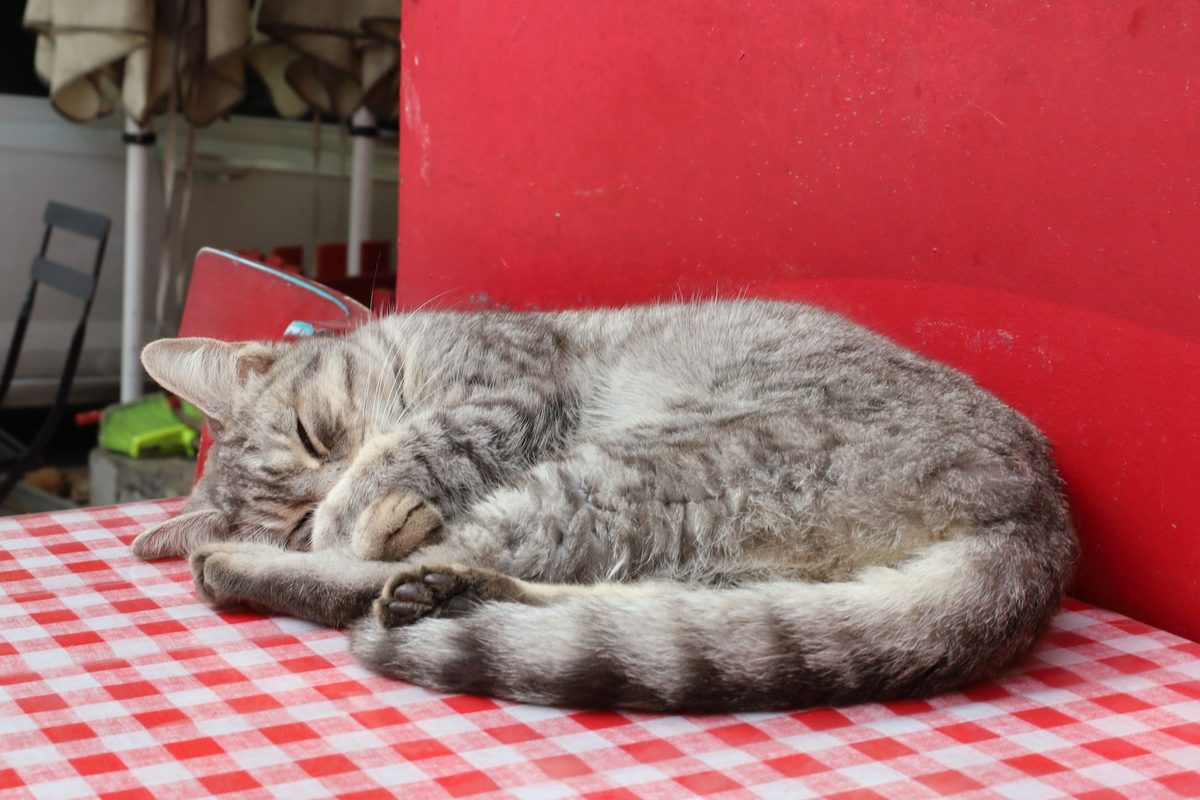
Often to nobody in particular, and sometimes to several homes at once. Three researchers who spent time in Sauraha, a tourist town in southern Nepal, documented 63 free-roaming cats and sorted each by its tie to people: to open space, to a place such as a restaurant or hotel, or to one person. So many cats sat between those boxes that the authors turned the three codes into one sliding scale, from space to place to person.1
Rhinos at sunset, cats in the shadows
Sauraha sits on the edge of Chitwan National Park, in the lowlands of southern Nepal. Locals say the river has shifted course, reshaped by concrete built into its banks for tourists who come to watch the sunset or take canoe rides into the park. In the early evening a rhino may wander through the sunset-viewing areas, between restaurants and tourists.2
Co-author Sarah Oxley Heaney described the fieldwork for the Society for Companion Animal Studies, which funded the project, "Companion Cats and Dogs in Nepal: A New Frontier", with a 2024 pump-priming award. The dogs were part of the town's rhythm, dozing in courtyards and following familiar people around, and several had notched ears, the local sign that a dog has been sterilized. The cats were harder to see.2
"We had to seek many out, where they lived in the margins: darting through shadows, resting under tables, or emerging at night."2
She describes two bonded tabby siblings at a riverside restaurant, cats loved and cared for by people living at restaurants, and more elusive cats that lived between several homes or were loosely tied to one spot.2 The paper itself rests on 27 interviews with 52 residents, alone or in groups, and on the 63 cats the team documented. It was published online in Anthrozoös on November 19, 2026, by Kristine Hill of the University of Hradec Králové, Michelle Szydlowski of Miami University and Oxley Heaney of AnthrozooCo.1
Space, place and person, and the cats in between
Each of the 63 cats got one of three codes for how it related to people and to buildings people made:1
Cats living outside, or on the edges of, places people define.
Cats tied to one human-built place, such as a shared home, a restaurant or a hotel.
Cats connected to one human who might be called their guardian or main caretaker.
The codes did not hold still. Many cats seemed to be in a liminal or in-between state, so the authors reframed them as a Space-Place-Person spectrum. They tie it to Umwelten transitions, which they gloss as changing environmental perceptions, and to an emerging "humano-cat culture", the culture of pet keeping, in a town shaped more and more by Western ideas through tourism, globalization and wildlife conservation. Their other themes are cats' own agency, including how cats help turn a space into a "place" with meaning, and a new role for companion cats as both commodities and kin.1
The abstract does not say how many cats landed under each code, or how many sat in between. The full paper is behind a paywall and the publisher's site refused our requests, so those counts are not on this page.
Other ways researchers have drawn the line
Sauraha's scale has relatives. An Australian internet survey in 2015 sorted 1,305 cats into four kinds of relationship, and its counts show how much room lies between "owned" and "stray".3
| Study | Who was asked | How the cats or people sorted |
|---|---|---|
| Sauraha, Nepal, 20261 | 52 residents, 63 cats | Space, Place, Person, with many cats in between |
| Australia, 20153 | 1,013 people, 1,305 cats | Casual contact 353 (27.0%), semi-owned 98 (7.5%), owned but not planned 249 (19.1%), owned and planned 605 (46.4%) |
| Urban China, 20244 | 5,382 residents | About 45% had rescued or helped community cats, 38% would adopt one, 18% had complained about them; about 60% reported harmonious or conflict-free coexistence |
| Tel Aviv University, 20115 | Caretakers of street feeding groups | Two emotional styles: attachment and detachment |
The Australian middle step is the one that looks most like Sauraha's in-between cats. A semi-owner feeds a cat often, for a month or more, without thinking of it as theirs. Those cats got less care than owned ones: 47% of the 98 semi-owned cats were known to be sterilized, and where people knew, 30% of semi-owned cats had had kittens, against 7% of owned cats that came into the home unplanned.3 The 2011 interviews found a split on the human side instead: some caretakers of street cats grew deeply attached, while others kept an emotional distance while doing the same daily work.5
In our reading, what Sauraha adds is a stop between the street and the sofa. The Australian scale runs from no owner to one owner, seen from the person's side. The Nepali one starts from the cat and puts a building in the middle: a restaurant or hotel where a cat belongs to the place more than to anyone in it.1
Oxley Heaney's own summary: "It wasn't that Nepal 'treats animals better.' It's that the ethics of care here look different."2 How cats in street colonies sort themselves out is a question in our cat trivia game.
Up next
Christopher writes and runs Cat Trivia Games. The sources for this article are listed below, and how the site is made and corrected is on the editorial policy page. More about the author.
References
- Hill, Szydlowski and Oxley Heaney, Anthrozoös, pages 1 to 23, online November 19, 2026 (abstract read via OpenAlex). Shared space and place: Community cats and emerging humano-cat cultures in Sauraha, Nepal. back
- Oxley Heaney, Society for Companion Animal Studies blog. In the shadows and the sun: reflections on cats, dogs and a multispecies community. back
- Zito, Vankan, Bennett, Paterson and Phillips, PLOS ONE, volume 10, article e0133293, 2015 (open access). Cat ownership perception and caretaking explored in an internet survey of people associated with cats. back
- Gu, Zhang, Peng, Ni, Wang, Xiong, Liu and Wang, Animals, volume 14, article 525, 2024 (PubMed Central). A survey of public opinion on community cats' general health and relationship quality with residents in urban China. back
- Finkler and Terkel, Anthrozoös, volume 24, pages 203 to 218, 2011. Dichotomy in the emotional approaches of caretakers of free-roaming cats in urban feeding groups: Findings from in-depth interviews. back
Written by Christopher Fox under our editorial policy.