 Cat Trivia Games
iOS App
Cats Meow More When Someone Is There: 86 Meows Versus 20
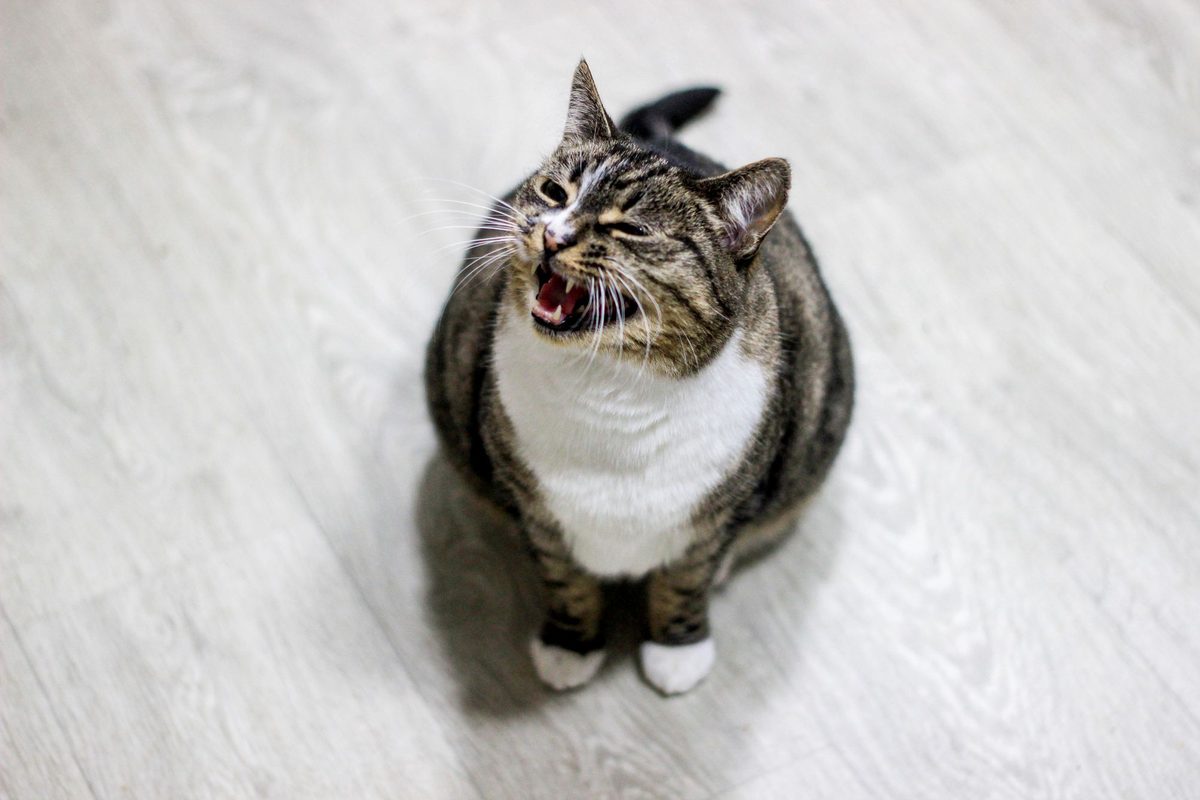
With a favorite treat sealed in a container, 38 pet cats meowed 86 times in total when an attentive person was in the room and 20 times alone.2 The University of São Paulo researchers say this fits the meow being a message aimed at people.3 It does not show that cats understand a person can open the container.
The study at a glance
| Detail | What the sources report |
|---|---|
| Journal | Animal Behaviour, volume 242, article 123756 |
| Published | Online November 5, 2026, in the December 2026 issue |
| Authors | Naila Fukimoto, Natalia Albuquerque and Carine Savalli |
| Sample | 38 pet cats whose owners said they often meow around food |
| Method | An unreachable treat, one minute with an attentive person present and one minute alone |
| Location | Authors at the Institute of Psychology, University of São Paulo, and the Federal University of São Paulo, Brazil; where the cats lived is not stated in ThePrint or The Independent |
| Open access | No; this summary uses the journal record and three news reports |
| DOI | 10.1016/j.anbehav.2026.123756 |
What the researchers did
Each cat's favorite treat sat in a small plastic container. The cat could see and smell it through openings but not reach it.2
Each cat had one minute with an attentive person in the room and one minute with nobody there, while the team counted meows and noted where the cat looked.3 The paper's indexed keywords include audience effects, gaze behavior, unsolvable tasks and citizen science.1
What they found
| Measure | Person present | Nobody present |
|---|---|---|
| Total meows, all 38 cats | 86 | 20 |
Meows were far more likely with a listener. The analysis put the odds of meowing at more than 16 times higher with a person present.2 ThePrint and ScienceAlert give 86 and 20 as totals for all the cats.28 The Independent, via Yahoo, instead reports about 20 meows per cat alone and over four times as many with a person.3
Gaze went with the meows. Cats often looked at the person while meowing, sometimes switching between the person and the food. The researchers call this recipient-specific signaling: a signal directed at a particular individual.2
Alone, the cats waited. With nobody in the room, cats stood still and gazed at the door significantly more.3 The authors conclude the results "are consistent with meowing playing a communicative role in cat–human interactions."3
What the study cannot tell us
- What the cats understood. The findings do not establish whether cats consciously understood that a person could solve the problem.2
- Whether quieter cats do the same. All 38 cats were known to be vocal around food, so results might differ for cats that rarely meow.2
- What each meow meant. The study counted meows. Whether cats use different meows for different wants is left for future work.2
- Ages, order and coding. The paper is not open access, and neither ThePrint nor The Independent gives the cats' ages, the order of the two conditions or how meows were coded.23
How it fits earlier research
Meows are uncommon between cats. Cornell's Nicholas Nicastro noted in 2004 that meows are observed infrequently between cats, and that rescue workers describe them as largely absent in unsocialized feral cats.4 He compared 48 meows from six domestic cats with 48 meow-type calls from eight captive African wildcats at the National Zoological Gardens in Pretoria. The domestic meows were shorter and higher pitched, and 26 human listeners rated them far more pleasant.4
Cats also notice whether a person is paying attention. In a 2021 study with a solvable and then an unsolvable treat task, cats with an attentive caregiver looked at the person sooner and for longer, and alternated their gaze more when the task could not be solved.5
Hearing a meow is easier than decoding it. In 2020, 225 adults heard six meows recorded while cats waited for food, were isolated or were brushed. Fewer than half named the context correctly, and food meows were easiest to recognize.6
The same São Paulo team has worked on testing cats at home. In 2023 they described synchronous citizen science, in which a researcher guides the owner through an experiment on a recorded video call, used with 48 owner and cat pairs.7 ThePrint and The Independent do not say whether the new study used that setup.
Quick quiz: how well do you know cat behavior?
Because its effects on a kitten's temperament are not absolute or unchangeable, researchers usually avoid calling weeks two to seven a 'critical period' and instead use what term?
Answer: sensitive period. Scientists favor 'sensitive period' because while weeks two to seven matter a great deal, outcomes are not fixed the way a true critical period would imply. Source
Between play sessions with the same toy, a 5-minute interval versus a 25-45 minute interval produced different results in cats. Which interval produced MORE intense play when a novel toy was introduced?
Answer: The 5-minute interval produced more intense play (post-inhibitory rebound). Research on cat play timing showed that shorter intervals (5 minutes) between sessions produced stronger post-inhibitory rebound. Play in the fourth session with a novel toy was more intense than with longer intervals (25-45 minutes). The shorter interval appears to enhance the rebound effect, possibly due to heightened residual motivation for play. Source
Beyond the interdigital glands, which of these body regions is also cited as a scent-gland site cats use for territorial marking, separate from the paws used in scratching?
Answer: The chin. Alongside the paw glands activated during scratching, cats carry scent glands in the cheeks, chin, top of the head, and base of the tail, all used for different marking behaviors like bunting and rubbing. Source
Frequently asked questions
Do cats meow at each other?
Rarely, yet meows are among the most common sounds cats make toward people.4
Can people tell what a meow means?
Only partly. In the 2020 listening study, cat owners and women did better at recognizing the brushing and isolation meows.6
Why did the cats look at the door when alone?
The study recorded that they did, not why. The authors suggest the cats were telling apart which behavior works better when someone is there to respond.3
Up next

Christopher writes and runs Cat Trivia Games. The sources for this article are listed below, and how the site is made and corrected is on the editorial policy page. More about the author.
References
- Fukimoto, Albuquerque and Savalli, Animal Behaviour, volume 242, article 123756, 2026. The social use of meow in the interaction between cats and humans. Keywords and author affiliations from the OpenAlex record. back
- Romal Renny, ThePrint, November 12, 2026. Cats likely meow on purpose to ask humans for help, study finds. back
- Vishwam Sankaran, The Independent via Yahoo News, November 12, 2026. The secret behind cat meows to get human attention unravelled. back
- Nicastro, Journal of Comparative Psychology, volume 118, pages 287 to 296, 2004. Perceptual and acoustic evidence for species-level differences in meow vocalizations by domestic cats (Felis catus) and African wild cats (Felis silvestris lybica). back
- Zhang, Needham, Juma, Si and Martin, Animal Cognition, volume 24, pages 1109 to 1119, 2021 (open access). Feline communication strategies when presented with an unsolvable task: the attentional state of the person matters. back
- Prato-Previde, Cannas, Palestrini and colleagues, Animals, volume 10, article 2390, 2020 (open access). What's in a meow? A study on human classification and interpretation of domestic cat vocalizations. back
- Islaine Maciel, Instituto de Psicologia, Universidade de São Paulo, March 30, 2023 (in Portuguese). Novo método para pesquisa em comportamento de gatos, a Ciência cidadã síncrona. back
- Michelle Starr, ScienceAlert, November 11, 2026. Science has finally shown that your cat meows to demand that you fix their world. back
Written by Christopher Fox under our editorial policy.