 Cat Trivia Games
iOS App
Leopard Cats in a Panda Park Keep Their Night Hours Near People
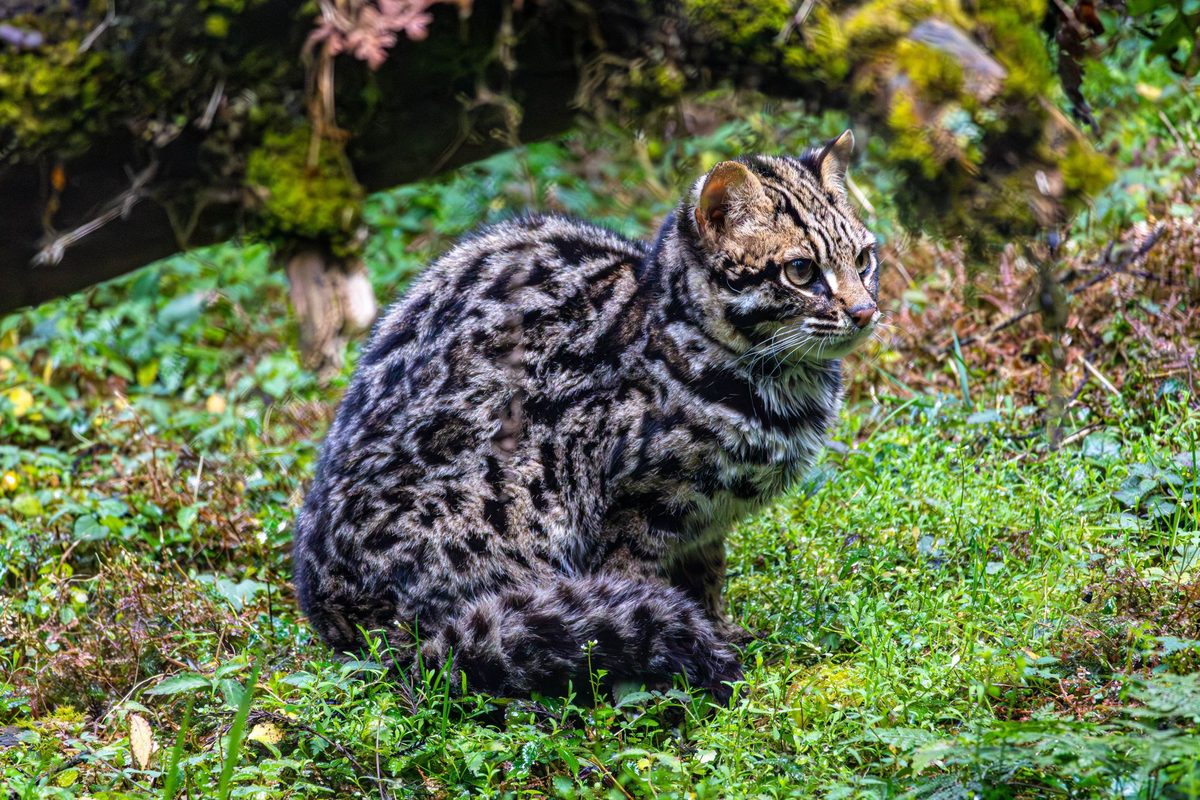
Leopard cats in the Yingjing section of China's Giant Panda National Park kept the same mostly nocturnal schedule at camera sites with and without signs of people, livestock or dogs. They were busiest between 2 and 6 a.m., and a model found no spatial link between the cats and people. Their potential habitat still tracked distance from settlements.1
The study at a glance
| Detail | What the paper reports |
|---|---|
| Journal | Diversity, volume 18, issue 11, article 669 |
| Published | October 30, 2026 |
| Authors | Mingxia Fu et al. (12 authors) |
| Sample | 687 independent leopard cat detections at 181 of 474 camera stations, over 283,279 camera-trap days |
| Method | Camera trapping from October 2017 to April 2024, activity overlap analysis, a two-species occupancy model and habitat modeling |
| Location | Yingjing section of Giant Panda National Park, China |
| Open access | Yes, under a CC BY 4.0 license |
| DOI | 10.3390/d18110669 |
What the researchers did
The team asked whether people, livestock and domestic dogs moving through the park change when and where leopard cats (Prionailurus bengalensis), a small wild cat, are active.1
They compared daily activity at disturbed and undisturbed sites, used a two-species occupancy model to test whether cats and people shared stations more or less often than chance, and mapped likely habitat.1
What they found
A night cat, busiest from May to November. Daily activity peaked between 02:00 and 06:00, and yearly activity was concentrated from May to November.1
The same clock at disturbed sites. Activity at disturbed and undisturbed sites overlapped closely (overlap coefficient 0.91, 95% CI 0.84 to 0.97), and the difference was not statistically significant (P = 0.763).1
No avoidance at the station level. The occupancy model found no spatial association with humans (species interaction factor 1.00).1
Settlements still shape the map. Three features were the main predictors of potential habitat:1
| Predictor | Contribution to the model |
|---|---|
| Distance to settlements | 29.67% |
| Distance to water sources | 24.18% |
| Elevation | 19.04% |
Potentially suitable habitat covered 328.03 square kilometers, 39.60% of the Yingjing section.1
What the study cannot tell us
- Which disturbance matters. The study pooled people, livestock and domestic dogs as one disturbance. The authors say future work should separate them, since pooled analyses may hide different responses.1
- Whether there is no effect. The cats showed no clear overall avoidance under current conditions, yet their habitat was closely tied to distance from settlements.1
- How many cats there are. Detections count photo events, and the abstract gives no population estimate. This summary draws on the abstract and journal record.
- Other places. One park section, with its own mix of people and land use, may not represent others.
How it fits earlier research
Xinlong, in southwestern China, gave a similar result. Camera traps there from 2015 to 2023 found leopard cats independent of humans and cattle (interaction factor 1.00) but avoiding domestic horses (0.76). Roads and settlements contributed little to the habitat model, while the yellow-throated marten accounted for 52.4%. The authors credited local traditions that protect wildlife and the species' adaptability.2
In Tieqiaoshan Nature Reserve in Shanxi, a camera study from 2017 to 2019 found that leopard cat occupancy decreased over time. Elevation affected colonization more than distance to villages or roads did. The cats tended to avoid North Chinese leopards in the first sampling period and occurred independently of them in the later two.3
Leopard cats and people share a long past. Ancient remains from 14 archaeological sites in China show leopard cats in human-altered settings from at least 5,400 years ago until about 150 CE. The earliest known domestic cat in China dates to around 730 CE.4
Quick quiz: how well do you know cat behavior?
Apart from mother-kitten interactions, adult pet cats mostly reserve meowing to communicate with whom?
Answer: Their human caregivers. Studies note that outside mother-kitten bonds, adult cats rarely meow at each other; meowing seems to have developed largely as a signal aimed at people, since cats learned it reliably gets a human response. Source
At what age do kittens typically begin to use the litter box?
Answer: Around 3 weeks old. Kittens are usually given a low-sided litter tray from about three weeks old, once they're mobile enough to climb in; many learn to use it simply by watching their mother. Source
Based on stress recovery research with shelter cats, what can be inferred about the mechanism by which hiding boxes accelerate stress recovery?
Answer: Hiding boxes allow the parasympathetic nervous system to downregulate stress and restore balance faster. Cats that recovered from stress seven days earlier with hiding box access likely did so because refuge allows the autonomic nervous system to shift from sympathetic (fight-or-flight) to parasympathetic (rest-and-restore) dominance. When cats feel safe in a hiding place, their stress response system can downregulate, allowing homeostasis and recovery to proceed more efficiently. Source
Frequently asked questions
Is a leopard cat a small leopard?
No. It is a separate small wild cat species, Prionailurus bengalensis. In the Shanxi study, leopard cats tended to avoid leopards in one of three sampling periods.3
Did leopard cats ever live with people?
Yes, in China for thousands of years, but only the domestic cat became fully domesticated. The same study traces China's house cats to the Levant and proposes Silk Road merchants brought them, though more early samples are needed to confirm the route.4
What is a species interaction factor?
A number from a two-species occupancy model. A value of 1.00 means the two species occur independently. Values below 1 suggest avoidance, as with horses (0.76) in Xinlong.2
Up next
Christopher writes and runs Cat Trivia Games. The sources for this article are listed below, and how the site is made and corrected is on the editorial policy page. More about the author.
References
- Fu, Zheng, Zhang et al., Diversity, volume 18, article 669, 2026 (open access). Spatio-temporal responses of leopard cats to anthropogenic activities in the Yingjing section of Giant Panda National Park. back
- Chen, Tian, Pan et al., Animals, 2023 (PubMed Central). The minimal impact of anthropogenic disturbances on the spatial activities of leopard cats in Xinlong, China. back
- Vitekere, Wang, Karanja et al., Animals, 2020 (PubMed Central). Dynamic in species estimates of carnivores (leopard cat, red fox, and North Chinese leopard): a multi-year assessment of occupancy and coexistence in the Tieqiaoshan Nature Reserve, Shanxi Province, China. back
- Han, Hu, Liu et al., Cell Genomics, 2026 (PubMed Central). The late arrival of domestic cats in China via the Silk Road after 3,500 years of human-leopard cat commensalism. back
Written by Christopher Fox under our editorial policy.