 Cat Trivia Games
iOS App
Whisker Stress Bowls Tested: Fewer Spills, Same Appetite
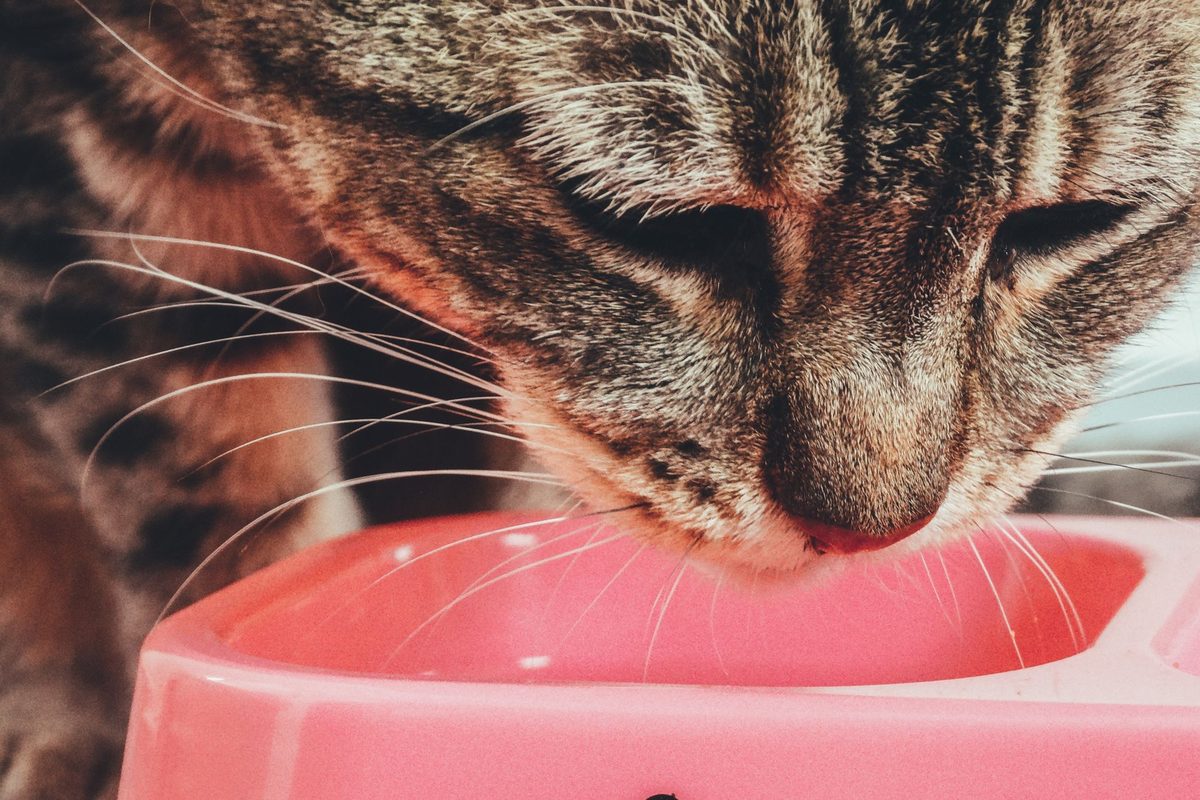
When 26 pet cats moved from a deep, narrow bowl to a wide, shallow one, the spills stopped: 10 cats dropped kibble from the deep bowl and none from the wide one. Intake did not change, neither bowl was chosen more often, and video showed no signs of discomfort. The authors conclude the results do not confirm "whisker stress" as a systemic phenomenon in cats.1
The study at a glance
| Detail | What the paper reports |
|---|---|
| Journal | Russian Veterinary Journal, issue 4, 2026, pages 18 to 23 (in Russian, with an English abstract) |
| Published | October 19, 2026 (received October 14, accepted October 19) |
| Authors | Anastasiya N. Ovcharova et al. (three authors) |
| Sample | 26 clinically healthy pet cats living with their owners |
| Method | Each cat was its own control over eight days: usual deep bowl, then a wide shallow bowl, then both; food weighed, meals filmed |
| Location | Cats fed in their own homes; authors at VNIIFBiP in Borovsk and PFLab, a pet food palatability research lab in Moscow, Russia |
| Open access | Free PDF on the journal site; no license stated |
| DOI | 10.32416/2500-4379-2026-4-18-23 |
What the researchers did
Each cat's usual bowl was the control: a deep, narrow plastic dish about 9 cm across and 4 cm deep in the paper's figure. The test bowl was a "whisker-friendly" dish of similar material, 19 cm across and 3 cm deep, so the whiskers would touch the rim less.1
On day 1, after a 12-hour fast with water available, each cat ate from its usual bowl. Days 2 to 4 used only the wide bowl on the normal routine, and day 5 repeated the fast with it. On days 6 to 8 both bowls held the same amount of food, swapping sides daily. The daily ration was 100 g of dry food.1
Food was weighed to the nearest gram before and after, including kibble outside the bowl. Test meals were filmed for five minutes or until the cat walked away, and owners rated eating speed on a five-point scale.1
What they found
| Measure | Deep, narrow bowl | Wide, shallow bowl | Difference? |
|---|---|---|---|
| Food eaten in the test meal (mean) | 18.4 g | 21.8 g | Not significant |
| Cats that dropped food outside the bowl | 10 of 26 (38.5%) | 0 of 26 | Significant |
| First choice when both bowls were offered (days 6 to 8) | 41 times (52.6%) | 37 times (47.4%) | Not significant |
| Food eaten in the side-by-side test (mean) | 13.5 g | 15.3 g | Not significant |
Spills were the clear change. Cats that dropped food from the deep bowl lost 1 to 5 g each, and the paper's photos show kibble scattered around the deep bowl and staying inside the wide one.1
No signs of discomfort. Videos showed no restlessness at the bowl, walking away from food, head shaking or eating-related vocalizing, even at the deep bowl.1
Owners saw a difference the numbers did not confirm. With the wide bowl, 72% of owners rated eating as "normal" or "fast", against 60% with the deep bowl, and "slow" ratings fell from 30% to 18%. The shift was not statistically significant. Afterward, 57% of owners kept using the wide bowl.1
What the study cannot tell us
- Whether order played a part. Every cat used its deep bowl first and the wide bowl after three days of practice, so bowl and time are confounded.1
- Everyday grazing. Intake was compared at single meals after a 12-hour fast, filmed for up to five minutes. A fasted cat may eat differently from the same cat nibbling through a normal day.1
- Which cats might be sensitive. Breeds and ages are not reported. The authors call for high-speed video, recordings of whisker nerve activity and comparisons across breeds and ages.1
- Anything about cats that are off their food. All 26 cats were healthy. In dvm360's 2017 coverage of whisker fatigue, the AVMA's president said changes in eating behavior should be addressed with a veterinarian.4
- Independent review. Five days passed between receipt and acceptance, and two of the three authors work at a pet food palatability lab. The paper declares no conflict of interest.1
How it fits earlier research
Cat whiskers are very sensitive. In a 1971 recording from the whisker nerve fibers of anesthetized cats, the median fiber responded to a deflection of 12 minutes of arc, a fifth of a degree, with the whisker vibrated 50 times a second.3
Whisker fatigue drew scrutiny in 2017. dvm360 reported that a New York Times story on it interviewed only sources with a vested interest in selling bowls and included no input from veterinarians. A Boston Magazine search of three veterinary journals for "whisker fatigue" found nothing, and the AVMA's president said there was currently no evidence that whiskers rubbing on bowls caused cats stress or discomfort.4
The new paper describes Slovak and Foster's 2021 study as the only earlier controlled test.1 Its 40 indoor cats followed a similar plan: a 12-hour fast, a meal from the usual dish, seven days with a whisker-friendly dish, then both. That dish brought no evidence of changes in eating time, dropped food or food eaten, and the estimated probability that a cat preferred it was 0.74.2 The two studies agree on intake. They differ on spills, where only the new study found a difference, and on preference, where it found none.
Quick quiz: how well do you know cat behavior?
When multiple cats in a household compete for resources, Jackson Galaxy's Cat Mojo framework suggests this reflects what underlying need?
Answer: Cats feel insecure about territory and resource ownership. Jackson Galaxy connects resource competition to territorial insecurity. When cats lack confidence in owning their territory and resources, conflict increases. According to PetMD, inter-cat aggression and resource-guarding behaviors stem from cats feeling threatened over high-value items and spaces, reflecting underlying lack of territorial security. Source
When researchers tested whether cats recognize their own name, how did most cats actually respond, according to the study?
Answer: Subtle cues, like ear or head movement. The study found cats showed recognition through subtle responses such as moving their ears, head, or tail, but fewer than 10 percent of cats actually got up and approached when their name was called. Source
When reward-based training shows diminishing returns, where a cat's response becomes slower or less reliable as training progresses, this performance decline is most likely due to:
Answer: Habituation to that specific reward type reducing its reinforcing strength. When performance deteriorates partway through training despite the cat initially being responsive, habituation to a single reward type is the primary culprit. The cat's nervous system adapts to that specific reward's sensory characteristics through repetition, diminishing its power to reinforce. Introducing a different reward type or varying between rewards restores the cat's responsiveness, proving the motivation remains intact, only that specific reward's effectiveness diminished. Source
Frequently asked questions
What is whisker stress?
It is the idea, also called whisker fatigue, that whiskers repeatedly brushing a deep bowl overload a cat and put it off eating. Bowl makers and bloggers promote it, the new paper notes, while confirming studies are almost absent.1
Did the cats warm to the wide bowl over time?
Slightly, without reaching significance. On day 6, 15 cats went to the deep bowl first and 11 to the wide one. On day 8 it was 14 for the wide bowl and 12 for the deep one.1
Is there any reason to use a wide bowl?
The authors suggest one: for a cat that often drops food, a wider, shallower bowl may cut the mess, whether or not whisker stress applies.1
Up next

Christopher writes and runs Cat Trivia Games. The sources for this article are listed below, and how the site is made and corrected is on the editorial policy page. More about the author.
References
- Ovcharova, Maslennikova and Maslennikova, Russian Veterinary Journal, issue 4, pages 18 to 23, 2026 (free PDF, in Russian). Experimental evaluation of the effect of the feed bowl design on the eating behavior of domestic cats in the context of whisker stress. back
- Slovak and Foster, Journal of Feline Medicine and Surgery, volume 23, pages 389 to 392, 2021. Evaluation of whisker stress in cats. back
- Hahn, The Journal of Physiology, volume 213, pages 215 to 226, 1971. Stimulus-response relationships in first-order sensory fibres from cat vibrissae. back
- James, dvm360, June 12, 2017. Whisker fatigue: Did pet bowl companies invent a feline malady? back
Written by Christopher Fox under our editorial policy.