 Cat Trivia Games
iOS App
Why Do Cats Sleep So Much?
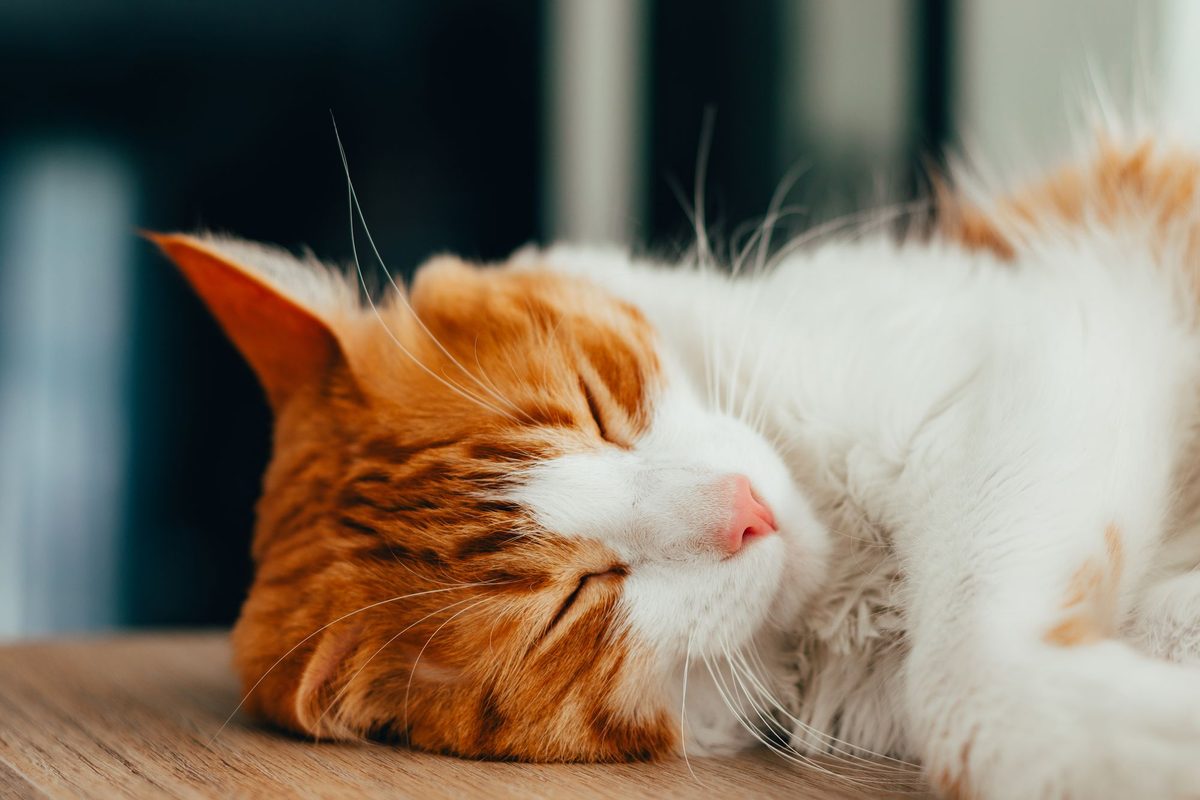
Cats sleep so much because they are predators that save energy between bursts of activity, and across mammals, carnivores sleep more than omnivores and plant eaters.12 A typical cat sleeps 12 to 16 hours a day in several short naps, and kittens and older cats may sleep closer to 20. Most cats are busiest around dawn and dusk.13
Why cats sleep more than many mammals
Carnivores and omnivores sleep more than body size alone predicts, perhaps to save energy: they generally have safe places to sleep, and calorie-dense meals make constant activity unnecessary. Plant eaters sleep least, and large ones may sleep less than small ones because they are more exposed to predators, or because low-calorie food takes hours to eat.2
Stalking, running and pouncing are tiring, and a play session can leave a house cat ready to rest.3 Age, health, boredom, weather and temperament shift the total, and outdoor cats typically sleep less than housecats.3 Sleep time goes up on cold, rainy or cloudy days.4
How many hours cats sleep at each age
Care guides differ by a few hours: PetMD gives 12 to 16 hours for most cats, PDSA an average of 15 and Cats Protection 16 or more.134
| Life stage | Daily sleep or rest | What changes |
|---|---|---|
| Newborn kittens | Most of the time4 | In land mammals, total and REM sleep peak at birth, then fall toward adult levels2 |
| Growing kittens | Up to 20 hours1 | Patterns start to match an adult's as they mature4 |
| Adults | 15 hours or less by PetMD's figure1 | Taken in several short bursts3 |
| Seniors (10 and up, per PetMD)1 | Closer to 20 hours, by PDSA's figure3 | Over 24 hours, cats aged 10 to 11 had more brief awakenings (6 to 14 seconds), less REM and more non-REM sleep than cats aged 2 to 45 |
| Seven feral cats, Ainoshima, Japan, 1977 to 1978 | 18 hours 51 minutes of rest a day on average (78.5%)6 | Rest counted sleeping, lying, sitting and self-grooming, so it includes waking time6 |
| 28 pet cats aged 1 to 10, collar sensors, New Zealand, 2022 to 2023 | Lying 36.7% of the time, about 8.8 hours a day7 | Lying included sleeping; lying, sitting and standing together took 86% of their time7 |
Neither field study measured sleep on its own: the Japanese one logged radio signals only as active or resting, and the New Zealand model sorted collar data into eight behaviors, none of them sleep.67 The cat age calculator converts a cat's age to human years.
Light sleep, REM and twitching
Cats cycle between light dozing, often 15 to 30 minutes long, and a deeper stage of typically 5 to 7 minutes. Around a quarter of their sleep is the deeper kind.3 In light sleep the smallest sound can often wake a cat, and some doze sitting upright or with one eye half open.3
The deeper stage is REM sleep,3 and it can show: whiskers, ears and tail may twitch and breathing changes.4 PDSA says the twitches mean the cat is likely dreaming.3 During REM the brain is highly active, heart rate and breathing vary and the eyes move rapidly. The brain's movement systems fire strongly, but the motor neurons block their output.2
Research on cats gave REM its other name, paradoxical sleep. In 1959 Michel Jouvet described near-complete loss of muscle tone during REM in cats, then the main animal model for sleep research, and the contrast with intense brain activity led to the name.8 His flower pot technique deprived cats of REM: each slept on an upturned pot surrounded by water, and when REM slackened its muscles, it fell off or touched its snout to the water and woke.8 A 2017 tribute credits his cat work, along with dreamlike ("oneiric") behavior in animals, with making the clinical definition of REM sleep behavior disorder possible.8
Quick quiz: how well do you know cat behavior?
The roughly 65 percent secure attachment rate found in cats was notable because it closely matched a comparable rate long documented in which group?
Answer: Human infants with their caregivers. Around 65 percent of human infants are classified as securely attached to their caregiver, a proportion the cat study found strikingly similar to. Source
The term 'bunting' specifically refers to which feline greeting behavior?
Answer: When a cat headbutts you with its forehead. Bunting is the specific term for when a cat headbutts another cat or person with its forehead. This deposits pheromones from facial glands as a bonding gesture. When the behavior extends to the whole body and tail, it is called allorubbing. Source
The typical sequence of a cat's slow blink includes half-blinks followed by which of these?
Answer: A prolonged eye narrowing or full eye closure. The slow blink sequence is defined as a series of half-blinks followed by either a prolonged eye narrowing or a complete eye closure. This specific pattern of eyelid movements is what distinguishes it from normal blinking. Source
Dawn, dusk and the seasons
Cats are crepuscular, most active at dawn and dusk, when their natural prey would be active.14 A cat that seems to sleep all day may be awake while you are in bed.1
Air temperature shifted the schedule of the feral cats on Ainoshima, a small island in Fukuoka Prefecture, Japan. Activity peaked at dusk and dawn and moved toward night as it got warmer, so the cats were nocturnal in summer and more active by day in winter. They rested two hours or more at one site, moved for less than 30 minutes, then rested again at the next.6
Pet cats with outdoor access shift with the seasons too: in the New Zealand collar study they were less active in winter than summer, and indoor-only cats showed no seasonal difference. Older cats spent less time active.7 The same paper cites an earlier study in which colony-housed cats were more active while staff were present.7
Sleep changes that need a vet
Sleep that changes suddenly, or a lot of extra napping, can signal an underlying health problem. If a cat is constantly lethargic and loses interest in petting, food or play, speak to your vet.3 Illnesses that can make a cat sleep more include hyperthyroidism, diabetes, kidney, heart and liver disease, and cancer.1
In older cats, more sleep or a move to easier-to-reach resting places may point to arthritis. Extra night activity can come from arthritis pain, hyperthyroidism, high blood pressure or cognitive decline, which can bring excessive vocalizing (also a feature of deafness).4 Hyperthyroidism mostly affects middle-aged and older cats. Its most common signs are weight loss, a bigger appetite and more thirst and urination, and it can cause hyperactivity.9
Cognitive dysfunction syndrome is age-related decline with behavior changes no other medical condition explains. Its signs include altered sleep and wake patterns and vocalizing, especially at night. A 2020 paper cites estimates that behavior problems, often linked to undiagnosed cognitive dysfunction, affect 28 to 36% of cats aged 7 to 14, 50% of those 15 or older and 88% of those 16 to 19.10 Among owners of 37 diagnosed cats it surveyed (median age 15.9), 29.7% reported sleep-wake changes, 35.1% said the cat vocalized mostly at night, and two thirds were woken at night. It is a diagnosis of exclusion: high blood pressure, hyperthyroidism, FIV infection and reactivated toxoplasmosis can cause identical changes.10
Some signs cannot wait:
- Breathing. A cat breathing with difficulty or with an open mouth needs a veterinarian right away.11
- Urinating. A cat straining or unable to urinate needs a veterinarian right away, because a blocked urethra is an emergency.12
- Sleep plus other changes. Extra sleep with loss of appetite or weight loss calls for a vet visit right away.1
Frequently asked questions
Can a cat pretend to be asleep?
Stressed cats can feign sleep, commonly when sharing a resource, such as a favored raised resting spot, with a cat outside their social group. Ears that move as though listening, or lying on the chest or in a crouch, suggest the cat is not really resting. Cats that curl up touching and groom each other are likely in the same group.4
Why does my cat keep changing where it sleeps?
Cats often rotate their sleeping places, a habit thought to come from wild ancestors as a way to limit external parasites. If a cat ignores a new bed, moving it somewhere higher, quiet, warm and sunny may help.4
Why did my cat bite me when it woke up on my lap?
Most cats woken by stroking realize what is happening, but some wake disoriented and react defensively to what feels like a threat. Once a lap cat falls asleep, stop stroking it.4 For bites during ordinary petting, see what 66 owners reported.
Up next
Christopher writes and runs Cat Trivia Games. The sources for this article are listed below, and how the site is made and corrected is on the editorial policy page. More about the author.
References
- Nicole Zittritsch, LVT, PetMD (updated March 25, 2026). Why do cats sleep so much? back
- Jerome M. Siegel, Nature 437 (2005), author manuscript at PubMed Central. Clues to the functions of mammalian sleep. back
- PDSA (November 9, 2022). Why do cats sleep so much? back
- Vicky Placzek RVN and Katie Smith RVN, The Cat, Cats Protection (Summer 2014). The importance of sleep (PDF). back
- S. S. Bowersox, T. L. Baker and W. C. Dement, Electroencephalography and Clinical Neurophysiology 58 (1984), abstract at PubMed. Sleep-wakefulness patterns in the aged cat. back
- Masako Izawa, Journal of the Mammalogical Society of Japan 9(5) (1983). Daily activities of the feral cat Felis catus Linn. (PDF). back
- Michelle Smit, Rene A. Corner-Thomas, Ina Draganova, Christopher J. Andrews and David G. Thomas, Sensors 24 (2024). How lazy are pet cats really? Using machine learning and accelerometry to get a glimpse into the behaviour of privately owned cats in different households. back
- Gabriel Natan Pires, Sergio Tufik and Monica Andersen, Sleep Science 10 (2017). Michel Jouvet and his importance for Brazilian preclinical sleep research. back
- Cornell Feline Health Center. Hyperthyroidism in cats. back
- Petra Černá, Hannah Gardiner, Lorena Sordo, Camilla Tørnqvist-Johnsen and Danièlle A. Gunn-Moore, Animals 10 (2020). Potential causes of increased vocalisation in elderly cats with cognitive dysfunction syndrome as assessed by their owners. back
- Cornell Feline Health Center. Dyspnea (difficulty breathing). back
- Cornell Feline Health Center. Feline lower urinary tract disease. back
This is general information, not veterinary advice. Written by Christopher Fox under our editorial policy.