 Cat Trivia Games
iOS App
HOME / BREEDS / AMERICAN RINGTAIL
American Ringtail Cat Breed
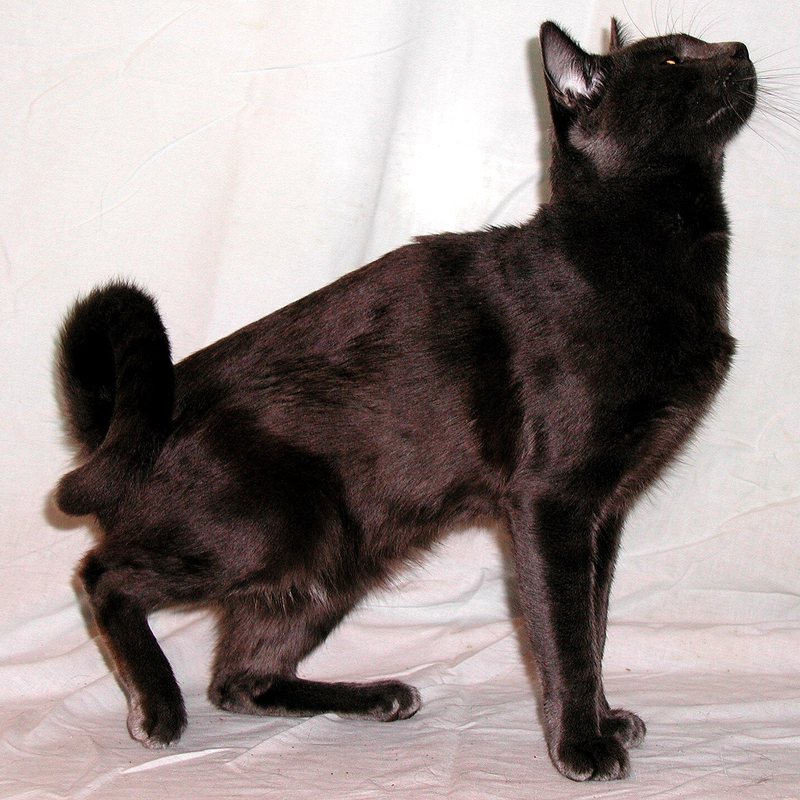

The American Ringtail is an uncommon developing breed known for carrying its tail in a curve over the back. The tail can also be lowered. Reports describe affectionate, curious cats, but the small population means there is much less reliable information than for established breeds.
Quick facts
- Tail: carried curled over the back; breed descriptions say the cat can straighten and move it
- Coat: typically short or medium length, in many colors and patterns
- Status: listed in TICA's Experimental Registry in 2009; not on TICA's or CFA's breed lists as of 2026
- Health data: no published breed-specific health surveys for this small population
Temperament and daily life
Owners describe affectionate behavior, although reports from a small group cannot establish a reliable breed-wide temperament. Breed descriptions call Ringtails affectionate, curious and outgoing, sometimes shy with strangers. Like any cat, a Ringtail needs regular play, places to climb and somewhere quiet to rest.
Grooming and care
With a short or medium coat, grooming needs are modest. A metal comb works through short fur, and longer coats do well with grooming sessions every few days to remove dead hair and prevent tangles. General care advice adds trimming nails every two to three weeks, scooping the litter box at least once a day and providing a sturdy scratching post at least three feet high.
Handle the tail as gently as any cat's. It is a normal tail held in an unusual position, so never pull it or try to straighten it.
Health considerations
Published health data are limited. The population is small, the breed dates only to the late 1990s, and there is no published breed-specific disease survey. That does not establish that Ringtails are free of inherited disease, so ask a breeder about the health of the parents and keep up routine veterinary care.
The everyday problems that affect most cats still apply: between 50 and 90 percent of cats older than four have some form of dental disease, and a Cornell clinician estimates that about half of the cats seen at veterinary clinics are overweight or obese, naming free feeding as a major factor. Ask your veterinarian about a dental routine and a feeding plan that suit your cat.
History
Published breed histories describe the breed starting in 1998 with Solomon, a feral kitten that Susan Manley bottle-fed. At about four weeks old his tail began curling over his back, a veterinarian found no medical cause, and in 1999 Manley began breeding to see whether the trait would pass on. Other breeders joined the program from the mid-2000s.
The International Cat Association's board minutes record the registry side. In 2004 the board voted to deny the breed Registration Only status. In 2005 it accepted the name American Ringtail, and from May 2009 it listed the breed, in shorthair and longhair, in its Experimental Registry. TICA's current breed list (checked October 2026) does not include it, and the Cat Fanciers' Association does not list it either.
Appearance
The tail is the defining feature. Breed descriptions say it is not stuck in a ring: the cat can straighten it and move it around, and adults usually carry it curled toward or over the back. Breeders have worked with domestic shorthairs and other breeds, and Ringtails come in many colors and patterns.
Before choosing an American Ringtail
Availability is limited, so verify the pedigree and current breeding program if that matters to you. What is known about temperament and health comes from a small number of cats, so meeting the individual cat, and asking about its parents' health, tells you more than the breed name.
American Ringtail FAQ
Is the American Ringtail's curled tail painful? Breed descriptions say the tail is not fused and that the cat can straighten it and move it around. There is little published veterinary research on the trait, so ask your veterinarian about any stiffness, pain or change in how your cat carries or uses its tail.
Are American Ringtail kittens born with curled tails? No. Breed descriptions say kittens are born with straight tails, which begin to curl toward the back as the kittens grow.
Sources
- The International Cat Association board minutes: 2004 annual meeting, 2005 annual meeting and 2009 summer meeting (archived copies)
- Catster: American Ringtail cat
- ASPCA: cat grooming tips
- ASPCA: general cat care
- Cornell Feline Health Center: feline dental disease and obesity
Try a mixed breed question
What is one of the most recognizable features of the Devon Rex?
Answer: Large ears and curly coat. The Devon Rex is known for its oversized, low-set ears paired with a soft, wavy (rexed) coat, an instantly identifiable combination. Source