 Cat Trivia Games
iOS App
Abyssinian Cat Breed
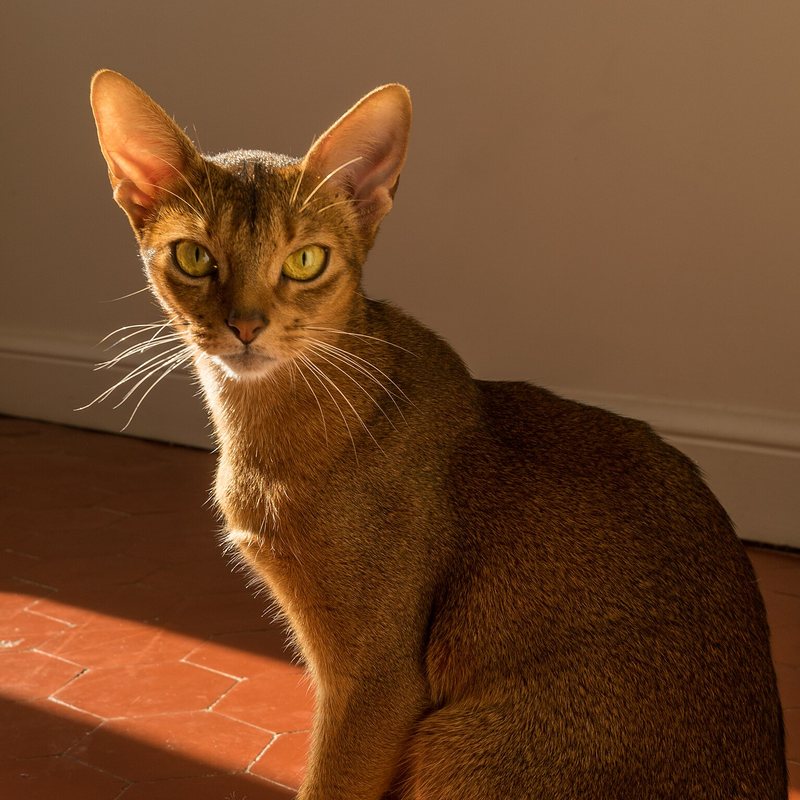

Abyssinians are active, curious cats with a short, ticked coat. They tend to stay close to whatever you're doing, although sitting still on your lap may be less appealing than investigating the next shelf. If you enjoy playing with your cat and giving them places to climb, there's a lot to like about this breed.
Quick facts
- Weight: about 6 to 9 pounds for females and 7 to 12 for males, per TICA
- Life expectancy: estimates differ, from 9 to 13 years (PetMD) to 14 to 17 or more (TICA)
- Coat: short and ticked; CFA accepts ruddy, cinnamon, blue and fawn
- Activity: high; CFA describes a cat that is constantly on the move unless asleep
- Voice: CFA calls the breed not particularly talkative
- Grooming: light, a comb or brush a few times a month
Temperament and daily life
Abys are often described as intensely curious problem-solvers, and the Cat Fanciers' Association sums up the personality as busy, active, agenda-driven and affectionate. That curiosity is what people notice first. A new bag, a moved chair or an open cupboard usually gets inspected before the day carries on, and many Abys like to be in the same room as their people, joining in rather than watching.
Lap time tends to be short. An Aby may settle in your lap for a moment, but with its activity level it is unlikely to stay there long, and many do not like being left alone for long stretches. They are often sociable with visitors and other pets, but introductions and the individual cat's temperament matter.
Grooming and care
The coat needs little work: combing or brushing a few times a month controls shedding, and a gentle rub with a chamois cloth adds sheen. General cat-care advice still applies: frequent brushing reduces shedding and hairballs, and nails stay blunter when they are trimmed every two to three weeks.
Most of the effort goes into the home. An active cat needs opportunities to play, climb and explore, so cat trees near windows, shelves the cat is allowed on, a sturdy scratching post and food puzzles all help. Regular play with a wand toy gives that curiosity somewhere to go.
Health considerations
Amyloidosis, pyruvate kinase deficiency and progressive retinal atrophy are among the breed's main health concerns. Renal amyloidosis is a buildup of abnormal protein in the kidneys. It is rare, its causes are unknown, and heritability appears to play a role; Cornell's Feline Health Center quotes a veterinarian who says that when it is diagnosed, the patient is almost always an Abyssinian. Pyruvate kinase (PK) deficiency is an inherited red blood cell enzyme defect that can cause anemia. Progressive retinal atrophy (PRA) is a degeneration of the retina, the tissue losing its ability to function properly.
A genetic screening test exists for PK deficiency, and there are separate tests for two known PRA variants, rdAc and Rdy. Each result applies only to its own variant. No DNA test covers amyloidosis. The same veterinarian recommends regular bloodwork for Abyssinians so that it can be recognized early, so ask your veterinarian what schedule suits your cat.
History
Despite the name, the breed's origins are more complicated than a direct link to Ethiopia, which was once called Abyssinia. The name only reflects that the first Abyssinians exhibited in England were imports from Ethiopia, and genetic research places the breed's origins in the coastal areas of the Indian Ocean and Southeast Asia. The first Abyssinian seen at a cat show was Zula, at the Crystal Palace show in England in 1871. Abyssinians reached the United States in the early 1900s and were among the original breeds registered by CFA in 1906.
Appearance
The Abyssinian is a medium-sized cat with an arched neck and a lithe but muscular build, and it looks as if it is standing on tiptoe. The ears are large and cupped, and the eyes are almond-shaped. Each hair carries bands of darker and lighter color, called ticking. The ticked hairs give the coat a finely shaded appearance rather than bold body markings. Ruddy, a burnished red-brown, is the most popular color, and cinnamon, blue and fawn are the others CFA accepts. TICA's standard allows more colors, including a silver division.
Before choosing an Abyssinian
An Abyssinian may suit a home with time for daily interaction and safe climbing space. If you prefer a quieter companion, meet adult cats whose activity level is already known. Ask a breeder which DNA tests the parents had, and go over what those results do and do not cover with your veterinarian.
Abyssinian FAQ
Are Abyssinians hypoallergenic? No breed can be assumed safe for someone with a cat allergy, and a short coat does not change that. Spending time with the individual cat before committing tells you more than a breed label.
What is the difference between an Abyssinian and a Somali? Coat length. CFA describes the Somali as the longhaired variety of the Abyssinian, available in the same colors.
Sources
- Cat Fanciers' Association: Abyssinian
- Cat Fanciers' Association: Somali
- The International Cat Association: Abyssinian
- PetMD: Abyssinian
- Cornell Feline Health Center: renal amyloidosis
- Cornell Feline Health Center: feline vision problems
- EveryCat Health Foundation: pyruvate kinase deficiency in Abyssinian and Somali cats
- UC Davis Veterinary Genetics Laboratory: PRA rdAc and PRA Rdy tests
- ASPCA: general cat care
Quick quiz: 2 questions about the Abyssinian cat
Which of these is a known hereditary health condition in Abyssinian cats?
Answer: Pyruvate kinase deficiency. Abyssinians and related Somalis carry a recessive mutation causing pyruvate kinase deficiency, an enzyme defect that shortens red-blood-cell survival and leads to intermittent anemia; responsible breeders DNA-test for it. Source
Which word best describes the typical build of an Abyssinian cat?
Answer: Athletic. The CFA standard calls the Abyssinian lithe, graceful and well-muscled, standing as if on tiptoe, which reads as an athletic build rather than a heavy or low-set one. Source