 Cat Trivia Games
iOS App
Pixiebob Cat Breed
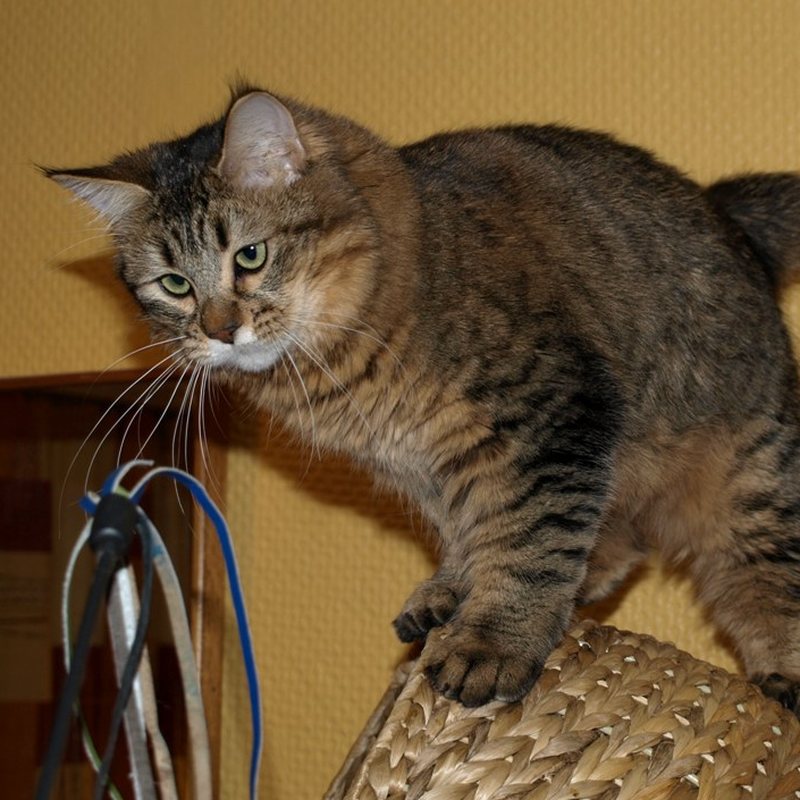

The Pixiebob has a sturdy build, a short tail and a spotted coat. Some also have extra toes. Despite the bobcat-like appearance, the breed is registered as a domestic cat, and many are described as sociable companions.
Quick facts
- Weight: 12 to 17 pounds for males and 8 to 12 for females (TICA); PetMD gives 9 to 17
- Life expectancy: 13 to 15 or more years (TICA, PetMD)
- Coat: short or long, thick, woolly and slightly coarse, usually a spotted tabby pattern
- Toes: extra toes allowed, up to seven toes maximum (TICA standard)
- Recognition: TICA championship since the 1998 show season; not on CFA's breed list (checked October 2026)
Temperament and daily life
Pixiebobs are often described as gentle, affectionate and laid-back, and many follow their people from room to room. They tend to communicate with chirps, chatters and trills more than meows (PetMD). Some enjoy retrieving toys or learning to walk in a harness. With children and other pets, supervised introductions and the individual cat's temperament matter more than the breed label.
Grooming and care
The thick, woolly coat needs regular brushing: about weekly for shorthairs and two to three times a week for longhairs is a common guide. Check the coat for tangles, including the long belly hair over the loose skin of the abdomen, and adjust the routine to the individual coat. On polydactyl feet, check every toe when you trim the nails: claws on extra toes may not touch the ground or the scratching post, so they wear down less and can grow into the paw pad if left untrimmed (CatWatch). A large, sturdy cat also needs a scratching post and cat tree solid enough for its weight.
Health considerations
Published breed-specific health information is limited, which does not establish that Pixiebobs are free of inherited disease. The breed is usually described as generally healthy, with advice to watch its weight, and the problems most often listed for it, obesity and dental disease, are common in cats generally. Ask a breeder about the parents' health and rely on your veterinarian for the individual cat.
The short tail has been studied. A 2013 study found that 8 of the 14 short-tailed Pixiebobs it tested carried one of the gene mutations that shorten the Manx's tail, in a gene called T; the other six did not, so the trait probably has more than one cause (Buckingham and colleagues, 2013). No study of spine or tail problems in Pixiebobs could be found (checked October 2026), so ask a breeder about the health of their short-tailed lines and have a kitten examined by a veterinarian.
History
In the spring of 1985, Carol Ann Brewer bought a polydactyl, spotted male kitten with a short tail. In January 1986 she rescued another short-tailed male, Keba, who sired a litter with a neighbor's domestic cat that April; Brewer kept a female from the litter and named her Pixie. In 1989 she wrote a standard and named the breed Pixiebob. TICA accepted the breed for exhibition in 1994, advanced it to new breed status from May 1, 1996, and in 1997 granted championship status beginning with the 1998 show season (TICA). TICA's standard permits no outcrosses.
Brewer's goal, in TICA's words, was a domestic cat with a visual similarity to the North American bobcat. Stories of barn cats mating with bobcats remain legend: bobcat hybrids have not been genetically proven, and genetic work on the breed points instead to Manx and Japanese Bobtail contributions. The Manx tail mutation found in many Pixiebobs was absent in the eight bobcats tested in the 2013 study.
Appearance
The Pixiebob is a medium to large cat with a rolling gait, lynx-tipped ears and a thick double coat, usually in a spotted tabby pattern. TICA's standard calls for a tail at least 2 inches long and no longer than the hock with the leg extended; kinks and curls are acceptable, and a tail under 1 inch or a full-length tail is disqualified. Extra toes are allowed up to seven toes maximum, and extra toes that do not touch the table are penalized. TICA also registers a separate Maine Coon Polydactyl, so the Pixiebob is not the only breed in which extra toes are accepted.
Before choosing a Pixiebob
A Pixiebob may suit a household with time for play and regular coat and claw checks, and room for a large cat. Ask a breeder about the parents' health and the health of their short-tailed lines, and meet the individual cat to see how sociable it is.
Pixiebob FAQ
Are Pixiebobs part bobcat? No bobcat ancestry has been shown. The breed was created to look like a bobcat, TICA registers it as a domestic breed, and genetic studies point to domestic ancestry, including Manx and Japanese Bobtail contributions.
Do all Pixiebobs have extra toes? No. Many have the usual number, and polydactyly is allowed rather than required: TICA's standard accepts up to seven toes maximum.
Are Pixiebobs hypoallergenic? No breed can be assumed safe for someone with a cat allergy. Spend time with the individual cat before committing.
Sources
- The International Cat Association: Pixiebob and the Pixiebob breed standard
- PetMD: Pixiebob
- Buckingham K.J. et al. (2013), Multiple mutant T alleles cause haploinsufficiency of Brachyury and short tails in Manx cats. Mammalian Genome
- Lyons L.A. (2015), DNA mutations of the cat: the good, the bad and the ugly. Journal of Feline Medicine and Surgery
- CatWatch (with Cornell's Feline Health Center): ingrown claws
- Cat Fanciers' Association: breeds (checked October 2026)
Try a mixed breed question
Which of these breeds is most visually similar to the Mekong Bobtail?
Answer: Siamese. Mekong Bobtails descend partly from Siamese stock, which is why they share the same pointed coat pattern, blue eyes, and vocal personality. The kinked tail is the main giveaway that tells them apart. Source