 Cat Trivia Games
iOS App
Manx Cat Breed
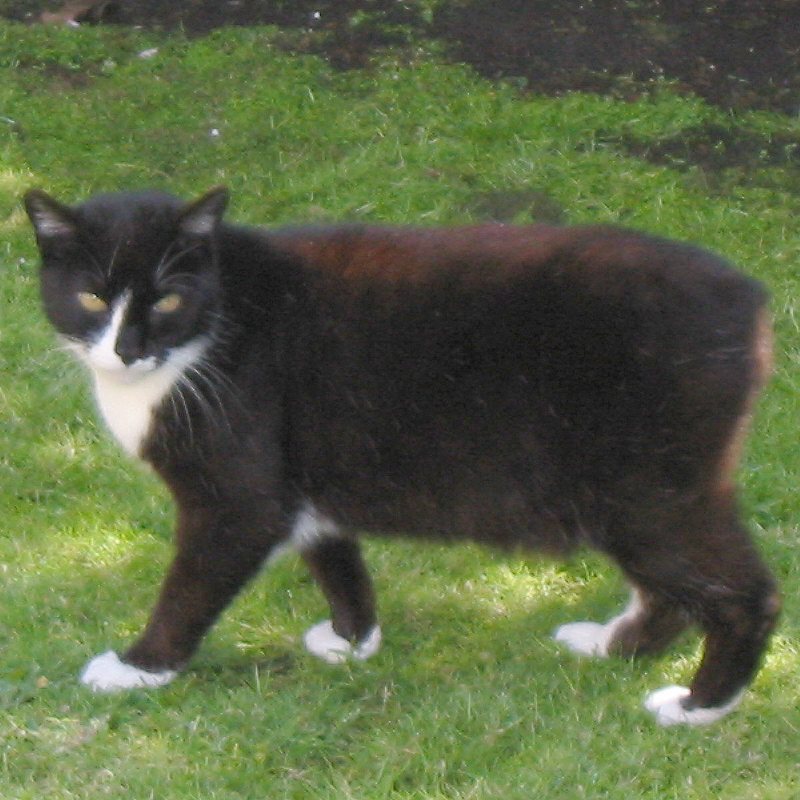

Manx cats are associated with the Isle of Man and a range of tail lengths, from no visible tail to a full tail. They have a rounded build and a dense coat. Spinal development and related care needs are important parts of understanding the breed.
Quick facts
- Origin: the Isle of Man, where tailless cats were first recorded in the sixteenth century (CFA)
- Weight: males average 10 to 12 pounds and females 8 to 10 (TICA)
- Life expectancy: estimates differ, from about 10 to 14 years (PetMD) to 16 or more (TICA)
- Tail: anything from none at all to a full-length tail, often within one litter
- Coat: short and dense; the longhaired form is the Cymric in TICA and the Manx longhair division in CFA
Health and welfare considerations
The gene that shortens the Manx tail also affects how the lower spine and spinal cord develop. "Manx syndrome" covers the problems that can follow, most often forms of spina bifida, which can cause partial paralysis of the hind legs, loss of bladder and bowel control and painful infections. Some Manx show no signs, while others have serious welfare problems, and completely tailless "rumpy" cats are affected most often. Signs may be present at birth or appear in the weeks to months afterward. Usually there is no effective treatment, although surgery occasionally helps.
How common is it? Spina bifida is described as common in Manx cats, and a 1979 study cited by UFAW found 7 of 44 kittens (16 percent) affected, all of them rumpies. That is one small, old study rather than a current rate for the breed. There is also no program to reduce the gene's harmful effects, since the same gene produces the missing tail.
Age and breeding practice give some information but no guarantee. CFA says problems are typically found before kittens reach four months of age, so some breeders wait before placing kittens, and it describes the regular use of tailed Manx in breeding programs. Neither practice shows that a particular kitten is free of spinal problems, and every Manx kitten should be fully examined by a veterinarian before purchase. Kittens with two copies of the gene die early in development, so every Manx carries one copy and can pass it on.
International Cat Care names the Manx as an obvious example of a breed whose defining feature comes from a mutation that harms the cat's health, and UFAW points out that breeding Manx cats keeps these problems going. A Manx with mobility or continence problems can need daily nursing care, and its veterinarian can explain what that involves.
Two other problems are reported. Cats with short, kinked "stumpy" tails are prone to arthritis between the deformed tail bones, which can be very painful, and corneal dystrophy, a group of conditions affecting the clear front of the eye, typically shows when kittens are about four months old. Handle the hindquarters gently: the nerve endings where the tail would be are still present but unprotected, and pressure there can cause pain.
Temperament and daily life
CFA describes the Manx as quiet and gentle, with occasional bursts of play, and notes that many attach most strongly to one or two family members and can take a while to accept newcomers in the home. Many enjoy fetch and other games with their people, and they tend to talk in chirps and trills rather than loud calls. Their long, powerful hind legs make them strong jumpers, and some learn to open doors. With children, dogs and other cats, slow introductions and the individual cat's temperament matter more than the breed label.
Grooming and care
The coat sheds but is not prone to matting. A shorthaired Manx can be combed or brushed two or three times a month, and most Manx do not need regular baths. Check the rear end as you groom: soiling there can be a sign of a continence problem, which is a reason for a veterinary visit. The short body can make a Manx look overweight when it is not, although neutered cats can gain weight, so ask your veterinarian to assess body condition.
History
The breed comes from the Isle of Man in the Irish Sea. A folk tale says the Manx lost its tail in the closing door of Noah's Ark. More likely, the missing tail began as a mutation in the island's native shorthaired cats, an incomplete dominant gene that then spread to the other cats on the island, and long coats probably arrived with cats brought over during the long period of Viking rule. Manx appeared at the first cat shows in Britain and were among the breeds CFA registered when it began in 1906.
TICA recognized the Manx and its longhaired form, the Cymric, for championship competition in June 1979. CFA has shown longhaired cats as a division of the Manx since May 1994.
Appearance
Roundness runs through the Manx standard: a round head with prominent cheeks, large round eyes, a short back that arches from the shoulders to a round rump, and hind legs longer than the front legs. The cats should feel surprisingly heavy when lifted, and both coat lengths are thick and well padded. Tail types are often grouped as rumpy (no tail), rumpy riser (a small rise of bone), stumpy (a short, often kinked tail) and longie (a longer tail). CFA's breed page says only completely tailless cats can be shown in CFA, while TICA lists tailed cats separately as the Manx Tailed.
Before choosing a Manx
Read about Manx syndrome first, and ask for the kitten's veterinary examination and the parents' health records rather than relying on the kitten's age or a breeding rule. Plan for regular grooming, gentle handling of the hindquarters and regular veterinary checks. Spending time with the individual cat, and its parents if you can, shows more of its personality than the breed's reputation.
Manx FAQ
Is a hopping gait normal in a Manx? Not necessarily. Long hind legs affect how a Manx moves, but an abnormal hopping gait, standing flat on the hocks and loss of feeling around the hind end are among the signs of spina bifida in Manx cats. A kitten or cat that hops, walks on its hocks or has accidents outside the litter box should be examined by a veterinarian.
What causes the Manx's short tail? A 2013 study found mutations in a gene called T, also known as Brachyury, in 95 percent of the short-tailed Manx it tested, with different mutations in different family lines. One of those mutations also turned up in American Bobtails and Pixiebobs. The Japanese Bobtail's kinked tail has been linked to a different gene, HES7.
Are Manx cats hypoallergenic? No breed can be assumed safe for someone with a cat allergy. Spend time with the individual cat before committing.
Sources
- UFAW: Manx syndrome
- Cat Fanciers' Association: Manx and the Manx breed article
- The International Cat Association: Manx and Manx Tailed
- International Cat Care: inherited disorders in cats
- PetMD: Manx
- Buckingham K.J. et al. (2013), Multiple mutant T alleles cause haploinsufficiency of Brachyury and short tails in Manx cats. Mammalian Genome
Quick quiz: 2 questions about the Manx cat
Reviews of feline social behavior note that naturally tailless cats carry a specific communication handicap with other cats. Which pair of affiliative signals is a tailless cat, such as the Manx, least able to produce?
Answer: The upright 'tail-up' approach and tail-wrapping. The vertically raised 'tail-up' signal and conspecific tail-wrapping are both affiliative displays that literally require a working tail, so a Manx or other tailless cat cannot perform them. Grooming, scent-marking, and facial signals are unaffected, which is why only the tail-based greetings are compromised. Source
The long-haired variety of the Manx is known by which name?
Answer: Cymric. The long-haired Manx is called the Cymric. Some registries treat it as a separate breed, but it carries the same taillessness gene and double coat, just with medium-to-long fur, 'breeches,' and ear and toe tufts. Source