 Cat Trivia Games
iOS App
Cats in Ancient Egypt: Bastet, Mummies and Myths
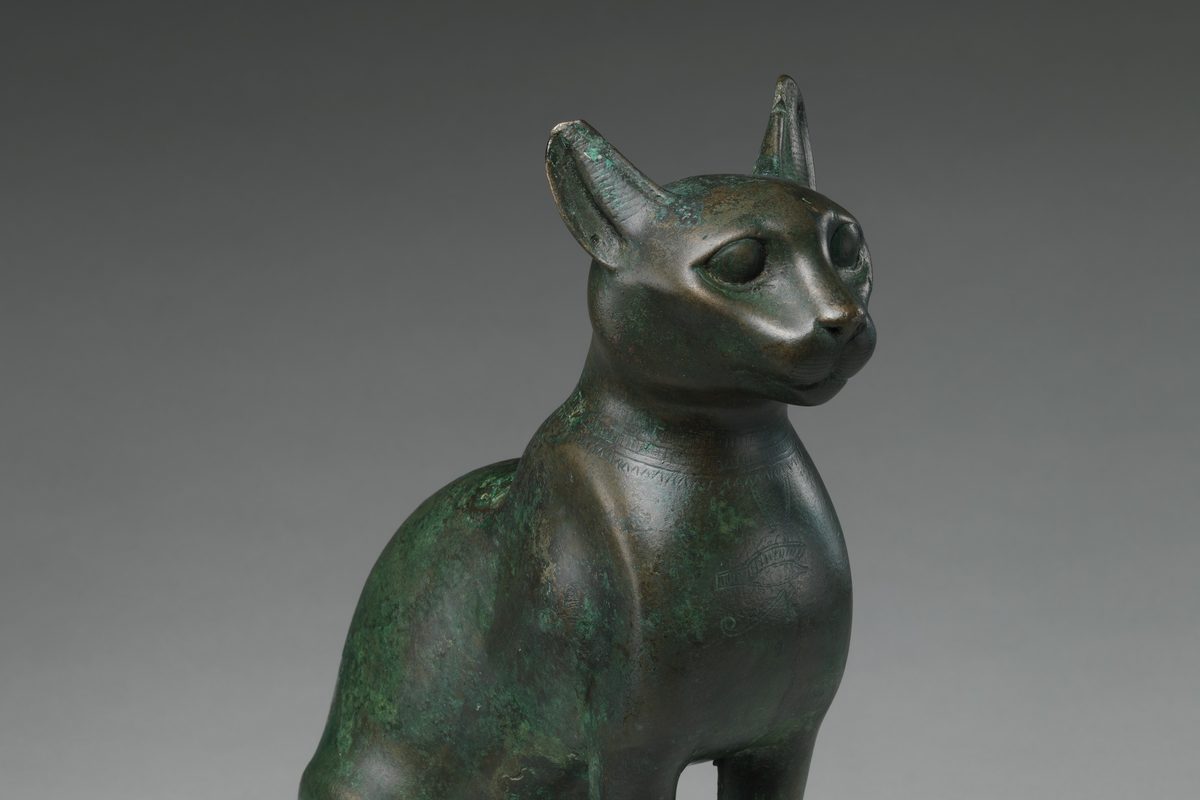
In ancient Egypt, people were caring for captive cats by about 3700 BC, long before cats became sacred animals. Later, cats were linked to the goddess Bastet, and temples bred them in huge numbers to be killed young and mummified as offerings. Greek writers said killing a cat meant death, yet X-rays of cat mummies show young cats with dislocated necks, which researchers read as deliberate killing.
When Egyptians started keeping cats
Cats and people at Hierakonpolis, a Predynastic site in Upper Egypt, lived in close contact by about 3700 BC, almost two thousand years before the traditional date for domestication (the Middle Kingdom, around 1950 BC, or perhaps 300 years earlier on circumstantial evidence).1 In rough date order:
- About 9,500 years ago, Cyprus. Outside Egypt, a cat buried near a person shows close contact.1
- 5th millennium BC, Badarian period. A man's grave may hold a cat at his feet, but the bones are unavailable to confirm it.1
- About 3800 to 3600 BC, Hierakonpolis. A pit in the elite cemetery HK6 held six cats: an adult male, a female almost a year old (too young to be their mother) and four kittens of four to five months from two litters.1
- About 3700 BC, the same cemetery. A jungle cat (Felis chaus) with a healed broken femur and humerus was tended for several weeks before being sacrificed.1
- About 2000 BC, Middle Kingdom. Tomb paintings and cat mummies from this period were long taken as Egypt's first evidence of domestic cats.12
- From about 1500 BC, New Kingdom. Cats appear more often in wall paintings and reliefs. In the tomb of Nebamun at Thebes, a painted cat helps a fowler hunt birds in the Nile marshes.2
- About 900 BC. Cemeteries just for cats appear, particularly at Bubastis, Bastet's cult center.2
The six cats' bones measure like domestic cats, but the team warned that the yardsticks, set on cats from European sites, may not suit Egyptian ones. What they treat as certain is close contact between these cats and people.1
Wildcats from the Near East and from Egypt both contributed to the domestic cat at different times, ancient DNA shows, and Egyptian cats spread across the Old World in the Classical period, apparently along trade routes.4 A 2025 study of 87 ancient and modern genomes still calls the birthplace uncertain (the Levant, Egypt or elsewhere) and dates cats' arrival in Europe to about 2,000 years ago, probably from North Africa.5
Bastet and her city, Bubastis
Bastet could be shown as a cat, another feline or a human with a feline head.6 Her cult center was Bubastis, "House of Bastet," at Tell Basta southeast of the Delta town of Zagazig, and the city may have been the capital of all Egypt in Dynasties 22 and 23.2
Herodotus, writing around 450 BC,3 called the goddess Artemis and her festival at Bubastis the most zealous in Egypt. Men and women sailed there with rattles and flutes; at towns along the way some women danced and others jeered at the local women. More grape wine was drunk than in the whole rest of the year, and locals told him 700,000 people came, not counting children.7
Some cat statues were made to hold a mummy, such as a 27.4 cm leaded bronze cat from the Ptolemaic Period (332 to 30 BC) at the Metropolitan Museum of Art.8
Quick quiz: how well do you know cat history?
In Bengali folk belief connected to the goddess Shashthi, why are women traditionally cautioned against harming a cat?
Answer: Because the cat is Shashthi's vahana and mistreating it can bring her anger. Since the cat is Shashthi's sacred mount, Bengali folk belief holds that harming one risks incurring the protective goddess's wrath, particularly toward the well-being of children. Source
In Driscoll's 2007 genetic study, which two DNA sources did his team analyze together to reconstruct the ancestry of nearly 1,000 wildcats and domestic cats?
Answer: Mitochondrial DNA and microsatellites. Driscoll's team combined mitochondrial DNA, which traces maternal lineage, with short repetitive nuclear DNA sequences called microsatellites, to assess ancestry across the sampled cats. Source
In Islamic tradition, cats are believed to possess a spiritual quality called 'barakah.' What does this term refer to?
Answer: A blessing power or spiritual grace that brings good fortune. Barakah refers to a blessing power or spiritual grace in Islamic belief. The concept of barakah extends to cats in Islamic culture, making them highly regarded as auspicious and spiritually beneficial animals to keep in homes. This belief reinforces the reverent status cats hold in Islamic societies. Source
Cat mummies made as temple offerings
Votive offerings, by far the most common of Salima Ikram's six kinds of animal mummy (from buried pets to food for the afterlife), number in the millions. Production took off in the Late Period (672 to 332 BC) and lasted to at least the fourth century AD.6
Some animals were bred for the trade, others imported or caught wild, and temple priests killed and embalmed them. Visitors bought the mummies as offerings, perhaps much as people offer candles in churches today; some Egyptologists think they carried messages to the gods.6
A 1981 study X-rayed 53 cat mummies that Flinders Petrie gave to the British Museum (Natural History) around 1900, and linen from two was radiocarbon dated to about 380 BC and 170 BC. Ages at death bunched into two groups: 20 cats died at one to four months and 17 at nine to twelve months. Only two lived past two years.3
The authors judged natural deaths very unlikely. They think the cats were killed at about four months, when big enough to wrap, or at nine to twelve months, when cats not needed for breeding were culled, probably many of them males. Seven of the 53 had badly dislocated neck vertebrae, which they read as deliberately broken necks.3
A 2020 scan points the same way. High-resolution 3D X-rays of a cat mummy at Swansea University's Egypt Centre show a kitten under five months old with its top two neck vertebrae separated. Its neck may have been broken to kill it or to hold the head upright for wrapping.6
Most of the 1981 mummies were plainly wrapped. Eight had geometric light and dark bandaging like Ptolemaic human mummies, and only one had a painted head. The authors reasoned that price depended on the care taken and the buyer's wealth.3
Skulls show how some of these cats lived. A 2026 study of 131 skulls from Beni Hasan mummies in Vienna's Natural History Museum found disease or injury, mostly dental, in more than half of them and in all but one of the jungle cats. The authors think all the cats were kept together in similar captive conditions.9 I wrote up the rest of that study in Egyptian cat mummy skulls point to life in captivity.
The 1890 cat mummy sale in Liverpool
In February 1890, about 180,000 mummified cats from a cemetery at Beni Hasan, weighing about 19.5 tons, were shipped from Alexandria to Liverpool and auctioned as farm fertilizer.10 Chris Elliott's 2023 study of British press coverage ties the sale to a wider trade in mummies as souvenirs, collection pieces and museum acquisitions; the coverage also reflected worries about farm productivity.10
So many cats were dug up at Bubastis and other sites in the late 1800s, the 1981 X-ray paper says, that boatloads went for fertilizer or, it is said, ballast. One skull, which reached the British Museum (Natural History) from the Royal College of Science in 1900, is "the sole relic of a consignment of 19 tons of mummies that were imported to Britain."3
What Greek writers claimed, and what the bones show
Greek writers describe harsh punishments for harming cats. Diodorus of Sicily says he saw one: while a Roman embassy was visiting and Egyptians were anxious not to offend Rome, a Roman accidentally killed a cat, and neither the king's officials nor fear of Rome could save him.11
| Topic | Ancient claim | What the evidence shows |
|---|---|---|
| Killing a cat | Herodotus: killing a sacred animal on purpose meant death, and an accident brought a penalty set by priests, except for an ibis or a hawk, where death was certain either way.7 Diodorus: killing a cat or an ibis meant death, even by accident, sometimes at a crowd's hands before any trial.11 | Ages at death and dislocated necks in the 1981 X-rays point to deliberate killing.3 |
| Care of sacred cats | Diodorus: revenue from land set aside paid for their care. Keepers called the cats with a clucking sound and fed them bread broken into milk, or raw fish from the Nile.11 | Disease or injury marks more than half of the 131 Beni Hasan skulls.9 One kitten X-rayed in 1981 had juvenile osteoporosis from a diet short of calcium. The authors say that does not prove neglect: today the disease is most often linked to meat-only feeding.3 |
| Where cats were buried | Herodotus: dead cats were carried to sacred buildings in Bubastis, embalmed and buried there.7 | Cat cemeteries are known at Bubastis, Saqqara, Thebes and Beni Hasan,6 and on a smaller scale at Abydos, Dendera and the Dakhla Oasis.2 |
| Embalming | Diodorus: a dead sacred animal was wrapped in fine linen and treated with cedar oil and fragrant spices.11 | Tests on the 1981 cats found two methods: bandages soaked in natron, or resin put directly on the body. Two bodies were not themselves soaked in natron.3 At Bubastis, debated evidence suggests cat bodies were burned in brick furnaces.2 |
Herodotus also wrote that everyone in a household shaved off their eyebrows when a cat died a natural death, and shaved the whole body and head for a dog.7 Accounts like his made it "generally assumed that the Ancient Egyptians never killed cats," the 1981 authors wrote. They called that "probably a misconception."3
Frequently asked questions
Did ancient Egyptians worship every cat?
No. Cats as a species were considered sacred, but an individual cat became sacred only after special rituals, in the belief that Bastet lived within it. The temple cats at Bubastis were treated as the goddess's earthly form.2
What did ancient Egyptian cats look like?
Much like the African wildcat. The cat in Egyptian paintings is assumed to be Egypt's wildcat, which is usually sandy-colored, rather like an Abyssinian, or its domestic form. Guard hairs from the 1981 mummies have the banded "agouti" pattern of wild cats, and the authors think the cats had tawny yellow-grey fur with striped tabby or Abyssinian markings.3 Ancient DNA suggests one tabby variant became common only after the Middle Ages, so directed cat breeding seems to have started later than for most other domestic animals.4
Were Egyptian cats bigger than wildcats?
Many mummified ones were. Most mummified cats in the British Museum (Natural History) are rather larger than today's African wildcat, and in 1833 Ehrenberg named them Felis bubastis, halfway in size between the jungle cat and the domestic cat. Domestic animals usually end up smaller than their wild ancestors, at least early on.3 One suggested explanation is the special status and care these cats received.1
Up next
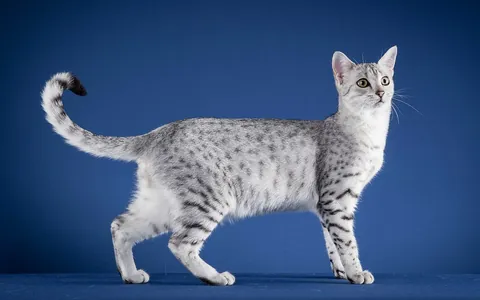 Cat BreedsEgyptian MauA spotted breed whose looks are compared with cats in Egyptian art.
 Cat Facts100 Cat Claims: True, False or Not That SimpleMore popular cat claims, checked one at a time.
Breed photos: mostly Wikimedia Commons contributors under free licenses, cropped. Every photographer and license is on the photo credits page.

Christopher writes and runs Cat Trivia Games. The sources for this article are listed below, and how the site is made and corrected is on the editorial policy page. More about the author.
References
- Van Neer, W., Linseele, V., Friedman, R. and De Cupere, B. (2014), Journal of Archaeological Science. More evidence for cat taming at the Predynastic elite cemetery of Hierakonpolis (Upper Egypt). back
- Evans, Elaine A., McClung Museum of Natural History and Culture, University of Tennessee. Cat mummies. back
- Armitage, P. L. and Clutton-Brock, J. (1981), Journal of Archaeological Science. A radiological and histological investigation into the mummification of cats from Ancient Egypt. back
- Ottoni, C. and others (2017), Nature Ecology and Evolution. The palaeogenetics of cat dispersal in the ancient world. back
- De Martino, M. and others (2025), Science. The dispersal of domestic cats from North Africa to Europe around 2000 years ago. back
- Johnston, R. and others (2020), Scientific Reports. Evidence of diet, deification, and death within ancient Egyptian mummified animals. back
- Herodotus, translated by G. C. Macaulay. Project Gutenberg. The History of Herodotus, Volume 1 (Book 2, chapters 59 to 67 and 137). back
- The Metropolitan Museum of Art. Cat statuette intended to contain a mummified cat (56.16.1). back
- Van Neer, W., De Cupere, B. and Ottoni, C. (2026), Journal of Archaeological Science. Keeping cats for mummification in ancient Egypt: osteological evidence from Beni Hassan. back
- Elliott, Chris (2023), The Journal of Egyptian Archaeology. Cats, commerce, and cemeteries: the mummified felines of Beni Hasan. back
- Diodorus Siculus, Library of History, Loeb Classical Library edition (1933), on LacusCurtius. Book 1, chapters 83 and following. back
Written by Christopher Fox under our editorial policy.