 Cat Trivia Games
iOS App
Extinct Cat Breeds, Lost Bloodlines and Breeds That Came Back
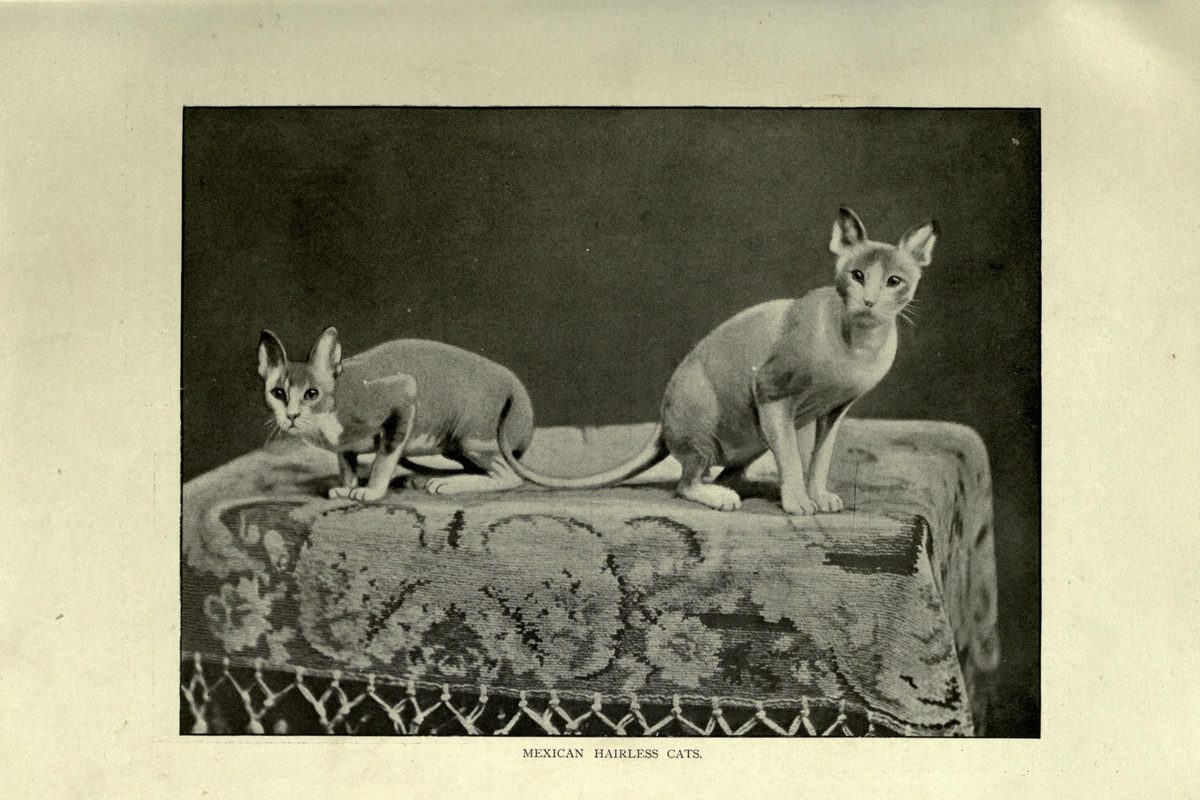

Cat historians and researchers describe these as extinct cat breeds: the Mexican Hairless, known from a sibling pair in a 1902 New Mexico letter; the California Spangled, gone by 2000; the blue-eyed Ojos Azules; and the original Chantilly-Tiffany bloodlines. The Poodle Cat and Missouri Rex are listed as lost; the Chinese lop-eared cat and York Chocolate are in doubt. The Birman, Turkish Angora and Havana Brown nearly vanished and were saved.
Extinct, lost and rebuilt cat breeds at a glance
| Breed or line | Origin | What happened | Status |
|---|---|---|---|
| Extinct or lost | |||
| Mexican Hairless | Albuquerque; owner's letter of February 3, 1902 | The pair was never mated; the male was killed by dogs | "Now extinct"12 |
| Chantilly-Tiffany | New York; first litter in May 1969 | Revived from 1988; the last known US cattery burned in 2012 | "All original bloodlines are lost"3 |
| California Spangled | Los Angeles, 1986 | 58 ever registered; TICA dropped it in 2000 | Considered extinct by 200045 |
| Ojos Azules | New Mexico; founder cat Cornflower, first bred in 1984 | Ten registered by 1992 | "Considered extinct"67 |
| Poodle Cat (Pudelkatze) | Germany, 1987 or 1994; Devon Rex crossed with Scottish Fold | Curtailed by German law against breeding cats with defects; some interest elsewhere in Europe | Listed as recently lost8 |
| Missouri Rex | Early 1990s | Recessive curly coat, unlike the Devon or Cornish Rex; financial mismanagement left three cats by the late 1990s | Listed as recently lost8 |
| In doubt | |||
| Chinese lop-eared cat | China, in European accounts from the 1650s | Last reported sighting 1938 | "Regarded as an extinct cat variety," if it ever was one9110 |
| York Chocolate | New York state goat dairy farm; first kitten, Brownie, born 1983 | About 60 cats in 2005; breed websites went inactive in 2004 | Still on WCF's breed list (June 2026)1112 |
| Nearly lost, then saved | |||
| Turkish Angora | Reached Europe from the Middle East in the 1600s; Turkey's national breed | Nearly lost to Persian crosses | Preserved by Turkish zoo programs13 |
| Birman | France, from a pair shipped from Burma about 1919 | One breeding pair left in Europe after the Second World War | Rebuilt by outcrossing14 |
| Havana Brown | England after the Second World War, then North America | 36 CFA registrations in 1997, the fewest of any breed | Recognized; CFA outcross program since 20191516 |
The oldest records: a hairless pair and a lop-eared rumor
The Mexican Hairless is known mainly from its owner's letter. Mr. Shinick of Albuquerque wrote in February 1902 that he got the cats "from the Indians a few miles from this place," and that "the old Jesuit Fathers" told him they were "the last of the Aztec breed." In winter they grew light fur along the back and tail ridge that shed in warm weather. He never mated the siblings, and the male, Dick, got out one night and was killed by dogs. The Chicago Cat Club had valued them at 1,000 dollars each; Shinick priced the female, Nellie, at 300.1
The letter appeared in Frances Simpson's The Book of the Cat in 1903, where H. C. Brooke regretted the pair was never mated.1 Sarah Hartwell's cat-history site Messybeast notes that Nellie could have been bred to a similarly shaped domestic cat and the kittens back to her to recover the hairlessness. Hairless kittens already turned up in ordinary litters: the site quotes a Boston Post report of a hairless brother and sister, Scud and Mystery, at Boston's first cat show in 1878.2
Messybeast also doubts the Aztec story. A 1908 Albuquerque Journal report it quotes says Shinick bred Nellie himself and that she died that December after he sent her east for a show. Hartwell thinks the pair were most likely hairless siblings given a romantic origin story.2
The Chinese lop-eared cat may never have been a true variety. Darwin wrote in 1868 that "in China a breed has drooping ears."9 In the same book, Brooke described a Continental show with a class for it: "but, alas, the class was empty!"1 By 1927 he wrote that the drop-eared cat, "if ever existed, is now extinct." Messybeast gives 1938 as the last reported sighting, a droop-eared cat imported from China. The site also says the name Sumxu was attached to it by mistake: the word comes from a 1656 woodcut by the Jesuit missionary Michael Boym of a black-and-yellow animal, which Hartwell likens to the red panda or the yellow-throated marten.10
Modern breeds that faded out
California Spangled. Neiman Marcus offered this spotted cat as its 1986 His and Hers Christmas gift, at 1,400 dollars a cat, but only 58 were ever registered.45 According to UPI, Los Angeles breeder Paul Casey said he developed it from five foundation varieties, which the report lists as "Siamese, Angora, Abyssinian and Egyptian cats, with a dash of Malayan house cat." The store and Casey conceded US cat clubs did not recognize it as a separate breed.4 The launch drew about 350 orders and enquiries. TICA dropped the breed in 2000 for lack of progress.5 The California Spangled guide covers the Louis Leakey story behind it.
Ojos Azules. Deformed kittens and hidden carriers drove its decline, according to a 2024 genetics study in Animals. Breeding studies found white kittens with skull deformities born to two blue-eyed parents, which "reduced the enthusiasm for the breed." Blue-eyed kittens were also born to parents without blue eyes, so some carriers did not show the trait, which "led to the decline of the breed." Among 117 cats with dominant blue eyes that the study sampled from 14 breeding lines and some mixed lines, four lines carried none of the three known PAX3 variants, so dominant blue eyes have more than one genetic cause.6 The Ojos Azules guide covers its founder cat, Cornflower.
Chantilly-Tiffany. This chocolate semi-longhair nearly died out when its Florida breeder stopped in the mid-1980s. New breeders revived it from 1988 with Havana Brown, Nebelung, Somali and European-type Angora outcrosses. The last known US breeder, in Illinois, lost its cattery and archives in a 2012 fire, and Messybeast concludes "all original bloodlines are lost."3 The Chantilly-Tiffany guide sorts out its names and the Tiffanie mix-up.
Quick quiz: how well do you know cat breeds?
Which body type best describes the Ocicat according to breed standards?
Answer: Athletic and lithe. Official standards call for a 'moderate type' body - well-muscled and solid yet graceful and lithe - giving Ocicats an athletic build rather than the cobby, slender, or stocky frames of other breeds. Source
Which breed does the CFA say is used as an outcross for the American Wirehair?
Answer: American Shorthair. The CFA says the wiry coat is a spontaneous mutation that first appeared in a litter of barn cats in upstate New York in 1966. The American Shorthair is used as an outcross, so Wirehairs should look structurally similar to American Shorthairs, apart from the coat. Source
Which breed is most closely related to the Nebelung?
Answer: Russian Blue. The Nebelung was developed as a longhaired counterpart to the Russian Blue, and the Russian Blue was used as an approved outcross while the Nebelung's own standard was being established. Source
Close calls: breeds that were rebuilt
Turkish Angora. Interbred closely with Persians as the cat fancy grew in England, the breed "virtually disappeared," according to the Cat Fanciers' Association (CFA). Turkish government zoo programs preserved it from the 1930s, and the first Turkish Angoras reached the United States in 1954.13
Birman. CFA says one breeding pair was left in Europe after the Second World War. French breeders outcrossed to Persians and Siamese, and pure litters were born again by the early 1950s.14
Havana Brown. A 1998 CFA article by breeder Richard Bilello ran under the heading "A breed on the brink of extinction." It estimated fewer than 1,000 alive, under 130 of them unaltered, and noted outcrossing had been cut off in 1974: "There are too few cats and they are too closely bred."15 A 2008 genetic survey put the breed among those with the lowest heterozygosity, a measure of genetic diversity, with the Burmese, Singapura and Sokoke.17 In 2019 CFA opened a regulated outcross program to certain colors of Oriental Shorthair and Siamese and to unregistered black or blue domestic shorthairs.16
Why extinct is hard to prove
A registry listing does not prove a breed still exists. The York Chocolate is still on the World Cat Federation's breed list, updated June 6, 2026,12 yet Messybeast says any survivors must be in critically small numbers.11
A breed called extinct may also survive out of sight. Messybeast reports that some cats from geneticist Solveig Pflueger's Ojos Azules program went to a breeder who kept breeding them, and that these "may be the last true Ojos Azules in existence."7 Some California Spangleds may also have lived on as unregistered pets.5
Messybeast's pages disagree on dates: one says TICA stopped recognizing the Ojos Azules in 2000, another that TICA returned it to registration-only status in 2014.87
Frequently asked questions
Is the Sphynx descended from the Mexican Hairless?
The Sphynx's recorded history starts elsewhere: CFA traces it to a hairless kitten born in Toronto in 1966 and two hairless cats from Minnesota in 1975, Epidermis and Dermis.18 Messybeast sees only a remote possibility that later cases of random hairlessness trace back to Nellie, since pet cats were not spayed in the early 1900s.2
Can an extinct cat breed be brought back?
Only as a look-alike; the original line is gone with its last cats. Messybeast suggests the Chantilly-Tiffany look could be recreated from its four foundation breeds, and the Ojos Azules revived if a blue-eye mutation without harmful side effects turns up.38 Look-alikes already exist: the Altai, started from a blue-eyed street cat found in Kazakhstan in the mid-1990s, is a separate breed,6 and blue-eyed cats developed in Russia since 2015, sometimes called Russian Ojos Azules or Topaz, are unrelated to the American breed.8
Up next
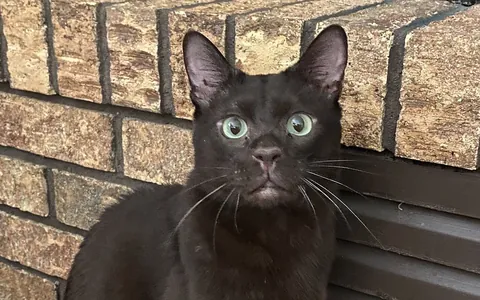 Cat BreedsHavana BrownThe chocolate breed a 1998 CFA article called endangered.
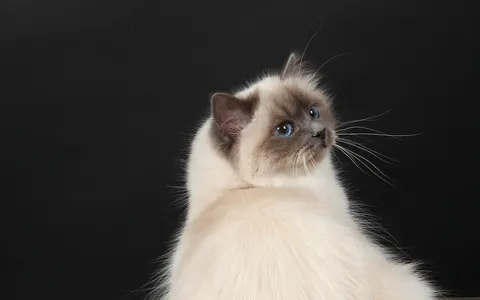 Cat BreedsBirmanDown to one breeding pair in Europe after the Second World War, then rebuilt.
Breed photos: mostly Wikimedia Commons contributors under free licenses, cropped. Every photographer and license is on the photo credits page.
Christopher writes and runs Cat Trivia Games. The sources for this article are listed below, and how the site is made and corrected is on the editorial policy page. More about the author.
References
- Frances Simpson, with H. C. Brooke (1903). The Book of the Cat, chapter 26, "Some foreign cats" (Project Gutenberg). back
- Sarah Hartwell, Messybeast. Lost breeds: Mexican Hairless, or Aztec cat. back
- Sarah Hartwell, Messybeast. History of the Tiffany/Chantilly. back
- UPI Archives (September 22, 1986). Neiman Marcus offers new mews for Christmas. back
- Sarah Hartwell, Messybeast. Lost breeds: California Spangled cat. back
- Abitbol M, Dufaure de Citres C, Rudd Garces G, Lühken G, Lyons LA, Gache V (2024). Different founding effects underlie dominant blue eyes (DBE) in the domestic cat. Animals 14(13):1845. back
- Sarah Hartwell, Messybeast. Blue-eyed breeds: American Ojos Azules. back
- Sarah Hartwell, Messybeast. Recently lost breeds. back
- Charles Darwin (1868). The Variation of Animals and Plants under Domestication, volume 1, chapter 1 (Project Gutenberg). back
- Sarah Hartwell, Messybeast. Lost breeds: Chinese lop-eared cat. back
- Sarah Hartwell, Messybeast (2016). The York Chocolate. back
- World Cat Federation. WCF EMS code and championship status (updated June 6, 2026). back
- Cat Fanciers' Association. Turkish Angora: breed history. back
- Cat Fanciers' Association. Birman: breed history and breed future. back
- Richard C. Bilello, Cat Fanciers' Association (1998). The Havana Brown: a brown delight and an endangered species. back
- Cat Fanciers' Association. Havana Brown: breed history and breed future. back
- Lipinski MJ, Froenicke L, Baysac KC, et al. (2008). The ascent of cat breeds: genetic evaluations of breeds and worldwide random bred populations. Genomics 91(1):12-21. back
- Cat Fanciers' Association. Sphynx: breed history. back
Written by Christopher Fox under our editorial policy.