 Cat Trivia Games
iOS App
Sand Cats in Tunisia: Six Sightings, the First Published in About 90 Years
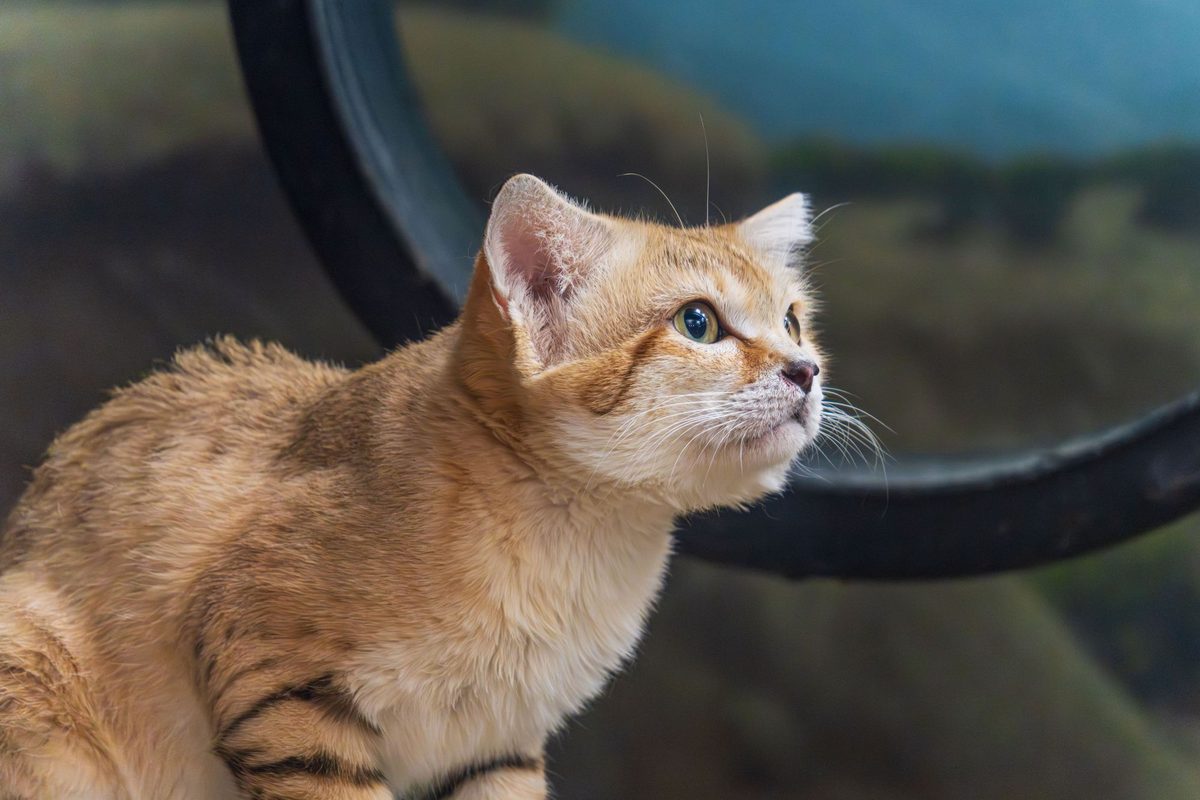
Researchers have recorded sand cats at six localities in southwestern Tunisia, about 90 years after the last published report of the species there. The evidence is six direct observations, one on video, and ten semi-structured interviews.1 The same lead author reported the first confirmed sand cat records from Libya in 2025.2
The study at a glance
| Detail | What the paper reports |
|---|---|
| Journal | Mammalia (De Gruyter); volume and pages not yet listed |
| Published | Online November 11, 2026 |
| Authors | Firas Hayder et al.: three authors at Sol Plaatje University and the University of the Witwatersrand, South Africa, and four independent researchers in Tunisia |
| Sample | Six direct observations (one on video) and ten semi-structured interviews, covering six localities |
| Method | Field sightings and interviews |
| Location | Southwestern Tunisia, in the Tunisian Sahara |
| Open access | Yes, under a CC BY 4.0 license |
| DOI | 10.1515/mammalia-2026-0092 |
What the researchers did
The team combined direct observations in the field, one of them filmed, with ten semi-structured interviews.1
Three Tunisian co-authors list bases in Kebili (Faouar, Sabreya and Douz), and a fourth in El Hamma, Gabes.1 I could not open the publisher's page, so the exact sites and dates of the sightings are not covered here.
What they found
Six localities. Six direct observations, one filmed, and ten interviews placed sand cats at six localities in southwestern Tunisia.1
A gap of about 90 years. The authors date the records to roughly 90 years after the last published report from Tunisia. Their reference list includes two French-language works on Tunisian mammals, from 1887 and 1935.1
More fieldwork needed. The authors say continued field surveys, more public awareness and targeted conservation measures are needed for what they call a rare desert carnivoran.1
What the study cannot tell us
- How many sand cats there are. Six sightings show the species is present, not its population size or trend.1
- Whether the cats ever left. The 90-year gap is in published reports, and a gap in the literature can mean nobody was looking. The authors present their work as filling a gap in knowledge of the current distribution.1
- How firm each interview record is. Interviews rely on memory and on telling one small cat from another. The abstract does not say how interview reports were checked.1
- The details. This summary draws on the abstract and journal record, so the habitat at each site and the interviewees' accounts are not covered.
How it fits earlier research
Three of the authors, including the first and last, also wrote a 2025 paper in the Journal of Arid Environments. It reported the first confirmed sand cat records in Libya, with photographs and videos. Thirteen records came from the southwest, which the authors suggest may be a stronghold for the species there. They also cite reports of sand cats being sold in local markets.2
Finding sand cats is a research problem in itself. A 2023 field study in the Atlantic Sahara found that camera traps gave reliable data and walking surveys to collect droppings for DNA failed completely. Footprints were held back by identification problems, a lack of good surfaces for tracks and frequent wind. The study also notes that the species' basic ecology is poorly known and that some local population declines have been detected.3
What a sand cat is
Adults weigh 1 to 3.5 kilograms (3 to 7.5 pounds), according to the Smithsonian's National Zoo. Dense hair and pads on the soles protect against desert heat and cold, and the pads help on shifting sand. Sand cats are mainly active at night and around dawn and dusk, escape the heat in burrows, and can go weeks without drinking, getting moisture from their prey.4
The Zoo lists Algeria, Niger and Morocco as Saharan range countries. Tunisia is on a different list on the same page: countries where hunting sand cats is prohibited.4
Frequently asked questions
Is a sand cat a pet cat living in the desert?
No. It is a separate wild species, Felis margarita, of the Sahara, the Arabian Peninsula and western Asian deserts.3
What do sand cats eat?
Mainly small rodents, with occasional hares, birds, spiders, insects and reptiles, including venomous vipers. The sound of prey burrowing underground sets them digging rapidly.4
Up next

Christopher writes and runs Cat Trivia Games. The sources for this article are listed below, and how the site is made and corrected is on the editorial policy page. More about the author.
References
- Hayder, Madikiza, Aloui, Sakhri, Ben Moussa, Lehsoumi and Do Linh San, Mammalia, 2026 (open access). New records of the sand cat (Felis margarita) in southwestern Tunisia after 90 years. back
- Hayder, Madikiza, Almuntasir, Sahbana, Mabrok, Hasan and Do Linh San, Journal of Arid Environments, volume 232, article 105485, published online 2025 (open access). Rediscovering desert ghosts: new records and range extensions of the sand cat and Saharan striped polecat in Libya. back
- Gil-Sánchez and colleagues, European Journal of Wildlife Research, volume 69, article 20, 2023 (open access). Applications of non-intrusive methods to study the sand cat: a field study in the Sahara Desert. back
- Smithsonian's National Zoo and Conservation Biology Institute. Sand cat. back
Written by Christopher Fox under our editorial policy.