 Cat Trivia Games
iOS App
Somali Cat Breed
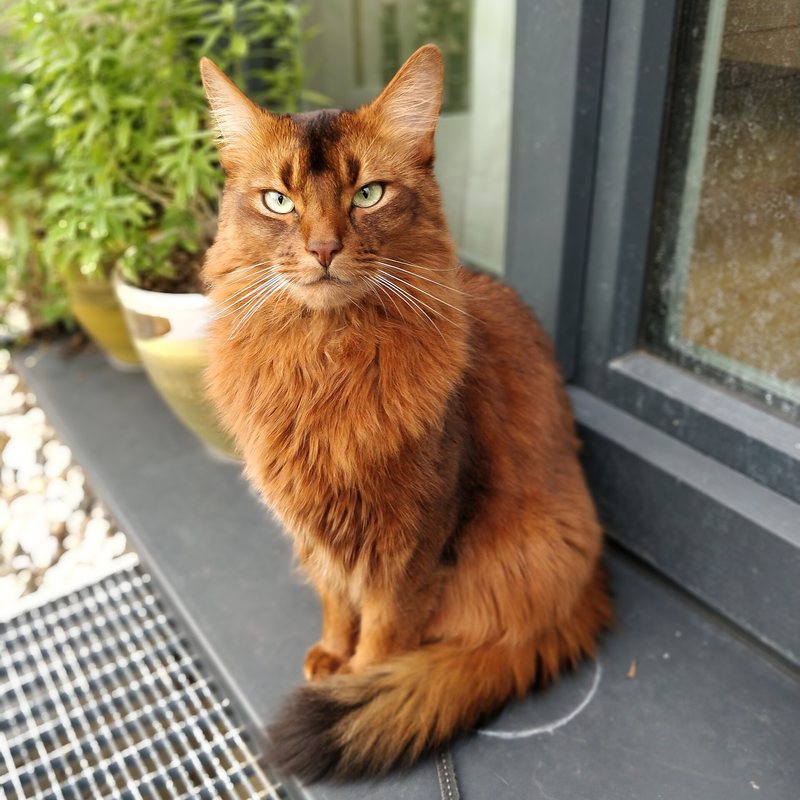

The Somali shares its breed foundation with the Abyssinian and has a longer, ticked coat with a full tail. Many are active, curious cats that enjoy climbing and exploring. Regular play and grooming are sensible expectations for life with one.
Quick facts
- Origin: longhaired kittens born in Abyssinian litters, developed into a breed in North America from the 1960s
- Coat: medium-length and ticked, with a full tail; the longhair gene is recessive
- Size: TICA gives 8 to 10 pounds for males and 6 to 7 for females; PetMD gives 6 to 10
- Life expectancy: 10 to 19 or more years (TICA); 11 to 16 years (PetMD)
- Registries: CFA registration in 1976 and championship status in 1979; also recognized by TICA, FIFe and GCCF
Temperament and daily life
CFA describes Somalis as "active, curious, and bold", intrigued by a closed cupboard door and clever enough that some learn to unlatch it. FIFe calls them intelligent, playful cats that love variety and do not like to be alone. Many like to climb, explore and join in with whatever is going on, and many get on well with other pets after careful introductions, although individual cats vary.
Daily play, climbing furniture and puzzle feeders give that curiosity somewhere to go. Keep cords, small objects and anything unsafe to chew out of reach, and secure cupboards that hold cleaning products or medicines. You may also meet active, sociable cats in shelters; ask about each cat's behavior.
Grooming and care
The coat is easier to keep than its length suggests. CFA recommends a weekly combing to remove dead hair and control shedding. TICA notes that some lines are prone to gum problems such as gingivitis and suggests starting tooth brushing early, so build a dental routine with your veterinarian's advice.
Health considerations
Pyruvate kinase (PK) deficiency is an inherited, recessive anemia. PetMD says Abyssinian and Somali cats are most often affected, the authors of a 2012 study recommend PK testing for both breeds, and UC Davis lists the Somali for its PK deficiency test.
Two forms of progressive retinal atrophy (PRA), which leads to blindness, have DNA tests for Somalis, and each covers one variant. The rdAc form, a recessive variant of the CEP290 gene, causes late-onset vision loss that is first detected at about seven months and usually ends in blindness by 3 to 5 years (UC Davis). The Rdy form, a dominant variant of the CRX gene, causes early-onset blindness, by about seven weeks of age (Laboklin). Clear results for these two variants say nothing about other eye conditions.
CFA and TICA also mention amyloidosis, which can damage the kidneys, in some lines. There is no simple screening test, so ask a breeder whether it has appeared in the kitten's family, which DNA tests the parents had and what the results mean.
History
Longhaired kittens occasionally appeared in Abyssinian litters in the United States in the 1950s, carried by a recessive longhair gene. In the mid-1960s, American breeder Evelyn Mague produced George, one of the first documented longhaired Abyssinians, and named the developing breed after Somalia, which borders Abyssinia (now Ethiopia); she worked with Canadian breeder Don Richings. CFA began registering Somalis in 1976 and granted championship status in 1979, adding blue in 1986 and fawn in 1990.
Appearance
The Somali has the ticked coat of the Abyssinian, with several bands of color on each hair, in a medium-length coat with a full tail; the tail and ruff give many Somalis a fox-like look. Accepted colors vary by registry. CFA accepts four (ruddy, cinnamon, blue and fawn) and disqualifies others, while FIFe accepts ruddy, blue, sorrel and fawn and silver versions of each, and TICA adds chocolate and lilac, each also with silver.
Before choosing a Somali
Plan for an active, inquisitive cat that wants daily play, places to climb and company, and for a weekly combing. Ask a breeder about PK deficiency and PRA testing and any family history of amyloidosis, and meet the individual cat if you can.
Somali FAQ
What is the difference between a Somali and an Abyssinian? Mainly coat length. A Somali has two copies of the recessive longhair gene, so it grows a longer coat and a full tail, and CFA allows Abyssinians as an outcross for Somalis. The breeds share ancestry, but individual temperaments vary.
Are Somali cats hypoallergenic? No breed can be assumed safe for someone with a cat allergy. Spend time with the individual cat before committing.
Sources
- Cat Fanciers' Association (CFA): Somali, its breed standard and registration rules
- The International Cat Association (TICA): Somali
- FIFe: Somali breed profile and Abyssinian and Somali standard
- Governing Council of the Cat Fancy (GCCF): Somali
- PetMD: Somali and pyruvate kinase deficiency in cats
- Grahn R.A. et al. (2012), Erythrocyte pyruvate kinase deficiency mutation identified in multiple breeds of domestic cats. BMC Veterinary Research
- UC Davis Veterinary Genetics Laboratory: PK deficiency test and PRA (rdAc) test
- Laboklin: progressive retinal atrophy (rdy) test
One question about the Somali cat
What phrase best describes a Somali cat's overall personality?
Answer: Energetic extrovert. Somalis score high for energy, playfulness, and sociability - they're an outgoing, people-seeking breed rather than a quiet or solitary one. Source