 Cat Trivia Games
iOS App
HOME / BREEDS / AUSTRALIAN MIST
Australian Mist Cat Breed
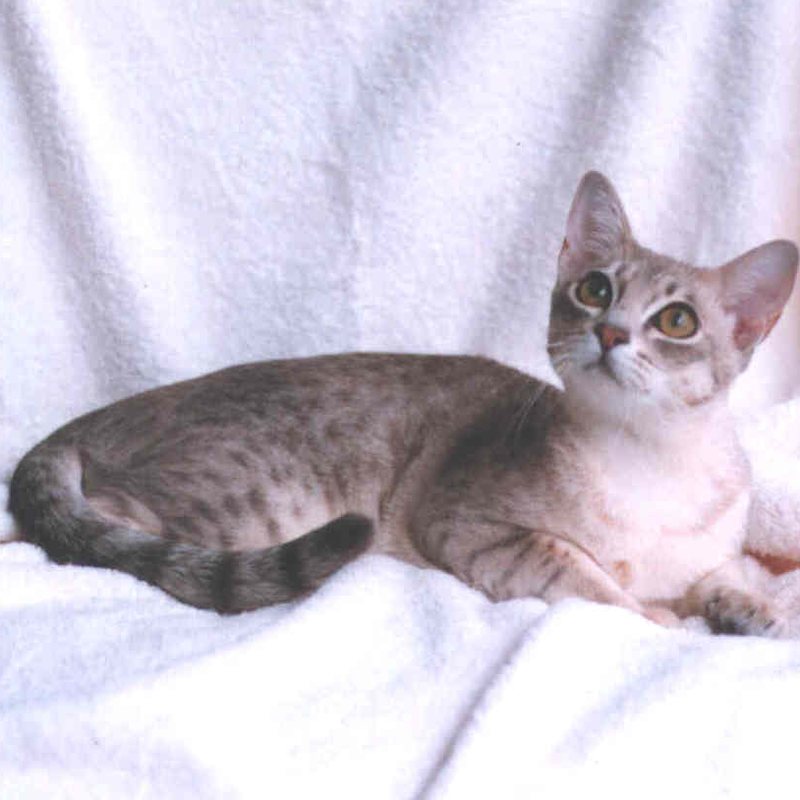

The Australian Mist was developed in Australia from Burmese, Abyssinian, and domestic cat lines. Its spotted or marbled coat has a softly shaded appearance that gives the breed its name. It is often described as sociable and affectionate, with a moderate activity level.
Quick facts
- Weight: about 8 to 15 pounds, per the UK's GCCF
- Life expectancy: about 15 to 18 years (GCCF; TICA gives 15 or more)
- Coat: very short with no undercoat; spotted or marbled in seven colors
- Foundation: about half European-style Burmese, a quarter Abyssinian and a quarter domestic spotted tabby
- Registries: listed by TICA and GCCF; not on CFA's breed list as of 2026
Temperament and daily life
Australian Mists are often described as tolerant of handling and not inclined to scratch, lively as kittens and less so once mature, and as cats for people who spend time with them regularly rather than leaving them alone for long periods. Some can be trained to walk on a lead.
Neutered cats usually fit in easily with other cats and dogs, but introductions still matter, and the individual cat's temperament counts for more than the breed's reputation. Many are happy to remain indoors but need the companionship of people or other cats.
Grooming and care
Australian Mists lose little hair, so they do not need much brushing: one or two brushings per week is plenty. General care advice also covers nail trims every two to three weeks and a sturdy scratching post.
The breed can make excellent indoor cats, which also protects native wildlife. An indoor cat still needs things to do, so add climbing space, a window with a view and regular play. The ASPCA's enrichment guide has practical ideas.
Health considerations
International Cat Care names the Australian Mist among the Burmese-related breeds affected by hypokalaemia, an inherited condition in which low blood potassium causes episodes of muscle weakness. It is usually first seen in kittens between two and six months old, although signs may not be noticed until around a year, and a typical sign is a neck bent downward that the cat cannot lift (ventroflexion). The gene involved, WNK4, has been identified and a gene test is available, so ask a breeder whether the parents were tested. Treatment is directed by a veterinarian.
Other health considerations are the ones most cats share: between 50 and 90 percent of cats older than four have some form of dental disease, and a Cornell veterinarian names free feeding as a major factor in feline obesity, so measured meals and regular checkups help.
History
Dr Truda Straede developed the breed in Australia, beginning in the mid to late 1970s; the work took it from her initial idea in 1977 to full championship in the Australian registries in 1986. The foundation was 50 percent European-style Burmese, 25 percent Abyssinian and 25 percent domestic spotted tabby, and TICA says outcrossing to the original breeds is no longer recommended. The UK's Governing Council of the Cat Fancy (GCCF) notes that a large number of foundation cats were used and that the breed arrived in the UK in 2007.
Appearance
The Australian Mist is a medium to large cat that feels substantial, muscular and heavier than it looks, with slender legs, oval paws and a long tail. The eyes are large and set wide apart, in any shade of green. The markings are delicate but distinct against a paler agouti ground, which gives the misted effect, and TICA lists two patterns, spotted and marbled, in brown, blue, chocolate, lilac, caramel, gold and peach.
Before choosing an Australian Mist
An Australian Mist may appeal to people looking for a sociable companion. Plan for company and regular play rather than long days alone, and for an indoor home with climbing space. Ask a breeder whether the parents have been tested for hypokalaemia, and meet the cats if you can.
Australian Mist FAQ
Was the Australian Mist always called that? No. It was first called the Spotted Mist. TICA says the name changed in 1998, when cats with marbled coats were accepted as part of the breed.
Are Australian Mists hypoallergenic? No breed can be assumed safe for someone with a cat allergy, and a coat that sheds little does not change that. Spend time with the individual cat before committing.
Sources
- The International Cat Association: Australian Mist
- Governing Council of the Cat Fancy: Australian Mist
- International Cat Care: hypokalaemia in cats
- ASPCA: cat grooming tips and feline DIY enrichment
- Cornell Feline Health Center: feline dental disease and obesity
Try a mixed breed question
What is one of the most recognizable features of the Devon Rex?
Answer: Large ears and curly coat. The Devon Rex is known for its oversized, low-set ears paired with a soft, wavy (rexed) coat, an instantly identifiable combination. Source