 Cat Trivia Games
iOS App
Balinese Cat Breed
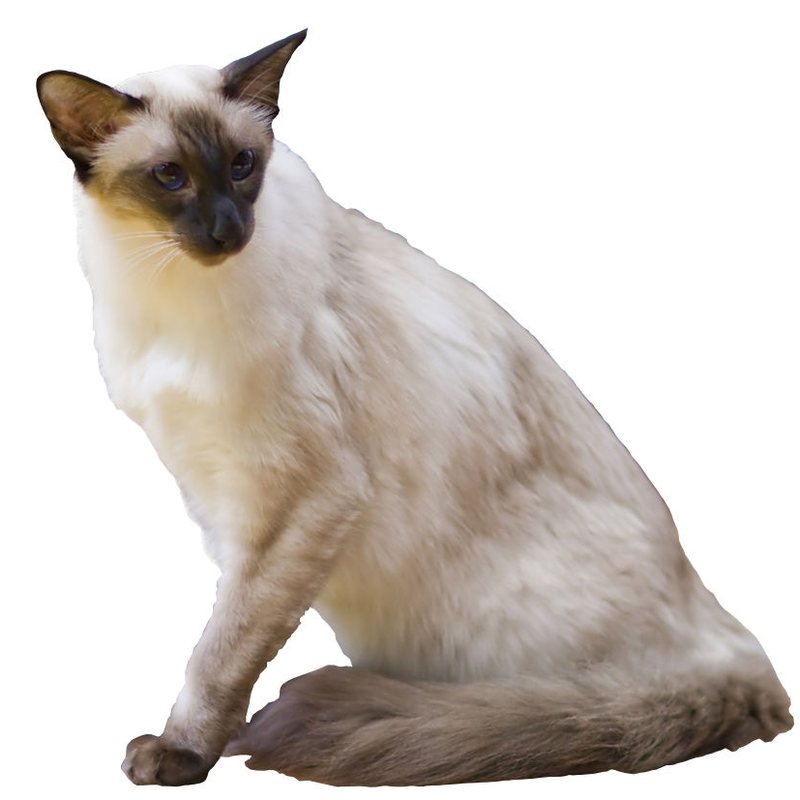

Balinese cats share the pointed coloring, blue eyes, and slender build of the Siamese, with a longer, silky coat and a plumed tail. They are often active and vocal, and many enjoy plenty of interaction with their people.
Quick facts
- Weight: about 5 to 8 pounds for females and 8 to 12 for males, per TICA
- Life expectancy: estimates differ: TICA says 10 or more years, PetMD gives an average of 18 to 22
- Coat: medium length, fine and silky with no downy undercoat, longest on the plumed tail
- Colors: pointed; CFA shows seal, chocolate, blue and lilac points, plus lynx, tortie and other points in a separate division
- Voice: softer and somewhat less talkative than the Siamese, per CFA, but not quiet
Temperament and daily life
Balinese are often described as alert, affectionate and always curious, cats that play hard and then curl up in a lap to sleep. Many are somewhat less talkative than the Siamese, with softer voices, but that does not make them quiet cats.
Plan regular interaction and enrichment. Another animal is only helpful if the cats are compatible and introduced carefully. Many Balinese appear to be quite fond of dogs, and older children may keep up with their activity level better than very young ones, though the individual cat's temperament still matters.
Grooming and care
The Balinese is single-coated, with no downy undercoat, and combing or brushing several times a month controls shedding. The coat may tangle less readily than a dense undercoat, but regular checks are still needed, especially in the plumed tail. General care advice adds nail trims every two to three weeks.
An active, curious cat needs places to climb, window perches and regular play. The ASPCA's enrichment guide has ideas for food puzzles and other activities.
Health considerations
UC Davis lists the Balinese among the breeds appropriate for testing for the rdAc form of progressive retinal atrophy (PRA), an inherited degeneration of the retina. Signs typically begin at around seven months, most affected cats are blind by three to five years of age, and there is no treatment. A DNA test identifies the rdAc variant, so ask whether the parents were tested; the result applies only to that variant.
Hepatic amyloidosis, a buildup of abnormal protein in the liver, can be an issue in Asian breeds such as the Balinese. There is no cure, but treatment can help slow its progression. PetMD says crossed eyes (strabismus) and an eye wobble (nystagmus) are normal in the breed and typically don't affect vision. That does not cover every eye sign, so any new or changing eye problem, or a cat that seems to see less well, needs a veterinary check.
History
Longhaired kittens occurred in Siamese litters as far back as the early 1900s and were quickly placed in pet homes. In the 1940s, two Siamese breeders, Helen Smith of Merry Mews cattery and Sylvia Holland of Holland's Farm cattery, began working to develop the Balinese as a separate breed. The name refers to Balinese dancers; the breed was not developed in Bali. CFA granted championship status in 1970 in the four traditional Siamese colors, accepted lynx, tortie and other points in 1979 under the name Javanese, and in 2008 its breeders voted to merge the two into a single breed with separate divisions.
Appearance
The head is a long, tapering wedge, and the large ears, wide at the base, continue its lines. The eyes are a deep sapphire blue. The standard calls for a fine, silky coat of medium length with no downy undercoat, lying close to the body so that it can look shorter than it is, and a tail whose hair spreads out like a plume. Because of the longer coat, the Balinese looks softer and less extreme than its shorthaired relatives.
Before choosing a Balinese
A Balinese may suit a home where someone is around for play and conversation, and where a vocal cat is welcome. Grooming is modest, but company and enrichment take daily time. Ask a breeder whether the parents were tested for the rdAc PRA variant, and meet the cats if you can.
Balinese FAQ
Are Balinese cats hypoallergenic? No breed can be assumed safe for someone with a cat allergy, and a single coat does not change that. Spending time with the individual cat before committing tells you more than a breed label.
What is the difference between a Balinese and a Javanese? In CFA, the Javanese was the name for Balinese in colors outside the four traditional Siamese points, such as lynx and tortie points. Since 2008 CFA has treated them as one breed with separate divisions.
Sources
- Cat Fanciers' Association: Balinese (breed profile and standard)
- The International Cat Association: Balinese
- PetMD: Balinese
- UC Davis Veterinary Genetics Laboratory: PRA rdAc test
- ASPCA: general cat care and feline DIY enrichment
Quick quiz: 3 questions about the Balinese cat
Which activity do Balinese cats typically enjoy?
Answer: Climbing to high perches. Balinese are agile, energetic cats that like to climb and survey their surroundings from above, so towers, shelves, and tall scratchers suit them well. Source
Which best describes a Balinese kitten's coat at birth?
Answer: Pale, with points that darken over its first weeks. Balinese carry the Siamese colorpoint gene, whose pigment-making enzyme only works in cooler skin, so kittens are born pale and the ears, mask, legs, and tail gradually darken over the following weeks. Source
The Balinese is a long-haired variety of which breed?
Answer: Siamese. The Balinese arose as a natural long-haired mutation of the Siamese, sharing its pointed coloration, deep-blue eyes, and svelte body. Source