 Cat Trivia Games
iOS App
Bengal Cat Breed
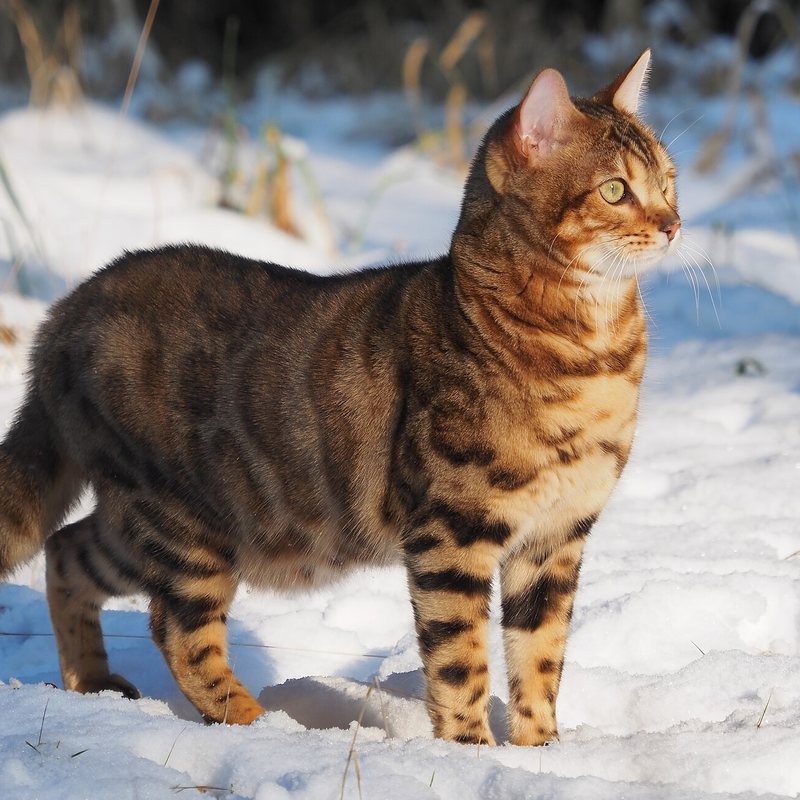

Bengals are known for spotted or marbled coats and an active, inquisitive temperament. Many enjoy climbing, chasing toys, and investigating whatever is happening around them. Their appearance attracts attention, but their daily need for interaction matters more when considering one as a companion.
Quick facts
- Weight: about 6 to 12 pounds for females and 9 to 15 for males, per TICA
- Life expectancy: 12 to 16 years in PetMD's profile; TICA says 12 to 20, depending on many factors
- Coat: soft and close-lying, spotted with rosettes or marbled, sometimes glittered; shorthair and longhair
- Activity: high, with kitten-like energy that often lasts into the senior years
- Ancestry: developed from domestic cats crossed with the Asian leopard cat; modern Bengals are bred Bengal to Bengal
- Registries: TICA championship since 1991; CFA championship since 2018
Temperament and daily life
Bengals are often described as confident, curious and devoted companions, although some are extroverted and busy while others prefer a quieter life. Many keep a kitten-like energy and attitude well into their senior years and are fascinated by water; they often learn tricks, and in many cases enjoy walks on a harness. Bengals are often considered quite talkative, though this is not true of every Bengal.
One veterinarian says Bengals may not be the best fit for families with small children because they usually don't like being held and have a strong hunting instinct. Homes with young children, birds or small caged pets need careful supervision and planning, and introductions to other animals should be gradual.
Grooming and care
The coat needs little more than a weekly brush. General care advice covers the rest: frequent brushing reduces shedding and hairballs, nails should be trimmed every two to three weeks, and a sturdy scratching post should be at least three feet high.
Most of the work is daily activity: tall cat trees, wall shelves, food puzzles, harness training if the cat accepts it, and regular interactive play. Bengals can easily become bored. Insufficient activity can contribute to unwanted behavior, but a change in behavior can have other causes, so a sudden change is worth raising with your veterinarian.
Health considerations
Cornell's Feline Health Center lists the Bengal among the breeds in which hypertrophic cardiomyopathy (HCM) is more prevalent. Echocardiography is the gold standard for diagnosis, and a serious and potentially life-threatening consequence of HCM is the formation of blood clots in the heart. Ask a breeder how the parents' hearts were checked.
Two inherited conditions have DNA tests. One is a form of progressive retinal atrophy in Bengals (PRA-b), an autosomal recessive blindness that begins at around seven weeks of age, with very compromised vision by about two years. The other is pyruvate kinase (PK) deficiency, an inherited red blood cell disorder that can cause anemia; UC Davis reports that its variant has been found in significant frequency in Bengals. Each test covers only its own variant.
PetMD also quotes a veterinarian who says Bengals are more likely than other breeds to develop lymphoma and are prone to gastrointestinal upset, and it lists patellar luxation. Those points are less well documented than the conditions above, so ask your veterinarian what to watch for in your cat.
History
The breed's beginnings go back to 1963, when Jean Mill crossed a domestic cat with an Asian leopard cat, a small wild cat from Asia. The modern Bengal traces to cats Mill bred from the early 1980s, and the name comes from the leopard cat's scientific name, Prionailurus bengalensis. TICA registers the early hybrid crosses as foundation generations (F1, 2G and 3G), which are not eligible for show, and it says modern Bengals are bred exclusively from Bengal-to-Bengal pairings. TICA accepted Bengals as a new breed in 1986, and they gained championship status in 1991. CFA accepted Bengals for registration in 2016, requiring five generations of pure domestic ancestry, and advanced them to championship status in 2018.
Appearance
Bengals are long and muscular, built to climb and jump. The coat is close-lying, soft and luxurious and may be glittered, a shimmer that catches the light along the hair, and Bengals can be shorthaired or longhaired. Patterns are spotted, ideally with two-toned rosettes, or marbled.
Before choosing a Bengal
A Bengal may suit a home with time for daily play, room to climb and patience for a cat that investigates everything. Meet adult Bengals if you can, since individual cats range from busy to fairly quiet. Ask which health tests the parents had, and check the local rules on hybrid-derived cats before you commit.
Bengal FAQ
Are Bengal cats legal everywhere? Rules can depend on your location, the cat's ancestry, and the authority applying them. Check the current requirements with the relevant local agency before acquiring or relocating a hybrid-derived cat.
Are Bengal cats hypoallergenic? No breed can be assumed safe for someone with a cat allergy, and the Bengal's coat does not change that. Spend time with the individual cat before committing.
Sources
- The International Cat Association: Bengal
- Cat Fanciers' Association: Bengal
- PetMD: Bengal
- Cornell Feline Health Center: hypertrophic cardiomyopathy
- UC Davis Veterinary Genetics Laboratory: PRA-b and PK deficiency tests
- ASPCA: general cat care
Quick quiz: 2 questions about the Bengal cat
The Bengal cat breed derives from Prionailurus bengalensis, a species known by which common name?
Answer: Asian leopard cat. Prionailurus bengalensis is the scientific name for the Asian leopard cat, the small wild felid whose genetics were combined with domestic cats to create the modern Bengal breed. This species is native to forests and grasslands across southern and eastern Asia. Source
Wikipedia's Bengal cat article says one New York city prohibits Bengals, even though the state regulates only early generations. Which city?
Answer: New York City. Wikipedia notes that New York City prohibits Bengals, while New York State regulates the F1 to G4 generations. Local rules change, so check the current rules where you live. Source