 Cat Trivia Games
iOS App
HOME / BREEDS / EXOTIC SHORTHAIR
Exotic Shorthair Cat Breed
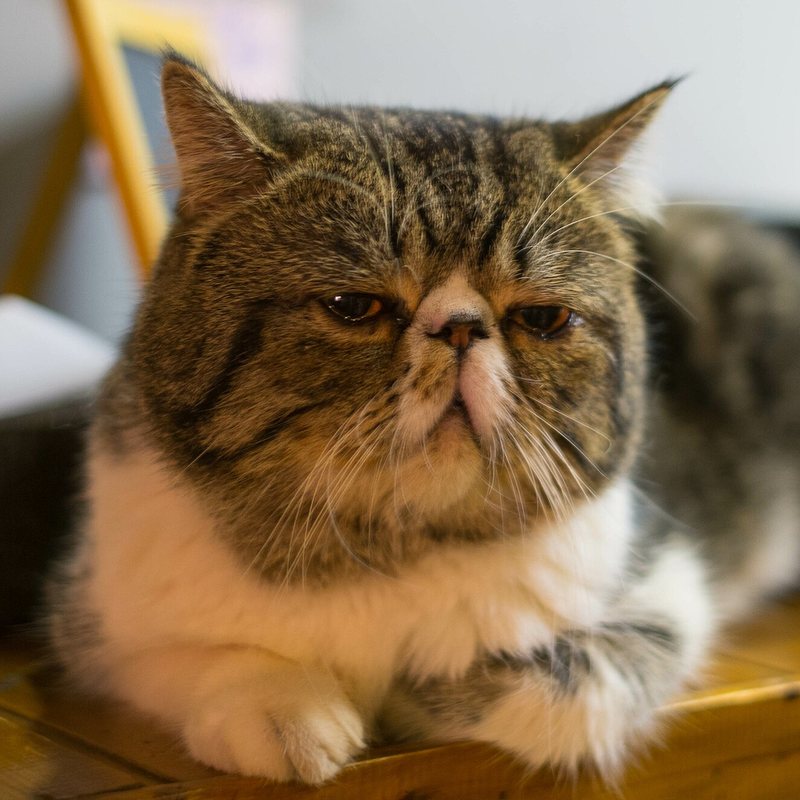

Exotic Shorthairs share many Persian features, including a rounded head and sturdy body, with a shorter, dense coat. Many are quiet companions, but the shorter coat does not remove the care concerns associated with a very flat face. Grooming, breathing, eye comfort, and overall health all deserve attention.
Quick facts
- Weight: about 10 to 12 pounds (PetMD)
- Life expectancy: estimates differ, from 8 to 11 years (TICA) to 8 to 15 (PetMD)
- Coat: dense and plush, standing out from the body, in the Persian's colors and patterns
- Face: flat (brachycephalic), which can affect breathing, eyes, teeth and skin
- Voice: quiet; purrs are more common than meows
Health and welfare considerations
The Exotic is judged by the same standard as the Persian apart from its coat, so it shares the Persian's flat face and the problems that can come with it. International Cat Care explains that an extremely flat face can cause protruding eyes that the lids cannot fully protect, which contributes to eye conditions such as keratitis and corneal sequestrum. Shortened tear ducts leave the eyes running and the face stained and sometimes sore, misaligned jaws cause dental problems, and deep skin folds can become infected. Narrow nostrils and airways and a long soft palate can make breathing difficult, a condition called brachycephalic obstructive airway syndrome, and airway problems can limit exercise and heat tolerance. International Cat Care's position is that traits which compromise a cat's welfare, including severe brachycephaly in Persians and similar breeds, should not be continued through further breeding.
Snoring, noisy breathing, constant tearing or a wet, sore face are signs to have checked by a veterinarian, not an unavoidable part of the look. A cat breathing rapidly, with effort or with an open mouth needs a veterinarian right away, as Cornell's page on breathing difficulty explains.
Polycystic kidney disease (PKD) was found in more than a third of Persian and Exotic Shorthair cats in the 1990s, when screening tests became available, and breeders have used screening since then to reduce it. A DNA test detects the PKD1 variant behind the inherited form; a negative result covers only that variant, and a positive result cannot predict how severely the cat will be affected. Ultrasound is needed for a definitive diagnosis, and signs most often appear at around seven years of age. The Persian, though not the Exotic, is on Cornell's list of breeds in which hypertrophic cardiomyopathy is more prevalent. That is not a measured Exotic rate, but heart checks are worth discussing with your veterinarian.
Ask a breeder for the parents' PKD results and about any breathing or eye problems in the line, look at the nostrils of the kitten and its parents, and have the individual cat's comfort assessed by a veterinarian.
Temperament and daily life
The Cat Fanciers' Association describes Exotics as quiet, loyal companions, devoted but not intrusive, content to stay near you without joining in everything you do. Meows are rare. Some people find them a little more active and playful than Persians. They are often described as less active than some breeds, but individual cats can still enjoy play and training. Because a flat face can limit exercise and heat tolerance, keep play sessions gentle and the home cool in hot weather. Some are shy with other animals at first, so introductions matter, as does the individual cat's temperament.
Grooming and care
The coat is short but dense, and Exotics shed more than you might expect, mostly seasonally. Combing with a steel comb manages the shedding: weekly is enough for most of the year, with extra attention during shedding season, and mats are uncommon unless the coat is neglected. The corners of the eyes and the sides of the nose often need regular cleaning, gently, with a soft, damp cloth. How often depends on the cat, and redness, sores or a change in discharge should go to your veterinarian.
History
The Exotic began in the 1950s with crosses between Persians and American Shorthairs, which produced shorthaired kittens with Persian heads and bodies. Accounts differ on who made the first crosses and why, and other breeds, including the Burmese and Russian Blue, were also used along the way. The cats were controversial at first, but they proved popular, and in 1966 the Cat Fanciers' Association established them as a breed. The name reflected the many shaded silver and chinchilla kittens, colors no shorthair breed had at the time. TICA granted the breed championship status in 1979.
Appearance
Apart from the coat, the Exotic matches the Persian: a cobby, muscular body set low on the legs, a round head, large round eyes and small, round-tipped ears set far apart. The coat is dense, plush and medium in length, standing out from the body over a thick undercoat. Exotics come in the same colors and patterns as Persians, from solids and tabbies to silvers, bicolors and pointed cats. Eye color follows coat color: copper for most colors, green or blue-green for silvers and goldens, and blue, copper or odd eyes for whites.
Before choosing an Exotic Shorthair
An Exotic may suit a calm home where someone can manage weekly combing, daily attention to the eyes and face, and a cool space in hot weather. The flat face brings documented health and welfare concerns, so ask about the parents' screening and any breathing or eye problems in the line. Meeting the individual cat, and having it checked by a veterinarian, tells you more than the breed description.
Exotic Shorthair FAQ
Are Exotic Shorthairs healthy? The breed has documented health concerns. The needs and comfort of an individual cat should be assessed by a veterinarian.
Are there longhaired Exotics? Yes. The Persian is still the Exotic's permitted outcross, so longhaired kittens occur, and CFA registers longhaired Exotics, which can compete in the Persian color classes. CFA also groups the Exotic with its longhair breeds because it is built exactly like a Persian.
Sources
- Cat Fanciers' Association: Exotic
- The International Cat Association: Exotic Shorthair
- PetMD: Exotic Shorthair
- International Cat Care: Persian cats and brachycephaly and inherited disorders in cats
- Cornell Feline Health Center: polycystic kidney disease, hypertrophic cardiomyopathy and breathing difficulty
- UC Davis Veterinary Genetics Laboratory: polycystic kidney disease (PKD1) test
One question about the Exotic Shorthair cat
Which cartoon cat is most often visually compared to the flat-faced, round-bodied Exotic Shorthair?
Answer: Garfield. Garfield's pushed-in face, round cheeks, and chunky build echo the brachycephalic Exotic Shorthair, which is why the two are so frequently likened to each other on looks alone. Source