 Cat Trivia Games
iOS App
HOME / BREEDS / BRITISH SHORTHAIR
British Shorthair Cat Breed
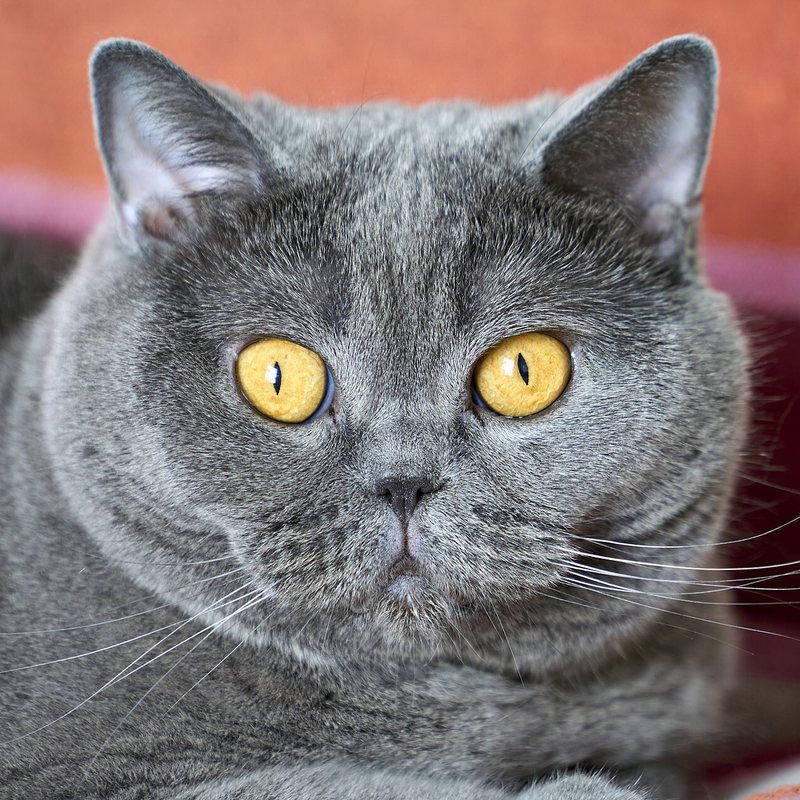

British Shorthairs have a dense coat, rounded features, and a sturdy build. They are often described as calm and affectionate without constantly seeking attention. Many prefer sitting beside you to being carried, though individual preferences vary.
Quick facts
- Weight: about 8 to 11 pounds for females and 10 to 16 for males, per TICA; CFA says males may reach 17
- Life expectancy: 12 to 20 years, per TICA and PetMD
- Coat: short, dense and plush; best known in blue, though many colors are accepted
- Maturity: full size at about three years of age, per CFA
- Registries: recognized by CFA; TICA championship since June 1979
Temperament and daily life
Many British Shorthairs are most comfortable keeping all four feet on the floor and are not fond of being carried around, and they tend to wait for an invitation to sit beside you rather than jump into your lap. They often spread their attention and affection across the family and rarely engage in lengthy conversation.
An independent temperament does not remove the need for daily care and attention. Regular play, company and a predictable routine suit most of these cats, and introductions to other pets should still be gradual.
Grooming and care
A coat this dense will shed, but because it is short and resilient, most owners find a quick weekly combing or brushing sufficient. Expect to brush more often when shedding increases; a rubber brush can be especially effective for removing dead hair on cats with short fur.
Extra weight hides easily under a plush coat. Measured meals, food puzzles and short daily play sessions help, and the ASPCA's enrichment guide has practical ideas.
Health considerations
The British Shorthair is among the breeds in which hypertrophic cardiomyopathy (HCM) is more prevalent, and HCM is diagnosed by echocardiography. No validated HCM DNA test exists for the breed: a 2024 review of feline HCM variants recommends routine genetic testing only for specific variants in Maine Coons and Ragdolls. Ask a breeder how the parents' hearts were checked.
Polycystic kidney disease (PKD) is evident primarily in Persians and occasionally in a few other breeds, such as Himalayans and British Shorthairs. A PKD1 test covers Persian-derived breeds, including the British Shorthair; a negative result means the cat does not carry that heritable variant, but a genetic test does not show how seriously a cat is affected, and ultrasound gives a definitive diagnosis. PetMD describes the breed as having few genetic or common medical conditions, but routine checkups still matter.
History
British Shorthairs first came into the public eye at turn-of-the-century cat shows at London's Crystal Palace. Both World Wars damaged the gene pool and made some crossbreeding necessary. CFA names crosses to Persians and to non-pedigreed cats; TICA says that after the Second World War the breed's lines were all but lost, so breeders crossed with domestic shorthairs, Russian Blues and Persians, among others. The British Shorthair gained championship status in TICA in June 1979.
Appearance
The body is stocky, semi-cobby, muscular, wide and firm, and the head is sweet-faced and rounded, with large round eyes and prominent whisker pads. The short coat is extremely dense and plush, with a crisp feel. The breed is best known for blue, commonly called grey, but many other colors are accepted. It does not reach full size until about three years of age, so a young adult may still be filling out.
Before choosing a British Shorthair
A British Shorthair may suit a calm household that is happy with a companion who sits nearby rather than on a lap. Plan for daily play, regular brushing and measured meals. Ask a breeder about heart and kidney screening, and what those results do and do not cover.
British Shorthair FAQ
Is the British Shorthair the same as a Chartreux or a Russian Blue? No, though blue British Shorthairs get confused with both. CFA describes the Chartreux as a French breed with a woolly coat, and the Russian Blue as having a double coat that stands out from the body and vivid green eyes.
Do British Shorthairs get along with children? CFA describes them as extremely patient and says they do well with children, but notes that they may withdraw during periods of loud activity and that children should learn these cats are not fond of being carried. Supervise interactions and give the cat places where it can rest undisturbed.
Sources
- Cat Fanciers' Association: British Shorthair
- The International Cat Association: British Shorthair
- PetMD: British Shorthair
- Cornell Feline Health Center: hypertrophic cardiomyopathy and polycystic kidney disease
- Frontiers in Veterinary Science (2024): review of feline HCM genetic variants
- UC Davis Veterinary Genetics Laboratory: PKD1 test
- Cat Fanciers' Association: Chartreux and Russian Blue
- ASPCA: cat grooming tips and feline DIY enrichment
Quick quiz: 3 questions about the British Shorthair cat
What is the most iconic coat color of the British Shorthair?
Answer: Blue-gray. The British Shorthair's signature look is its dense blue-gray coat, so much so that the breed was originally registered under the name 'British Blue.' Source
What breed of cat won Best in Show at the first Crystal Palace cat show in 1871?
Answer: A blue tabby British Shorthair. The top prize at the 1871 show went to a 14-year-old blue tabby British Shorthair female, a breed Weir himself especially favored. Source
Which of these breeds is placed in FIFe's Category III?
Answer: British Shorthair. FIFe's Category III groups shorthaired breeds such as the British Shorthair, Chartreux and Burmese. Source