 Cat Trivia Games
iOS App
HOME / BREEDS / UKRAINIAN LEVKOY
Ukrainian Levkoy Cat Breed
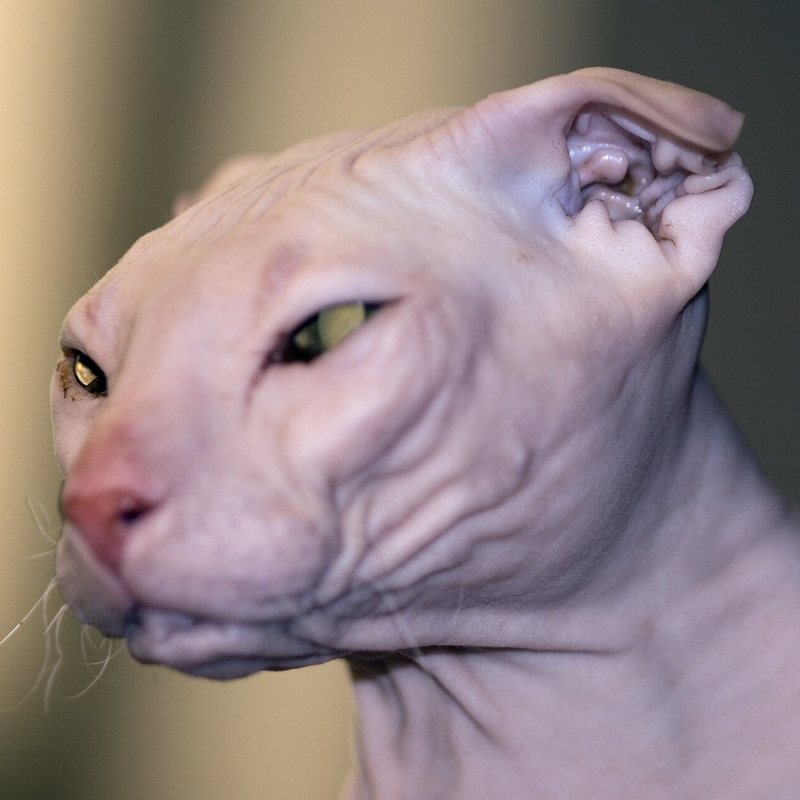

The Ukrainian Levkoy combines a largely hairless appearance with folded ears. Its development involved Donskoy and Scottish Fold cats. The folded-ear trait raises serious welfare concerns, while limited breed-specific research makes confident health claims inappropriate.
Quick facts
- Origin: Kyiv, Ukraine; the first Levkoy kitten was born on January 21, 2004 (RUI)
- Ancestry: Don Sphynx (Donskoy) and Scottish Fold cats, with Peterbald, Oriental, Persian and domestic cats also used
- Ears: folded, from Scottish Fold ancestry; straight-eared cats also occur
- Registries: a standard from Rolandus Union International (RUI), a Kyiv-based registry; not recognized by CFA, TICA, FIFe or WCF (checked October 2026)
- Size and lifespan: no reliable breed-specific figures are published
Health and welfare considerations
The Levkoy's folded ears come from its Scottish Fold ancestry. In the Scottish Fold, the variant that folds the ear also causes osteochondrodysplasia, a disorder of cartilage and bone that UFAW says develops in all cats with folded ears, leading to arthritis that is mild in some cats and severe and painful in others. Studies of the Levkoy itself are lacking. PetMD's guide to hairless cats says its long-term health is not yet fully understood but that the Scottish Fold's joint and cartilage problems suggest similar risks, and International Cat Care says more information is needed about other breeds with folded ears.
Osteochondrodysplasia has no cure, but that does not mean nothing can be done. International Cat Care explains that a veterinarian can help manage the pain with medication and suggest changes at home, such as low beds or steps, ramps, rugs on slippery floors and a litter tray with low sides; UFAW notes that long-term pain relief can have side effects of its own, so the plan belongs with your veterinarian. Signs of joint pain include stiffness, reluctance to jump, an abnormal gait, hiding and grooming less. Tell your veterinarian about stiffness, reluctance to jump or changes in movement. Do not force a painful joint or tail.
RUI's own standard bans breeding two folded Levkoys together because of the harm the hairless and folded-ear mutations do to the musculoskeletal system. Pairing a folded cat with a straight-eared one avoids kittens with a double dose of the fold variant, but, as UFAW explains for the Scottish Fold, folded kittens from such pairings still develop the disease to some degree. International Cat Care believes that traits which compromise a cat's welfare, including hairlessness, should not be continued through further breeding, and it considers continued breeding for the Scottish Fold mutation unethical.
Other health questions are open. The Cornell Feline Health Center lists the Sphynx, another hairless breed, among breeds in which hypertrophic cardiomyopathy is more prevalent, but that is not evidence about the Levkoy, which has different ancestry and no published heart data. Ask your veterinarian what screening makes sense for your cat.
Temperament and daily life
RUI describes Levkoys as contact-seeking, sociable cats that become attached to their people, while PetMD calls them stoic cats that often enjoy quiet company. Descriptions of a breed this small rest on relatively few cats, and joint pain can change how much a cat wants to play, climb or be handled, so meet the individual cat and watch how it moves. Introductions matter with children and other pets.
Skin and temperature care
A hairless cat needs skin care rather than brushing. PetMD notes that frequent baths can dry out the skin and advises asking your veterinarian about a skin-care routine for your cat. Hairless cats also burn easily and regulate their temperature less well than coated cats, and PetMD suggests window UV filters, cooling mats in summer and sweaters in winter. For sun protection, shade and an indoor life come first; International Cat Care advises using only a sunscreen made specifically for pets and labeled safe for cats, and asking your veterinary team about any product. Check the folded ears as part of routine care, and have any smell, discharge or head shaking looked at by your veterinarian.
History
The breed was developed in Kyiv by breeder Elena Biriukova of the Ladacats cattery, using Don Sphynx, Peterbald, Oriental, Scottish Fold, Persian and domestic cats. According to the Rolandus Union International history, the first Levkoy kitten was born on January 21, 2004. RUI publishes a breed standard and shows straight-eared Levkoys in a separate class. The Levkoy is not on the breed lists of CFA, TICA or FIFe, and the World Cat Federation's breed code list does not include it (checked October 2026).
Appearance
The Levkoy is largely hairless, with ears that fold forward. Because straight-eared cats also occur, folded ears are not universal in the breed.
Before choosing a Ukrainian Levkoy
UFAW and International Cat Care both treat the fold as a welfare problem, and International Cat Care also opposes continuing hairlessness where it compromises welfare. If a hairless cat appeals to you, breeds such as the Donskoy, Peterbald and Sphynx are not bred for the Scottish Fold ear trait, although each has its own care needs and welfare questions. If you already care for a Levkoy, or are adopting one that needs a home, plan for regular checks of the joints and skin, pain management when it is needed, protection from sun and cold, and a home arranged so the cat does not have to jump. No checklist removes the joint disease linked to folded ears.
Ukrainian Levkoy FAQ
Why is it called a Levkoy? According to RUI, the name came from the likeness of the folded ears to the petal of a levkoy flower (the stock plant), and it also echoes "levretka", the Russian name for the Italian greyhound.
Are hairless cats hypoallergenic? No. The main allergens come from saliva and skin glands, not hair, so cats with very little hair can still cause reactions. No breed can be assumed safe for someone with a cat allergy.
Sources
- Rolandus Union International (RUI): Ukrainian Levkoy history and breed standard (in Russian), and breed page (in Ukrainian)
- PetMD: hairless cats
- UFAW: Scottish Fold osteochondrodysplasia
- International Cat Care: Scottish Fold osteochondrodysplasia, inherited disorders, sunscreen and allergies to cats
- Cornell Feline Health Center: hypertrophic cardiomyopathy
- World Cat Federation: EMS breed code list; CFA: breeds; TICA: browse all breeds; FIFe: breeds (all checked October 2026)
Quick quiz: 2 questions about the Ukrainian Levkoy cat
What shape do the heads of Ukrainian Levkoy cats resemble from above?
Answer: A soft pentagon. Viewed from above, the Levkoy's head outline is a soft-edged pentagon that's slightly longer than it is wide. Source
A quiz-goer assumes every hairless cat carries the Sphynx's recessive coat mutation. In the Ukrainian Levkoy, where does the hairlessness actually come from, and how is it inherited?
Answer: From its Donskoy ancestry, as a dominant trait. The Levkoy was built from the Donskoy (Don Sphynx) crossed with the Scottish Fold, not from the Sphynx. The Donskoy's hairlessness is governed by a dominant gene, so any cat inheriting it is born bald or loses its coat while growing. That is the opposite of the true Sphynx, whose baldness is recessive. Same look, different genetics. Source